
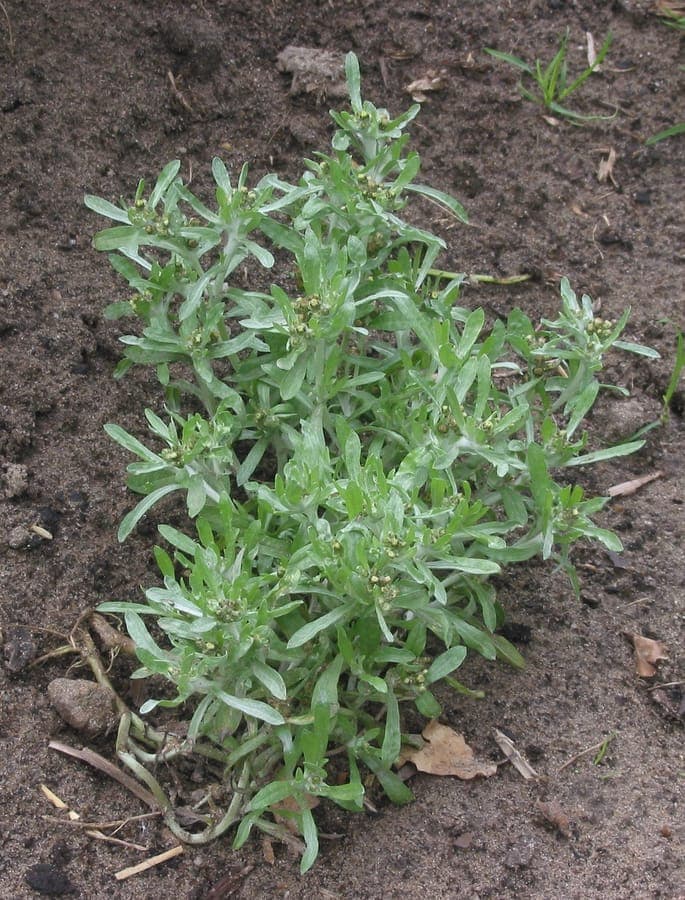
Rasbak / CC BY-SA 3.0, via Wikimedia Commons
Marsh cudweed: complete guide
Gnaphalium uliginosum
Want to see Marsh cudweed: complete guide in your garden?
1 minute, no credit card
Overview
Marsh cudweed (Gnaphalium uliginosum) is a humble annual that thrives where most garden plants struggle - in wet, poorly drained, and often acidic soils. Native across large parts of northern and central Europe, as well as parts of North America and northern Asia, this unassuming member of the Asteraceae family is a quiet performer in naturalistic planting schemes. It doesn't command attention with color or height, but its soft, silvery foliage and drought-tolerant structure in damp conditions make it a valuable addition to bog gardens, wetland edges, and wild meadow plantings.
Reaching just 15 to 40 cm in height, Marsh cudweed grows upright with multiple slender, branching stems covered in dense, white, woolly hairs. It's not showy, but its presence is felt in the texture it brings to a planting. It's especially useful in gardens where water collects, or in low-lying areas that stay damp year-round. If you're designing such a space, gardenworld.app lets you map out moisture zones and place moisture-loving plants like Marsh cudweed exactly where they'll thrive.
Appearance & bloom cycle
The plant has narrow, lance-shaped leaves, 2–5 cm long, arranged alternately along the stem. The foliage feels soft to the touch due to the thick covering of fine, silvery-white trichomes. From July through October, small, clustered flower heads appear at the stem tips. These are composed entirely of tubular florets, lacking the typical ray flowers of many daisies. The blooms start greenish and fade to a pale cream, almost parchment-like, and remain on the plant long after flowering.
While not rich in nectar, the flowers do attract small pollinators like hoverflies and solitary bees, especially in late summer when other blooms are fading. The dried flower heads persist into winter, adding subtle structure and visual interest in the dormant garden. Their papery texture catches frost and morning dew beautifully.
Ideal location
Marsh cudweed prefers partial shade to light sun, especially in hotter climates. It performs best in areas with consistent moisture - think pond margins, damp meadows, or low garden spots that collect rainwater. Full sun is acceptable only if the soil stays reliably wet. Avoid exposed, windy sites, as the slender stems can snap in strong gusts. A sheltered, moist corner near a water feature or under the light canopy of shrubs is ideal.
Using gardenworld.app, you can simulate different light and moisture conditions to find the perfect microclimate for Marsh cudweed before planting. This helps avoid trial and error and ensures your moisture-dependent plants establish successfully.
Free design
Want to see Marsh cudweed: complete guide in your garden? Make a free design now.
Soil requirements
The soil should be moist to wet, slightly acidic to neutral (pH 5.5–7.0), and rich in organic matter. Heavy clay or silty loams work well, as long as they don't form stagnant pools. Avoid dry, sandy, or highly alkaline soils. When planting, amend the soil with well-rotted compost or leaf mold to improve water retention and nutrient content. Do not add lime - this plant avoids calcareous conditions.
Watering
Consistent moisture is non-negotiable. The soil should never dry out completely, especially during the summer months. If your garden lacks natural water accumulation, plan for regular watering - at least twice a week during dry spells. Drip irrigation or soaker hoses are efficient options. A location with natural capillary rise, such as near a stream or in a swale, is ideal.
Pruning
Pruning isn't required for health or flowering, but you can cut back old stems in late winter or early spring to make room for new growth. If you want to limit self-seeding, remove the spent flower heads before they release seed. Alternatively, leave them intact to support overwintering insects and provide winter texture.
Maintenance calendar
- Jan: Cut back old stems; tidy up debris
- Feb: Prepare soil with organic matter
- Mar: Sow seeds directly or start indoors
- Apr: Harden off seedlings; protect from late frosts
- May: Transplant seedlings; monitor soil moisture
- Jun: Thin seedlings if overcrowded
- Jul: Flowering begins; watch for drought stress
- Aug: Maintain watering; check for pests
- Sep: Peak bloom; observe seed development
- Oct: Allow seeds to ripen or remove for control
- Nov: Leave some plants standing for winter interest
- Dec: Observe; minimal intervention needed
Winter hardiness
As an annual, Marsh cudweed does not survive winter as a mature plant. However, it reliably self-seeds in favorable conditions. Seeds germinate in spring when soil temperatures rise. It's hardy in USDA zones 6–9, where mild winters allow seeds to overwinter successfully. In colder zones, a light mulch of leaf litter can help protect dormant seeds.
Companion plants
Pair Marsh cudweed with other moisture-loving species such as Carex vulpinoidea, Eutrochium fistulosum, Mimulus guttatus, or Lythrum salicaria. These create a layered, naturalistic effect. Avoid aggressive spreaders like Phalaris arundinacea. You'll often find suitable companions at local garden centres, especially those focusing on native or wetland plants.
Closing
Marsh cudweed may not be the star of your border, but it's a quiet workhorse in the right setting. It asks for little beyond consistent moisture and a bit of shelter, yet delivers texture, seasonal interest, and ecological value. Let it weave through your damp corners naturally, and resist the urge to over-manage. Over time, it will find its place. For inspiration on how to integrate such subtle plants into your design, visit gardenworld.app - where functional beauty meets practical gardening.
Want to see Marsh cudweed: complete guide in your garden? Make a free design now.
Upload a photo, pick a style, and get a photorealistic design with plant list in under a minute.
No credit card required


Similar plants
Calendula stellata: complete guide
Calendula stellata
Complete guide to Calendula stellata, the star-flowered marigold from Sicily: location, soil, watering and companion planting tips.
Korean chrysanthemum: complete guide
Chrysanthemum x rubellum
Chrysanthemum x rubellum is a hardy autumn perennial with single pink to copper flowers from August to November. Care and combinations.
Helianthus divaricatus: complete guide
Helianthus divaricatus
Helianthus divaricatus is a North American woodland sunflower with yellow summer blooms, ideal for naturalistic borders and shady edges.