
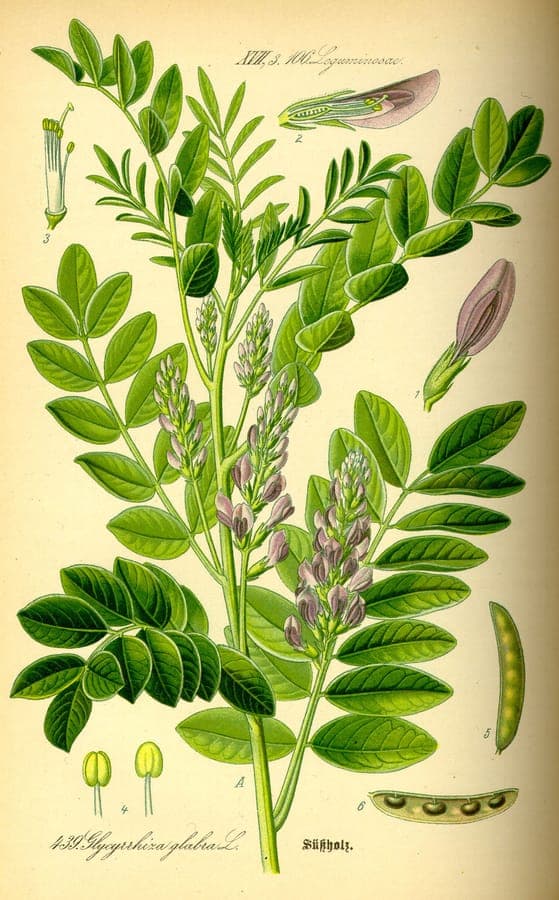
Wikimedia Commons / Public domain, via Wikimedia Commons
Licorice: complete guide
Glycyrrhiza glabra
Want to see Licorice: complete guide in your garden?
1 minute, no credit card
Overview
Licorice (Glycyrrhiza glabra) isn't just for sweet shops and herbal teas - it's a striking garden plant that deserves more attention from home growers. A member of the Fabaceae family, this herbaceous perennial or subshrub grows 1 to 1.5 meters tall and spreads slowly via underground rhizomes. Native to regions like Greece, Bulgaria, Iran, and parts of Central Asia, it thrives in temperate climates with long, warm summers. In the UK and Western Europe, it can be successfully grown in USDA zones 6–9, making it viable for most gardeners.
On gardenworld.app you can design a planting scheme that accommodates licorice's deep root system and spreading habit, ensuring it doesn't overcrowd neighbouring plants.
Appearance & bloom cycle
Licorice features upright, branching stems with pinnate leaves made up of 9 to 17 narrow, dark green leaflets. The foliage has a soft, slightly hairy texture and closes slightly at night. From July to August, it produces dense spikes of small, pale purple to whitish flowers, typical of the pea family. These attract pollinators like bees and hoverflies, boosting garden biodiversity.
After flowering, flat, hairy seed pods form, measuring 2–3 cm long. These mature in late summer and can be collected in September or October for sowing the following spring. The plant's real treasure lies underground: thick, sweet-tasting roots that develop fully after 3–4 years. These roots can reach depths of up to 1.5 meters, so planting in deep, unrestricted soil is essential.
Ideal location
Licorice demands full sun - rate it a solid 9 out of 10 for light. Choose a south- or southwest-facing spot where it receives at least 6–8 hours of direct sunlight daily. Give each plant a space of 60–75 cm to spread. While it can tolerate some crowding, it performs best with room to develop its deep taproot. In smaller gardens, consider planting in a large container with a depth of at least 60 cm to restrict vertical spread.
On gardenworld.app, you can generate a custom garden layout that factors in licorice's mature height and root depth, helping you avoid future conflicts with pathways or utilities.
Soil requirements
Well-drained, loamy soil with a pH between 6.5 and 7 is ideal. Avoid heavy clay that stays waterlogged, as licorice is prone to root rot. Improve drainage by mixing in sand or perlite. In sandy soils, boost moisture retention by incorporating compost or well-rotted manure. The plant fixes nitrogen, so it doesn't need rich soil, but a moderate fertility level supports steady growth.
Free design
Want to see Licorice: complete guide in your garden? Make a free design now.
Watering
During the first two growing seasons, water regularly, especially during dry spells in June and July. Once established, licorice is drought-tolerant thanks to its deep roots. Water only when the top 2.5 cm of soil feels dry. Deep, infrequent irrigation is better than daily sprinkling. Never let the plant sit in soggy soil - it won't survive prolonged wetness.
Pruning
Licorice requires minimal pruning. In early spring (March), cut back the dead stems to about 10 cm above ground level. This encourages fresh, vigorous growth and keeps the plant tidy. If you're saving seeds, leave a few pods on the plant until late autumn before clearing debris. Remove all plant matter in winter to reduce disease risk.
Maintenance calendar
- Jan: Check for winter damage, especially on young plants
- Feb: None required
- Mar: Cut back old growth, apply compost
- Apr: Monitor for rhizome spread, add mulch if needed
- May: Watch for aphids, water during dry periods
- Jun: Support tall stems if leaning, ensure full sun
- Jul-Aug: Peak flowering, pollinator activity high
- Sep: Collect ripe seed pods, prepare for root harvest
- Oct: Harvest roots from 3–4 year-old plants
- Nov: Clear dead foliage, apply light mulch in colder zones
- Dec: Inspect crown for heaving in freeze-thaw cycles
Winter hardiness
Licorice is hardy in USDA zones 6–9. In zone 6, apply a light mulch of straw or leaf litter to protect the crown during harsh winters. Established plants die back to ground level in winter but re-sprout in spring. Young plants benefit from extra protection in their first two winters.
Companion plants
Pair licorice with other sun-loving, drought-tolerant perennials like lavender, sage, yarrow, or Russian sage. It makes an excellent backdrop for ornamental grasses such as Panicum or Calamagrostis. Avoid moisture-hungry plants like hostas or ferns. Good nitrogen-fixing companions include clover or alfalfa, which enhance soil fertility without competing heavily.
Closing
Licorice is a rewarding plant for gardeners interested in herbs, medicine, or low-maintenance perennials. Its sweet roots are harvestable after 3–4 years, and the plant improves soil health over time. Source young plants from reputable garden centres like those found at OBI or Hornbach, or start from seed with patience. Remember to harvest sustainably - take no more than one-third of the root mass to keep the plant alive. With proper care, licorice can thrive for years, adding both beauty and utility to your garden.
Want to see Licorice: complete guide in your garden? Make a free design now.
Upload a photo, pick a style, and get a photorealistic design with plant list in under a minute.
No credit card required


Similar plants
Tall Silky Lupine: complete guide
Lupinus elatus
Tall silky lupine is a fast-growing Californian perennial with silvery foliage and blue-purple flower spikes, ideal for a prairie-style garden.
Garfield Lupine: complete guide
Lupinus garfieldensis
The Garfield lupine is a rare, fast-growing American perennial for alkaline, dry grassland gardens, with striking blue flower spikes.
Lupinus elegans: complete guide
Lupinus elegans
Lupinus elegans, the elegant lupine, is a spectacular blooming plant from Mexico with blue flower spikes. Care, cultivation and garden use.