
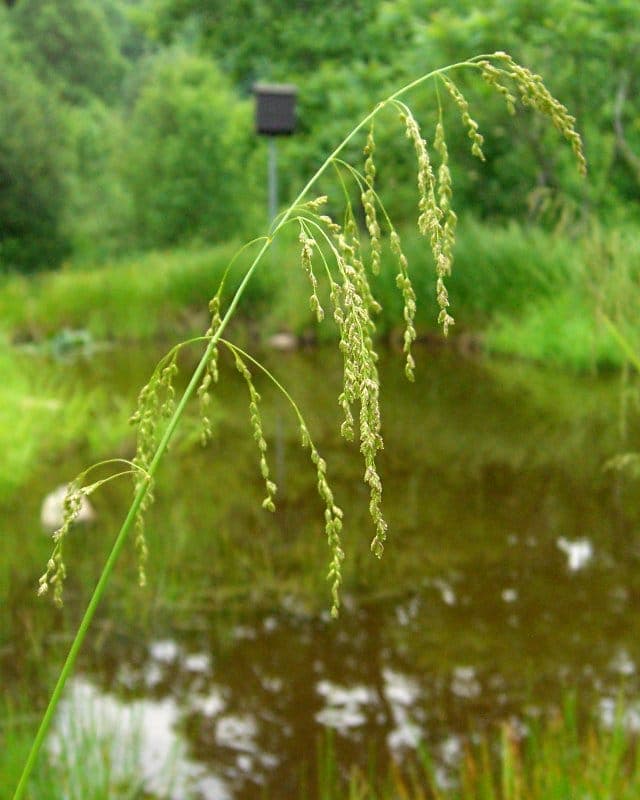
pellaea / CC BY 2.0, via Wikimedia Commons
Fowl manna grass: complete guide
Glyceria striata
Want to see Fowl manna grass: complete guide in your garden?
1 minute, no credit card
Overview
Fowl manna grass (Glyceria striata) is a slender, cool-season perennial grass that thrives in consistently moist to wet soils. Native to parts of North America - including regions from Alaska to Alabama and eastward into the Canadian provinces - it grows naturally in wet meadows, stream banks, and damp forest clearings. Though not native to the UK or Western Europe, it adapts well to temperate gardens with wet zones, especially where other grasses might struggle. As a rhizomatous graminoid, it spreads gradually, forming loose clumps that don't dominate but add subtle movement and texture.
This grass is ideal for gardeners looking to embrace a naturalistic planting style. On gardenworld.app, you can design a planting scheme tailored to moisture-rich areas where fowl manna grass can thrive without competing with drier-soil species.
Appearance & bloom cycle
Fowl manna grass reaches 2 to 3 feet (60–90 cm) in height, with arching, narrow leaves about 4–8 mm wide. The foliage is bright green with distinct longitudinal stripes - hence the species name striata. From late June through July, airy panicles rise above the foliage, displaying a soft, silvery-green inflorescence that catches the breeze with a delicate shimmer. The bloom lasts about three to four weeks.
After flowering, small, inconspicuous seeds develop, which are a food source for ground-feeding birds like sparrows and bobwhites - justifying its common name. The plant dies back in late autumn, with foliage turning pale yellow before collapsing. It regrows from rhizomes each spring, typically emerging in March or early April in USDA zones 4–8.
Ideal location
Plant fowl manna grass in partial shade (light level 5 out of 10) to light sun. It performs best in sheltered, moist areas such as woodland edges, pond margins, or damp swales. Avoid full south-facing sun in hot climates, as dry spells will stress the plant. A spot under dappled tree cover - say, beneath alders or willows - is ideal.
In urban gardens, consider using it in rain gardens or bioswales where runoff collects. It's also effective in transitional zones between lawns and wetland features. Use gardenworld.app to assess your garden's moisture retention and light exposure to pinpoint the best location for planting.
Soil requirements
This grass tolerates a wide pH range from 4.0 to 8.0, making it adaptable to acidic bogs and slightly alkaline clays. It prefers humus-rich, loamy soils that stay wet but not waterlogged. Sandy soils are unsuitable unless amended with compost or leaf mould to improve water retention. Avoid compacted or heavily fertilized soils - excess nitrogen causes floppy growth and weakens winter survival.
If planting in a constructed wet area, mix in well-rotted compost or composted bark to boost organic content. Steer clear of synthetic fertilizers; this species thrives on low fertility.
Free design
Want to see Fowl manna grass: complete guide in your garden? Make a free design now.
Watering
Consistent moisture is non-negotiable. From March to November, the root zone should never dry out. During summer droughts, especially in zones 6 and above, supplemental watering is essential. Aim for 5–10 cm of soil moisture at all times. Use rainwater when possible - tap water with high chlorine or lime content can harm sensitive roots.
Mulch lightly with leaf litter or straw to reduce evaporation. Avoid heavy mulches like gravel, which heat the soil and dry it faster. A 2–3 cm layer is sufficient.
Pruning
Pruning is minimal. In late winter or early spring (February to early March), cut back old foliage to 4–6 inches (10–15 cm) above ground. This clears space for new growth and prevents matting. Use sharp shears or grass trimmers. Remove dead material if it shows signs of fungal spotting.
If the plant spreads too vigorously in overly wet conditions, you can gently lift and divide the rhizomes every 3–4 years to keep it in check.
Maintenance calendar
- January: No action; inspect for winter damage
- February: Cut back old growth
- March: Plant or divide; resume watering
- April: Monitor for weeds
- May: No specific care needed
- June: Blooming begins; check moisture
- July: Peak bloom; watch for dry spells
- August: Maintain consistent moisture
- September: Seed dispersal; reduce watering slightly
- October: Foliage fades; prepare for dormancy
- November: Dormant; leave some debris for insulation
- December: No maintenance
Winter hardiness
Fowl manna grass is hardy to USDA zone 4 (–30°C), making it suitable for most of the UK, northern US, and Canada. Top growth dies back in winter, but rhizomes survive under snow cover or a light layer of mulch. In exposed sites or harsh winters, a thin layer of straw or bracken can help protect young plants.
Companion plants
Pair with moisture-loving companions like tussock sedge (Carex elata 'Aurea'), meadow rue (Thalictrum aquilegiifolium), or blue flag iris (Iris versicolor). It also works well with forget-me-nots (Myosotis scorpioides) or marsh marigold (Caltha palustris) for early-season colour. Avoid invasive species like purple loosestrife (Lythrum salicaria) that can outcompete it.
In mixed plantings, fowl manna grass adds fine texture and movement without overwhelming bolder perennials.
Closing
Fowl manna grass is a quiet achiever in the damp garden. It asks for little but gives back with grace, wildlife value, and seasonal rhythm. Its unobtrusive beauty suits naturalistic designs, rain gardens, or wild corners. Purchase plants from reputable garden centres or native nurseries - avoid wild harvesting. In the UK, check availability at local garden centres, especially those focusing on native or wetland plants.
With gardenworld.app, you can plan a moisture-zoned garden layout that integrates fowl manna grass seamlessly with other moisture-dependent species for year-round interest.
Want to see Fowl manna grass: complete guide in your garden? Make a free design now.
Upload a photo, pick a style, and get a photorealistic design with plant list in under a minute.
No credit card required


Similar plants
Sporobolus pungens: complete guide
Sporobolus pungens
Sporobolus pungens is a stoloniferous Mediterranean coastal grass with outstanding salt and drought tolerance, perfect for seaside and dry gardens.
Mediterranean aegilops: complete guide
Aegilops biuncialis
Everything about Aegilops biuncialis, a Mediterranean annual grass with ornamental spikes and outstanding drought tolerance for dry gardens.
Silver bluestem: complete guide
Bothriochloa saccharoides
Full guide to Bothriochloa saccharoides (silver bluestem): site, soil, watering, winter hardiness, pruning, and garden companions.