
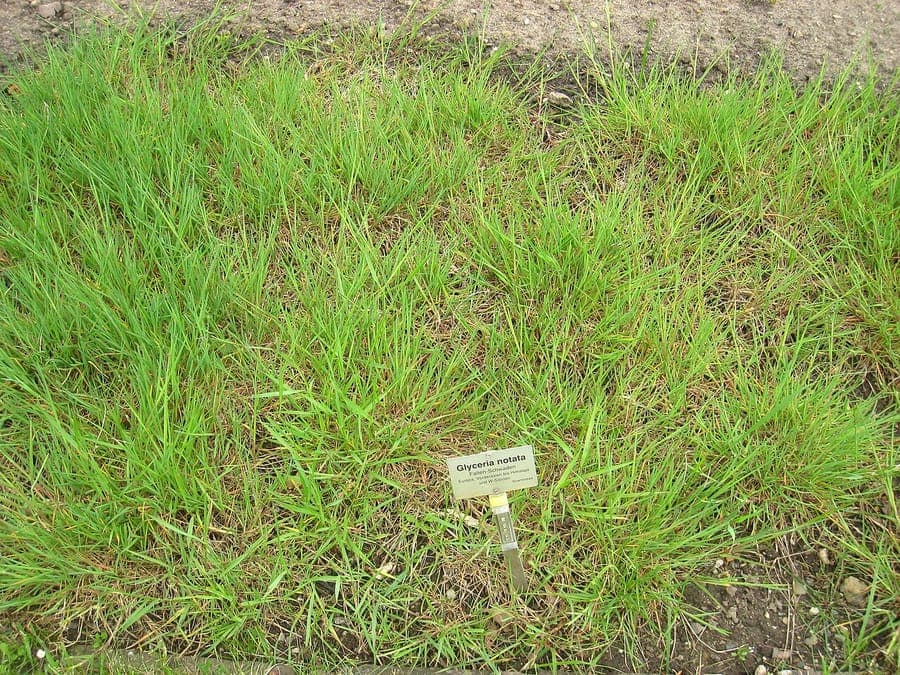
Daderot / Public domain, via Wikimedia Commons
Plicate sweet grass: complete guide
Glyceria notata
Want to see Plicate sweet grass: complete guide in your garden?
1 minute, no credit card
Overview
Plicate sweet grass (Glyceria notata) is a refined, clump-forming perennial grass native to wetlands across central and eastern Europe. It thrives in moist to wet soils and brings subtle texture to pond margins, rain gardens, and damp meadow plantings. As a member of the Poaceae family, it's not flashy, but its elegant form and adaptability make it a standout in naturalistic designs.
This grass is especially valued for its resilience and non-invasive nature. Unlike some aggressive wetland species, Glyceria notata stays within bounds, forming neat tufts without spreading uncontrollably. It's ideal for gardeners who want structure without domination. On gardenworld.app, you can generate a garden layout that integrates plicate sweet grass seamlessly with other moisture-loving plants for year-round visual interest.
Appearance & bloom cycle
Plicate sweet grass grows 60–100 cm tall with a spread of about 40 cm. Its defining feature is the deeply folded (plicate) leaves-each blade creased lengthwise, giving it a crisp, architectural look. The foliage is bright green, slender, and arching, creating soft movement in breeze.
From May through August, airy green flower panicles rise above the foliage. These open, branching inflorescences are pale green, turning beige as seeds develop. While not showy, they add delicate texture and support small pollinators and seed-eating insects. The bloom cycle is long, offering months of quiet beauty rather than a single burst.
Ideal location
This grass prefers full sun to light shade, scoring an 8 out of 10 for light needs. Aim for at least 6 hours of direct sunlight daily. In deep shade, it becomes leggy and floppy. Full sun promotes compact growth and better flowering.
Best planted at pond edges, in damp swales, or in low-lying areas where water collects. It also works in large containers as long as the soil stays constantly moist. Avoid hot, dry spots-even a single dry spell can cause tip burn or dormancy.
Soil requirements
Plicate sweet grass demands consistently moist, humus-rich soil with a pH between 5.5 and 6.5. It tolerates clay and silt but struggles in sandy, fast-draining soils. Amend poor soils with well-rotted compost or leaf mould to boost water retention and fertility.
Avoid highly alkaline conditions (pH above 7.0), which can cause chlorosis-yellowing between leaf veins. If your soil is calcareous, consider growing it in a raised bog bed with ericaceous compost to maintain acidity.
Free design
Want to see Plicate sweet grass: complete guide in your garden? Make a free design now.
Watering
Consistent moisture is non-negotiable. The roots should never dry out. In summer, check soil moisture every few days, especially in containers. Water deeply when the top 2–3 cm feel dry.
Use rainwater if possible-this grass is sensitive to lime and salt buildup from tap water. If using hose water, let it sit for 24 hours to dissipate chlorine. Overhead watering is fine, but early morning is best to prevent fungal issues.
Pruning
Minimal pruning required. Cut back old foliage in late winter or early spring (February to March) to 10–15 cm above ground. This clears space for new growth and keeps the plant looking tidy.
Leave seed heads through winter if you want to support wildlife or enjoy the frost-dusted look. In formal gardens, remove all dead material in spring for a clean start.
Maintenance calendar
- Jan: Dormant; no action needed
- Feb: Begin clearing old growth
- Mar: Finish pruning; apply compost
- Apr: Monitor moisture; new shoots emerge
- May: Flowers begin; ensure consistent water
- Jun: Peak bloom; watch for drought stress
- Jul: Flowering continues; no pruning
- Aug: Seed heads mature; reduce feeding
- Sep: Gradually reduce watering if rainfall increases
- Oct: Assess for winter cleanup
- Nov: Mulch base if extreme cold expected
- Dec: Dormancy; protect root zone
Winter hardiness
Plicate sweet grass is hardy in USDA zones 5–9. It reliably survives winter in most of the UK, northern Europe, and the northern US. The foliage dies back in autumn, but the crown remains alive underground.
In zone 5, a light mulch of leaf litter or compost helps insulate the crown during prolonged freezes. Avoid heavy mulches that retain too much moisture and encourage rot.
Companion plants
Pair with other moisture-loving perennials like Carex vulpinoidea, Eutrochium maculatum, or Iris versicolor. These share similar cultural needs and create layered, naturalistic plantings.
For contrast, combine with fine-textured rushes (Juncus spp.) or bold Gunnera manicata in large-scale designs. For smaller gardens, use with Osmunda regalis or Filipendula rubra. On gardenworld.app, explore pre-designed plant combinations that include plicate sweet grass for instant inspiration.
Closing
Plicate sweet grass isn't a headline act, but it's a reliable supporting player in any wet garden. It offers texture, movement, and quiet beauty without demanding much in return. Its adaptability and wildlife value make it a smart choice for eco-conscious gardeners.
You can find Glyceria notata at garden centres across the UK and Europe. Look for healthy, moist root balls and plant promptly. Avoid bargain bins with dried-out clumps-this grass hates drought stress from day one.
Want to see Plicate sweet grass: complete guide in your garden? Make a free design now.
Upload a photo, pick a style, and get a photorealistic design with plant list in under a minute.
No credit card required


Similar plants
Sporobolus pungens: complete guide
Sporobolus pungens
Sporobolus pungens is a stoloniferous Mediterranean coastal grass with outstanding salt and drought tolerance, perfect for seaside and dry gardens.
Mediterranean aegilops: complete guide
Aegilops biuncialis
Everything about Aegilops biuncialis, a Mediterranean annual grass with ornamental spikes and outstanding drought tolerance for dry gardens.
Silver bluestem: complete guide
Bothriochloa saccharoides
Full guide to Bothriochloa saccharoides (silver bluestem): site, soil, watering, winter hardiness, pruning, and garden companions.