
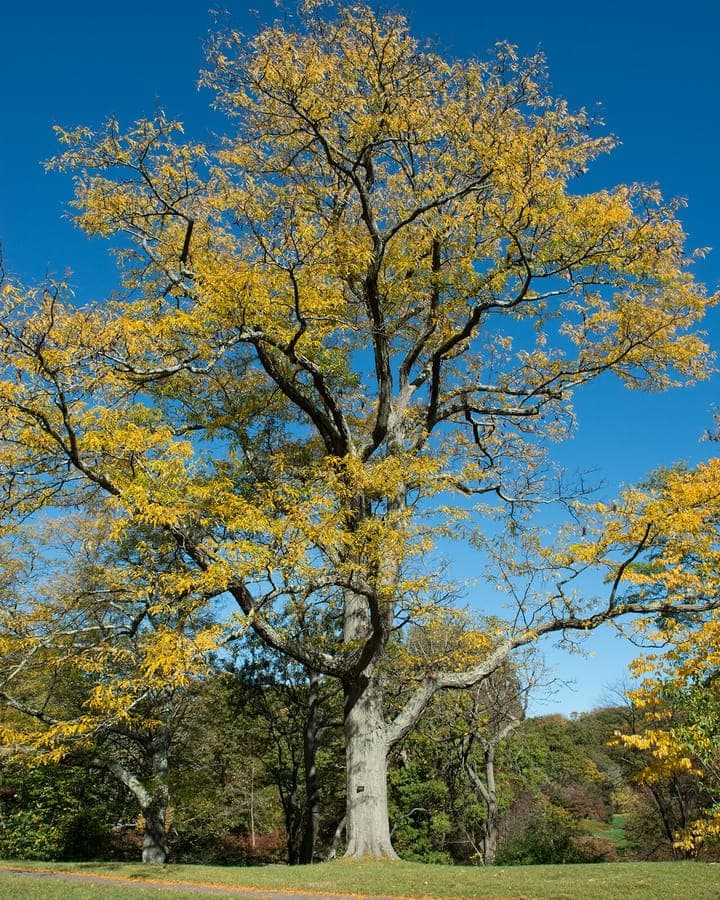
Plant Image Library from Boston, USA / CC BY-SA 2.0, via Wikimedia Commons
Three-thorn-acacia: complete guide
Gleditsia triacanthos
Want to see Three-thorn-acacia: complete guide in your garden?
1 minute, no credit card
Overview
Gleditsia triacanthos, commonly known as the Three-thorn-acacia, is a tall, stately tree native to central and southern United States-from Alabama to Iowa and as far east as Connecticut. Despite its spiky reputation, this member of the Fabaceae family brings elegance to large landscapes with its delicate, feathery foliage and open canopy. Reaching heights of 15 to 25 meters and spreading up to 18 meters wide, it's not a tree for compact gardens. But if you've got space, it's a long-lived, low-maintenance choice that casts light, dappled shade-ideal for lawns, parks, or spacious country estates.
On gardenworld.app you can visualise how a mature Three-thorn-acacia would influence shade patterns in your garden, helping you plan seating areas or underplanting zones effectively.
Appearance & bloom cycle
The tree's most distinctive feature is its bipinnately compound leaves, which can reach up to 30 cm in length. Each leaf is made up of dozens of tiny leaflets, 1–2 cm long, giving the canopy a soft, almost fern-like texture. In spring, the foliage emerges bright green, maturing to a rich dark green in summer before turning a striking golden yellow in autumn. The leaves often linger into early winter, providing seasonal interest.
Flowering occurs in late May to early June. The small, inconspicuous flowers are greenish-yellow and hang in slender racemes. They're not showy, but they attract bees and other pollinators. Gleditsia triacanthos is usually dioecious, meaning male and female flowers grow on separate trees. Only female trees produce the long, twisted seed pods-up to 45 cm in length-that persist through winter and can create litter.
Many gardeners prefer the thornless cultivar 'Inermis', which is typically male and produces no pods. This makes it far more suitable for urban settings, driveways, or family gardens. The wild type, however, sports formidable thorns up to 30 cm long, especially along the trunk and lower branches-nature's way of deterring herbivores.
Ideal location
Plant your Three-thorn-acacia in full sun-minimum 6 hours of direct sunlight daily. It needs room to grow, so keep it at least 5 meters from buildings, power lines, or other large trees. Avoid planting near patios or walkways if you're using a pod-bearing variety; fallen pods can be slippery and messy.
The tree's shallow, spreading root system makes it difficult to grow grass underneath. Instead, consider mulching the base with wood chips (5–8 cm deep) or planting shade-tolerant groundcovers like barrenwort (Epimedium) or liriope. On gardenworld.app, you can design a layered planting scheme that works with the tree's root spread and light conditions.
Soil requirements
This tree is adaptable to a wide range of soils-sandy, loamy, or clay-as long as drainage is adequate. It tolerates pH levels from 4.8 (acidic) to 8.0 (slightly alkaline), making it suitable for most garden soils in the UK and US. Avoid compacted soils, which restrict root growth. If planting in urban areas, ensure the site isn't prone to heavy foot traffic or vehicle parking.
Free design
Want to see Three-thorn-acacia: complete guide in your garden? Make a free design now.
Watering
Young trees need consistent watering during their first 2–3 years. Provide 20–30 liters of water per week during dry spells, ideally applied slowly to encourage deep rooting. Once established, Gleditsia triacanthos is highly drought-tolerant thanks to its deep taproot. Mature trees rarely need supplemental watering, even in prolonged dry summers.
Pruning
Pruning is rarely necessary, as the tree develops a strong, natural structure. However, young specimens may benefit from light training to establish a single trunk and remove crossing or weak branches. Prune during late winter (January to early March) when the tree is dormant. Use sharp, sterilized tools and wear thick gloves-especially with thorny varieties.
Avoid topping or heavy pruning, which can lead to weak regrowth and structural issues. The 'Inermis' cultivar is much safer and easier to maintain in residential settings.
Maintenance calendar
- January: Inspect for dead or damaged wood; prune if needed
- February: Final pruning window before bud swell
- March: Hold off pruning as sap starts to rise
- April: Monitor for aphids or fungal spots
- May: Observe flowering; note if tree is male or female
- June: No action required
- July: Check for drought stress; water young trees
- August: Minimal care; watch for pod development on female trees
- September: Begin preparing for leaf drop
- October: Rake up fallen pods if undesirable
- November: Leave fallen leaves as natural mulch
- December: Let tree rest; no maintenance needed
Winter hardiness
Gleditsia triacanthos is hardy to USDA zone 4 (-34°C), making it suitable for most of the UK, northern Europe, and the northern US. In milder zones (7–9), it thrives with no winter protection. Young trees may suffer minor tip dieback in harsh winters but recover quickly in spring.
Companion plants
Underplanting is tricky due to shade and root competition. Stick to the drip line for best results. Suitable companions include:
- Epimedium x youngianum – drought-tolerant, shade-loving perennial
- Carex vulpinoidea – soft, grass-like texture
- Heuchera – colorful foliage for contrast
- Pachysandra terminalis – reliable groundcover
Avoid moisture-hungry plants like hostas or delphiniums that will struggle under the tree's canopy.
Closing
The Three-thorn-acacia is a bold statement tree-graceful, tough, and long-lived. While the wild form's thorns and pods may deter some, the 'Inermis' cultivar offers all the beauty with none of the hassle. It's especially valuable in urban parks or large gardens where light shade and drought resistance are priorities. Look for young specimens at garden centres across the UK and US, often sold in 1.5–2m sizes. Always check the label: 'Inermis' means thornless and pod-free-ideal for family-friendly spaces.
Want to see Three-thorn-acacia: complete guide in your garden? Make a free design now.
Upload a photo, pick a style, and get a photorealistic design with plant list in under a minute.
No credit card required


Similar plants
Tall Silky Lupine: complete guide
Lupinus elatus
Tall silky lupine is a fast-growing Californian perennial with silvery foliage and blue-purple flower spikes, ideal for a prairie-style garden.
Garfield Lupine: complete guide
Lupinus garfieldensis
The Garfield lupine is a rare, fast-growing American perennial for alkaline, dry grassland gardens, with striking blue flower spikes.
Lupinus elegans: complete guide
Lupinus elegans
Lupinus elegans, the elegant lupine, is a spectacular blooming plant from Mexico with blue flower spikes. Care, cultivation and garden use.