
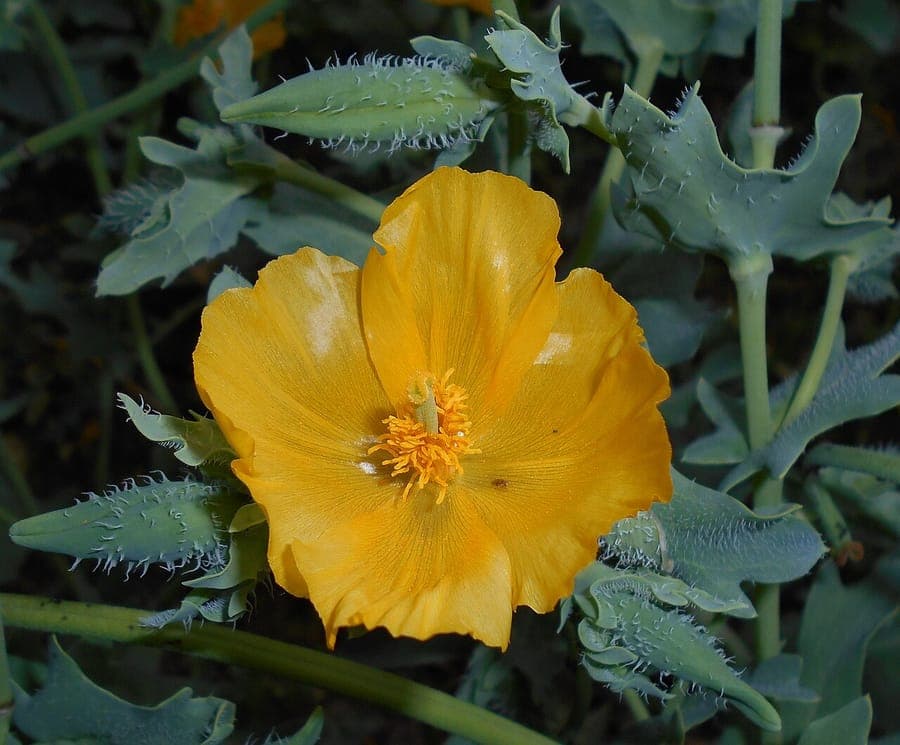
Salicyna / CC BY-SA 4.0, via Wikimedia Commons
Horned-poppy: complete guide
Glaucium flavum
Want to see Horned-poppy: complete guide in your garden?
1 minute, no credit card
Overview
Glaucium flavum, commonly known as the horned-poppy, is a striking biennial or short-lived perennial herb that commands attention with its bold yellow-orange flowers and elongated, horn-shaped seed pods. Native to coastal regions across southern and western Europe, this plant thrives in harsh, sandy environments where few others survive. While not a staple in most UK or North American gardens, adventurous gardeners appreciate its rugged charm and minimal care needs.
The horned-poppy isn't for those seeking tidy borders or fuss-free symmetry. It's a wild, architectural plant best suited to naturalistic designs, gravel gardens, or coastal landscapes. If you're planning a seaside garden or a drought-tolerant planting scheme, this species deserves a spot. On gardenworld.app, you can generate a custom garden layout that incorporates Glaucium flavum alongside other salt- and wind-tolerant species for a cohesive, resilient design.
Appearance & bloom cycle
Horned-poppy reaches 40–70 cm in height, with stiff, upright stems and glaucous, blue-green foliage covered in a waxy bloom that reduces water loss. The basal rosette features deeply lobed, greyish leaves that form early in the first year. Flowering occurs in the second year, starting in June and continuing through September. Each flower is 5–8 cm wide, with silky, bright yellow to orange-yellow petals and distinctive dark glands at the base.
After pollination, the flowers give way to slender, curved seed pods up to 15 cm long - the source of its common name. These mature from green to dry brown, eventually splitting open to release dark brown seeds. The plant often self-seeds freely in suitable conditions, creating a naturalised colony over time.
Ideal location
Full sun is essential. Glaucium flavum needs at least 6–8 hours of direct sunlight daily to flower well. It performs best in open, exposed sites - south- or west-facing slopes, coastal bluffs, or gravel beds. Avoid shaded or damp areas; this plant will not tolerate competition or humidity.
In the UK and similar climates, it grows well along the coast or inland on sandy, free-draining soils. You can find seeds or young plants at independent garden centres or online suppliers. Larger chains rarely stock it, but specialty nurseries occasionally carry it in spring. Check garden centres in coastal regions or browse online seed banks.
Free design
Want to see Horned-poppy: complete guide in your garden? Make a free design now.
Soil requirements
This plant demands sharp drainage. It flourishes in poor, sandy, or gravelly soils with low organic content. Ideal pH ranges from 6.0 to 7.8. Clay soils must be amended with coarse sand or grit to prevent waterlogging. Raised beds or rock gardens work well. Never plant in rich, moisture-retentive soils - root rot is a common killer.
On gardenworld.app, you can upload a soil test result to evaluate compatibility with Glaucium flavum. The platform will suggest amendments or alternative species if your soil is too heavy.
Watering
Once established, the horned-poppy is extremely drought-tolerant. Water sparingly - only during prolonged dry spells in the first growing season. After that, rainfall is usually sufficient. Overhead watering should be avoided; use ground-level drip irrigation if needed. Wet foliage increases fungal disease risk.
Pruning
No pruning is required. Deadheading is optional; leaving seed pods intact encourages self-seeding and adds winter interest. Cut back spent stems in late autumn if aesthetics are a concern, or leave them for birds and winter structure.
Maintenance calendar
- Jan: No action
- Feb: No action
- Mar: Sow seeds indoors at 15–20°C
- Apr: Harden off seedlings; prepare outdoor site
- May: Transplant outdoors, 30 cm apart
- Jun: Flowers begin; monitor for slugs
- Jul: Peak bloom; avoid fertilising
- Aug: Continue bloom; collect seeds if desired
- Sep: Final flowering; allow some pods to mature
- Oct: Cut back or leave for self-seeding
- Nov: Clear debris; loosen soil
- Dec: Dormant period
Winter hardiness
Hardy in USDA zones 7b to 10. In milder areas, the rosette may survive winter and flower the following year. In colder zones, treat as a biennial or protect with gravel mulch. Seedlings are more cold-sensitive, so autumn sowing should be timed carefully.
Companion plants
Pair with drought-tolerant species like Eryngium, Achillea, Sedum, or Stachys. Avoid moisture-loving plants like hostas or astilbes. Use stone mulch or gravel pathways to enhance drainage and complement the plant's architectural form. The horned-poppy also combines well with silver-foliage plants for contrast.
Closing
The horned-poppy is not a showy bedding plant, but a resilient survivor with bold visual appeal. It thrives where others fail - on poor soil, in dry heat, and under salty winds. If you're looking to create a low-input, high-impact garden, Glaucium flavum is a top contender. Try it in a forgotten corner or gravel path edge. And remember, on gardenworld.app you can generate a custom garden layout that incorporates Glaucium flavum alongside other salt- and wind-tolerant species for a cohesive, resilient design.
Want to see Horned-poppy: complete guide in your garden? Make a free design now.
Upload a photo, pick a style, and get a photorealistic design with plant list in under a minute.
No credit card required


Similar plants
Papaver gorodkovii: complete guide
Papaver gorodkovii
Papaver gorodkovii, the arctic poppy, thrives from Alaska to Russia's Far East. Discover how to grow this rare, extremely cold-hardy rock garden treasure.
Papaver setiferum: complete guide
Papaver setiferum
Papaver setiferum is a hardy giant Caucasian poppy with fiery red blooms. Discover siting, soil, deadheading and winter hardiness.
Pale Poppy: complete guide
Papaver alboroseum
Discover pale poppy (Papaver alboroseum) - rare alpine poppy with white-pink flowers. Precious beauty from Kamchatka. Cultivation in alpine and rock gardens.