
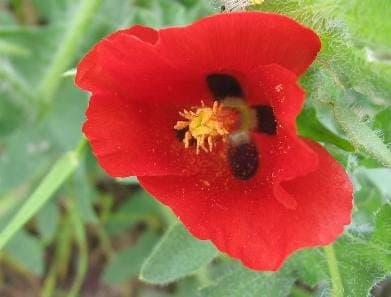
User User:Alberto Salguero on es.wikipedia / CC BY-SA 3.0, via Wikimedia Commons
Blackspot hornpoppy: complete guide
Glaucium corniculatum
Want to see Blackspot hornpoppy: complete guide in your garden?
1 minute, no credit card
Overview
Glaucium corniculatum, commonly known as the Blackspot hornpoppy, is a bold and elegant annual belonging to the Papaveraceae family. Native to regions like southern France, Greece, and the Canary Islands, it thrives in dry, sunny conditions with minimal care. This plant doesn't occur naturally in the UK or US, but it adapts well to gardens with good drainage and a Mediterranean-like exposure.
Reaching heights of 30 to 50 cm, it forms upright, glaucous stems with silvery-blue foliage and striking purple flowers. It blooms from May through July, making it a reliable summer performer. Gardeners appreciate its sculptural form and low water demands. If you're designing a drought-tolerant garden, the Blackspot hornpoppy fits perfectly. You can test layout ideas on gardenworld.app to see how it complements other sun-loving plants.
It's especially suited for rock gardens, dry borders, or large containers on patios. In urban settings, it adds drama without demanding rich soil or frequent watering.
Appearance & bloom cycle
The Blackspot hornpoppy produces vivid purple flowers, 4 to 5 cm across, held on slender, erect stems. The petals have a delicate, crinkled texture and a slight sheen, opening fully in bright sunlight. Each flower lasts several days, and new blooms emerge continuously from late spring into midsummer.
After flowering, the plant develops long, horn-shaped seed pods up to 15 cm in length-hence its common name. These pods add architectural interest even after the bloom cycle ends. The foliage is covered in a fine, waxy bloom that reduces water loss, a key adaptation to arid climates.
As an annual, it completes its life cycle in one season. Sow seeds in spring for blooms by early summer. If left to self-seed, it may return in subsequent years, provided the soil is well-drained and sunny.
Ideal location
This plant needs full sun-aim for a spot with at least 7 on the light scale (10 being full sun). South- or southwest-facing beds, rooftop gardens, or gravel borders work best. Avoid shaded areas or spots with aggressive root competition from trees.
It performs particularly well in coastal gardens or urban environments where heat and reflected light boost its flowering. Whether you're in USDA zone 7 or 9, this poppy thrives where moisture is limited but sun exposure is strong. Use gardenworld.app to model your garden and determine the best microclimate for planting.
Free design
Want to see Blackspot hornpoppy: complete guide in your garden? Make a free design now.
Soil requirements
Glaucium corniculatum prefers alkaline, well-draining soil with a pH between 7.5 and 8.0. Sandy or gravelly soils are ideal. Avoid heavy clay or water-retentive mixes, as they promote root rot.
If your soil is dense, amend it with grit, pumice, or coarse sand to improve drainage. Don't enrich the soil too much-this plant thrives in poor, lean conditions. Over-fertilizing leads to lush foliage but fewer flowers.
Watering
Once established, the Blackspot hornpoppy is highly drought-tolerant. Water only during prolonged dry spells, especially when young. Deep, infrequent watering encourages strong root development.
Avoid overhead watering, as it can promote fungal diseases. Instead, water at the base using a soaker hose or watering can. Rainwater is preferable, as tap water can increase soil alkalinity over time.
Pruning
Pruning isn't necessary. Deadheading isn't required to prolong blooming, but you can remove spent flower stems if desired. Leave a few pods to mature if you want natural reseeding.
In containers, you can cut back leggy growth by half in midsummer to encourage a second flush of blooms, though this is not always reliable.
Maintenance calendar
- March/April: Sow seeds directly in the ground or in pots. Keep seedlings dry and sunny.
- May: Blooms begin. Watch for slugs.
- June: Peak flowering. No feeding needed.
- July: Allow seed pods to form. Remove faded plants if reseeding isn't wanted.
- August: Collect seeds or let them disperse.
Winter hardiness
The Blackspot hornpoppy is an annual and does not survive winter. It completes its life cycle within one growing season. In USDA zones 7–9, it won't overwinter, but self-sown seedlings may appear the following spring if conditions allow.
No winter protection is needed. Clear spent plants in late summer if self-seeding is undesirable.
Companion plants
Pair it with drought-tolerant companions like Eryngium, Sedum spectabile, or Verbena bonariensis. These create a loose, naturalistic planting scheme.
Avoid moisture-loving plants like hostas or astilbes. Maintain spacing of about 30 cm between plants to ensure good airflow and reduce disease risk.
Closing
The Blackspot hornpoppy brings dramatic flair to low-water gardens with its vivid blooms and sculptural pods. It's a standout in gravel gardens, coastal sites, or modern container arrangements. With minimal care and striking presence, it's a rewarding choice for hands-off gardeners.
You can find seeds or young plants at garden centres across the UK and US. Plan your drought-friendly design on gardenworld.app to see how this poppy enhances your outdoor space.
Want to see Blackspot hornpoppy: complete guide in your garden? Make a free design now.
Upload a photo, pick a style, and get a photorealistic design with plant list in under a minute.
No credit card required


Similar plants
Papaver gorodkovii: complete guide
Papaver gorodkovii
Papaver gorodkovii, the arctic poppy, thrives from Alaska to Russia's Far East. Discover how to grow this rare, extremely cold-hardy rock garden treasure.
Papaver setiferum: complete guide
Papaver setiferum
Papaver setiferum is a hardy giant Caucasian poppy with fiery red blooms. Discover siting, soil, deadheading and winter hardiness.
Pale Poppy: complete guide
Papaver alboroseum
Discover pale poppy (Papaver alboroseum) - rare alpine poppy with white-pink flowers. Precious beauty from Kamchatka. Cultivation in alpine and rock gardens.