
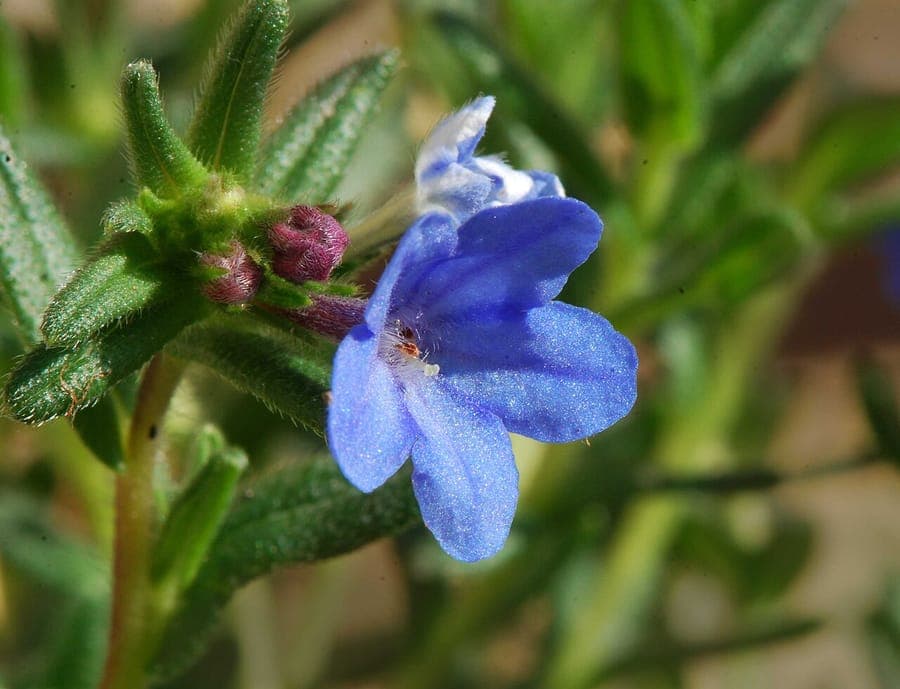
Pancrat / CC BY-SA 3.0, via Wikimedia Commons
Scrambling Gromwell: complete guide
Glandora prostrata
Want to see Scrambling Gromwell: complete guide in your garden?
1 minute, no credit card
Overview
Glandora prostrata, still widely sold under its former name Lithodora prostrata, is a low-growing, mat-forming subshrub in the borage family (Boraginaceae). Native to the acidic heathlands, stony hillsides, and open pine forest margins of south-western Europe - principally Spain, Portugal, southern France, and Morocco - it has earned a devoted following among rock garden enthusiasts across northern Europe. The species name prostrata describes the plant's spreading, ground-hugging habit, while the common name 'Scrambling Gromwell' alludes both to its borage-family kinship and to its tendency to thread its wiry stems through neighbouring plants.
The genus Glandora was separated from Lithospermum only in 2008, which is why nursery labels and older gardening books still show Lithodora as the genus name. Most reputable garden centres stock this plant in their rock garden or alpine sections, typically as the popular cultivar 'Heavenly Blue'. Few plants in the temperate garden world offer such a pure, saturated blue, and for that reason alone Glandora prostrata has become something of a legend among rock garden aficionados. On gardenworld.app you can explore planting designs where this intense blue acts as a structural accent in the front garden or terraced borders.
Beyond aesthetics, the plant provides early-season nectar for long-tongued bumblebees and other pollinators capable of reaching the deep, tubular flowers. On a sunny, well-drained acid slope with minimal maintenance, it delivers a carpet of blue year after year with almost no effort from the gardener.
Appearance and bloom cycle
Glandora prostrata forms a dense, cushion-like mat approximately 10 to 30 cm tall and 30 to 60 cm across. The stems are slender, slightly woody at the base, and covered in fine white pressed hairs. The leaves are narrowly lance-shaped, 1 to 2 cm long, dark green above and paler beneath, with a similar hairy texture. The dense leaf coverage gives the mat an attractively textured surface even when the plant is not in bloom.
The flowers are funnel-shaped with five spreading petals in intense cobalt to azure blue with a pinkish-white tube at the base. Individual flowers measure approximately 1 to 1.5 cm across and are arranged in small, coiling cymes typical of the borage family. The main flowering season runs from May to July, with peak display in May and June. In sheltered, south-facing positions, the first flowers can appear as early as late April. The timing coincides well with many alpine and rock garden perennials, offering excellent combination potential.
After flowering, small, shiny, stone-like nutlets form. These are inconspicuous and have little ornamental value. The plant remains evergreen through winter in milder conditions, its dark green mat providing ground cover and weed suppression year-round. The cultivar 'Heavenly Blue' is by far the most commonly sold selection, with slightly larger, more intensely coloured flowers than the straight species. 'Grace Ward' is a compact form suited to smaller rock gardens. 'Star' has unusually wide-open flowers. A white-flowered form ('White') also exists but is rarely seen in commerce.
Ideal location
Glandora prostrata needs a bright, open position with plenty of direct sun: a light score of 7 out of 10 indicates a preference for full sun to very light partial shade. A south or south-west facing slope in a rock garden or scree bed is ideal. The plant looks particularly beautiful spilling over the edge of a raised dry-stone wall, where the trailing stems can hang freely and drainage is guaranteed. In a hanging basket or trough it also performs well.
Deep shade should be avoided: in too little light the plant flowers poorly and the foliage becomes chlorotic. Once established it tolerates moderate summer drought, though it is somewhat less drought-tolerant than many Mediterranean shrubs: its atmospheric humidity score of 5 out of 10 indicates a moderate moisture requirement. Shelter from cold, desiccating winter winds is beneficial, especially for young plants in their first season.
When planting as a ground cover, space plants 30 to 45 cm apart centre to centre. For a specimen in a rock garden pocket, one plant per space of roughly 40 cm x 40 cm is appropriate.
Soil requirements
Soil chemistry is the single most critical factor in growing Glandora prostrata successfully. The plant requires an acidic to mildly acidic soil with a pH between 4.5 and 5.0 - comparable to the conditions preferred by heathers, rhododendrons, and blueberries. On alkaline or neutral soils it will rapidly develop iron chlorosis: the leaves yellow, growth stalls, and flowering practically stops. Always test the soil pH before planting, and correct if necessary with sulphur dust, acidic peat, or ericaceous compost.
The plant has low nutrient requirements (soil nutriment score 2 out of 10), thriving on lean, humus-poor to lightly humus-rich substrates. Rich, over-fertilised soil produces lush leafy growth at the expense of flowers. The ideal growing medium is sandy, slightly humus-amended, and fast-draining: on heavier soils, incorporate at least 30% coarse sharp sand or perlite into the planting area. Never use lime, calcium-rich builders' sand, or any material that could raise the pH around the roots, as even a slight drift toward alkalinity triggers chlorosis.
Free design
Want to see Scrambling Gromwell: complete guide in your garden? Make a free design now.
Watering
Glandora prostrata is moderately drought-tolerant once established, but less so than strictly Mediterranean plants. In summer, it tolerates dry spells of up to two weeks without distress, but during prolonged heat and drought lasting three weeks or more, supplementary watering of 5 to 8 litres per plant every ten days helps maintain vigour and flowering. The atmospheric humidity score of 5 reflects a moderate moisture need.
Rainwater or soft water is strongly preferred for all watering. Tap water in most of the United Kingdom and northern Europe is hard (high calcium content) and gradually raises the soil pH, ultimately triggering the chlorosis described above. Where tap water is unavoidable, counteract it periodically by watering with a light iron chelate solution, or by adding a very small amount of acidic pH buffer to the watering can.
Never allow water to pool around the base: waterlogged roots are susceptible to Phytophthora rot, which kills the plant rapidly. Free drainage is non-negotiable.
Pruning
Little pruning is required. After the main flowering period, around the end of June or early July, a light trim encourages fresh growth and can trigger a modest secondary flush in late summer or early autumn. Cut back flowered shoots to just above a side bud or leaf node. Avoid cutting into the hard, woody basal framework: on older plants, aggressive pruning into old wood often results in bare, non-regenerating stems.
For plants that have become very open or leggy, a more thorough cutting back to the fresh green base shoots in early March is possible, but only if there is ample green growth remaining to sustain the plant through regrowth. Remove any dead or winter-damaged stems promptly to promote good air circulation and reduce the risk of fungal issues.
Maintenance calendar
January–February: protect young plants from hard frost with a covering of conifer branches or loose straw. Established plants need no action.
March: check soil pH and adjust if necessary using acidifying fertiliser or sulphur. Light tidy-up of any desiccated winter stems.
April–May: peak flowering begins. Ensure the soil is moist but never waterlogged. Pollinators are active around the plant.
June–July: main bloom peaks and fades; trim back flowered shoots lightly to encourage compact re-growth.
August: keep the soil slightly moist during heat waves. Watch foliage colour; yellowing suggests calcium contamination or drought stress.
September–October: cease all feeding. The plant prepares for dormancy; drainage check recommended before autumn rains.
November–December: the evergreen mat remains attractive; ensure drainage is good going into winter.
Winter hardiness
Glandora prostrata is moderately cold-hardy, tolerating temperatures down to approximately -10°C in a sheltered, well-drained position. In USDA terms this places it in zones 7 to 8. In milder, oceanic parts of the UK, Ireland, and along the Atlantic coast of Europe the plant overwinters without difficulty. In colder, more continental climates, a light covering of cut conifer branches over the root zone in hard winters reduces frost penetration. Young plants in their first year are notably more frost-sensitive than established ones.
Pot-grown specimens must be moved to an unheated, frost-free greenhouse or cold frame during prolonged freezing weather. Avoid the combination of wet soil and frost, which tears roots and is often lethal. After a cold spell, wait until mid-April before cutting back apparently dead stems - the plant sometimes resprouts from the base even when the top growth looks completely dead.
Companion plants
Glandora prostrata belongs among acid-loving, well-drained companions. Excellent combinations include:
- Erica carnea 'Springwood White': white winter heath alongside the blue of glandora; identical pH preference, 30 cm spacing
- Calluna vulgaris 'Robert Chapman': heather with purple-red summer colour complementing the blue flowers
- Iberis sempervirens: white candytuft, flowering slightly earlier and shifting the colour emphasis
- Phlox subulata 'Emerald Cushion Blue': a similar mat-forming habit in delicate blue-lilac
- Festuca glauca: blue-grey fescue that visually echoes the cobalt blue of the glandora flowers
- Dianthus deltoides (maiden pink): low-growing, similarly acidic soil requirements, red-pink contrast
Avoid companions that prefer alkaline soil - lavender, hardy geraniums, clematis - since these require pH conditions incompatible with what glandora needs. A visit to a well-stocked rock garden section of a garden centre will reveal many suitable acid-loving partners, often grouped together on the display benches.
For an idea of how this planting combination would look in your own front garden, gardenworld.app lets you upload a photo and see a realistic visualisation of the finished design.
Closing thoughts
Glandora prostrata is one of those rare plants that punches far above its modest size in terms of visual impact. The deep blue flower carpet it produces every spring and early summer is among the most stunning colour moments the rock garden has to offer. Get the conditions right - acid soil, sharp drainage, full sun, soft water - and this plant will reward you for decades with almost no maintenance. Nail the soil chemistry, and everything else follows naturally.
Want to see Scrambling Gromwell: complete guide in your garden? Make a free design now.
Upload a photo, pick a style, and get a photorealistic design with plant list in under a minute.
10,000+ gardens designed already
No credit card required


Similar plants
Western waterleaf: complete guide
Hydrophyllum occidentale
Full growing guide for western waterleaf (Hydrophyllum occidentale): shade tolerance, soil needs, watering, winter hardiness and naturalistic garden use.
Limestone phacelia (Phacelia affinis): complete guide
Phacelia affinis
Full guide to Phacelia affinis, the limestone phacelia: sowing tips, purple-blue bee flowers, drought tolerance and uses in dry or wildlife gardens.
Pyrenean viper's bugloss: complete guide
Echium asperrimum
Echium asperrimum is a striking biennial from the western Mediterranean with rough bristly stems and vivid blue flowers. A magnet for bees and a bold border plant.