
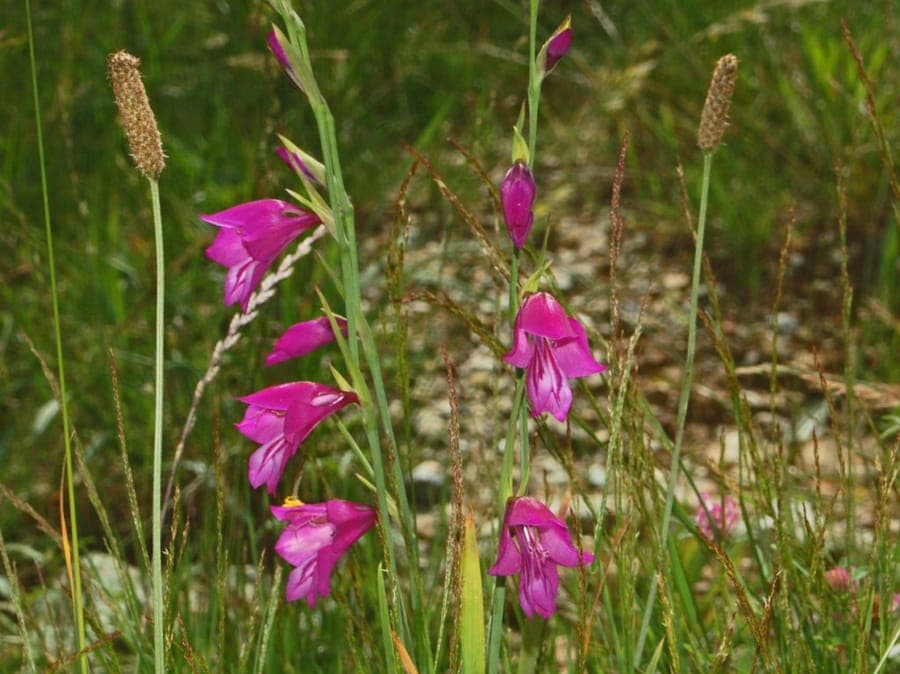
Hectonichus / CC BY-SA 3.0, via Wikimedia Commons
Gladiolus palustris: complete guide
Gladiolus palustris
Want to see Gladiolus palustris: complete guide in your garden?
1 minute, no credit card
Overview
Gladiolus palustris, the marsh gladiolus, isn't your average garden centre find. Unlike its flashy, cultivated cousins bred for cut flowers, this species thrives in wild, wet meadows across Central and Southeastern Europe. It's a delicate perennial bulb that brings quiet elegance to damp garden spots where others fail. If you've got a soggy corner or a pond margin that stays wet all summer, this is your plant.
Native to countries like Austria, Hungary and Bulgaria, it's not naturally found in the UK or most of North America, but it adapts well to moist, alkaline soils in zones 6–8. Gardeners who value biodiversity and naturalistic planting schemes often seek it out. And with gardenworld.app, you can map out a damp garden design that highlights this species alongside other moisture-loving perennials.
Appearance & bloom cycle
Standing 30 to 60 cm tall, Gladiolus palustris sends up narrow, sword-shaped leaves in early spring. The flowering stem appears in June, bearing 3 to 8 soft pink to pale magenta flowers. Each bloom has a deeper vein pattern, almost like brushstrokes, that guides pollinators to the nectar. The flowers open gradually from the bottom up, ensuring a long bloom window from late June through July.
Each individual flower lasts just a day or two, but the staggered opening keeps the display fresh. The plant dies back completely by late summer, so plan companion planting to cover the fading foliage. It's not the most flamboyant gladiolus, but its subtlety is part of its charm.
Ideal location
This species needs full sun to partial shade-aim for a light level of 7 to 8. In cooler climates like the UK or northern US, full sun is ideal. In hotter zones, afternoon shade helps prevent soil from drying out too quickly. A spot at the edge of a pond, in a rain garden, or in a consistently damp border works best.
Avoid dry, sandy beds or deep shade. It won't survive long in typical garden soil unless it's amended for moisture retention. Use gardenworld.app to preview how sunlight moves across your garden, so you can place your marsh gladiolus where it gets enough light without overheating.
Soil requirements
Gladiolus palustris demands alkaline, moist to wet soil with a pH of 7.5 to 8.0. It grows naturally in calcareous fens and damp grasslands, so replicate that with heavy loam or clay that holds water. If your soil is acidic, add ground limestone (50 g/m²) in autumn to gently raise pH.
Plant bulbs 8–10 cm deep, spaced 10 cm apart. Mix in well-rotted compost or leaf mould to improve moisture retention, but don't let water pool-roots can rot in stagnant conditions. A thin mulch of leaf litter or reed helps keep roots cool and moist.
Free design
Want to see Gladiolus palustris: complete guide in your garden? Make a free design now.
Watering
Keep soil consistently moist. During dry spells in June and July, water daily or install drip irrigation. Never let the soil dry out completely. A rain barrel near your pond or border makes watering easier and more sustainable.
In regions with dry summers, this is the plant's biggest challenge. Garden centres often stock self-watering kits or moisture meters-worth considering if you're serious about keeping bog plants happy.
Pruning
No pruning needed. After flowering, snip off the spent flower spike 2 cm above the soil, but leave the foliage until it yellows naturally. This feeds energy back into the bulb for next year. Remove any damaged or diseased leaves with clean shears to prevent fungal spread.
Don't compost infected material-burn it or dispose of it in general waste.
Maintenance calendar
- Jan: Check for frost damage; no action needed.
- Feb: Plan planting locations; order bulbs.
- Mar: Plant bulbs after last frost, usually late March.
- Apr: Keep soil moist; watch for aphids.
- May: Hand-weed; ensure good light exposure.
- Jun: Bloom begins; water daily if dry.
- Jul: Peak flowering; deadhead spent blooms.
- Aug: Reduce watering; stop feeding.
- Sep: Foliage yellows; leave in place.
- Oct: Lift bulbs if soil is poorly drained or prone to winter flooding.
- Nov: Store lifted bulbs in dry peat or wood shavings at 4–8°C.
- Dec: Dormant period; no fertilising.
Winter hardiness
Hardy in USDA zones 6 to 8. In zone 6 and colder parts of 7, lift bulbs in autumn to prevent rot. In milder areas (zone 7b and up), bulbs can stay in the ground with a light mulch of bracken or reed to insulate without smothering.
Avoid plastic covers-they trap moisture and encourage rot. If your soil is heavy clay and stays waterlogged, lifting is safer.
Companion plants
Pair with other moisture-loving species: Iris pseudacorus, Caltha palustris, Lythrum salicaria, Mentha aquatica, and Filipendula ulmaria. These create a naturalistic, pollinator-rich edge.
Avoid drought-tolerant plants like lavender or sedum-they'll struggle in the same soil. Also steer clear of aggressive spreaders like bamboo that could overwhelm the gladiolus.
Closing
Gladiolus palustris isn't for the lazy gardener. It demands attention to moisture and soil pH. But for those who care, it rewards with a rare, understated beauty. Buy bulbs from specialist nurseries or reputable garden centres-avoid generic gladiolus mixes.
Trusted UK suppliers often list true species stock, and online tools like gardenworld.app help you integrate it into a cohesive, moisture-rich planting scheme. With patience and the right spot, this marsh jewel can become a quiet highlight of your summer garden.
Want to see Gladiolus palustris: complete guide in your garden? Make a free design now.
Upload a photo, pick a style, and get a photorealistic design with plant list in under a minute.
No credit card required


Similar plants
Iris tingitana: complete guide
Iris tingitana
Iris tingitana, the Morocco iris, is the bulb species behind the Dutch iris: early blue-violet blooms that need a sunny, well-drained position.
Iris hookeri: complete guide
Iris hookeri
Hooker's Iris is a compact North American native plant with blue flowers. Low-growing and moisture-loving water plant.
Siskiyou iris: complete guide
Iris bracteata
Complete guide to Iris bracteata, the Siskiyou iris: location, soil, bloom cycle, watering, pruning and companion plants for this rare Pacific Coast iris.