
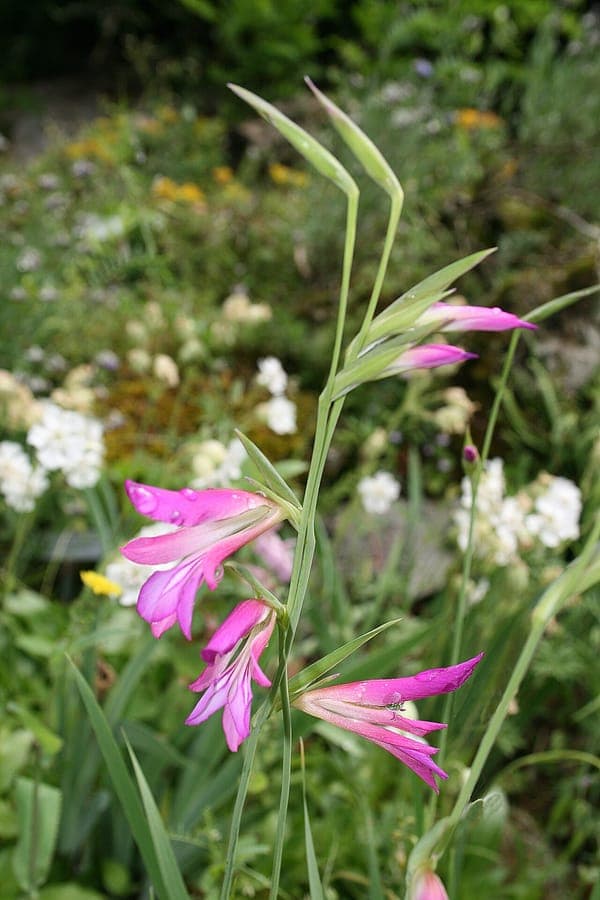
Jean-Pol GRANDMONT / CC BY-SA 3.0, via Wikimedia Commons
Field gladiolus: complete guide
Gladiolus italicus
Want to see Field gladiolus: complete guide in your garden?
1 minute, no credit card
Overview
Gladiolus italicus, commonly known as Field gladiolus, is a slender, upright bulbous plant native to southern Europe and North Africa. Though not wild in the UK or Ireland, it's a fantastic addition to naturalistic gardens, gravel beds, or dry borders. Unlike the tall, flashy hybrids from florists, this species has a more relaxed, wild look - perfect for blending into meadow-style plantings or adding a soft splash of colour in early summer.
It blooms from late June through July, making it one of the first gladioli to flower. Reaching 40 to 70 cm in height, it thrives in full sun and well-drained soils. If you're designing a drought-resistant garden, this plant should be on your list. It's especially suited to chalky or sandy soils and loves the warmth retained by stone walls or paved areas.
On gardenworld.app, you can create a garden plan that highlights the bloom sequence and light needs of Field gladiolus alongside complementary plants.
Appearance & bloom cycle
The most striking feature of Gladiolus italicus is its one-sided spike of 10 to 20 deep pink to burgundy-red flowers. Each bloom is 3–4 cm wide, with prominent dark veins running from the throat outward. The petals are slightly curled, giving them a delicate, almost ruffled look. The flowers open progressively from the base upward, with each bloom lasting 3 to 5 days. A single spike can stay in flower for up to three weeks.
The narrow, sword-shaped leaves are grey-green and about 20–30 cm long. They emerge early and form a tidy clump before the flower spike rises. Unlike larger gladioli, this species doesn't need staking - its stem is flexible but strong enough to withstand light wind and rain.
Ideal location
Choose a spot with full sun - aim for a light level of 7 or higher. South- or southwest-facing borders work best. Avoid shady or damp areas, especially under trees or near downspouts. This plant thrives in open, airy spaces where air circulates freely to prevent fungal issues.
Plant in groups of 5–7 bulbs for a natural effect. Spacing should be around 10 cm apart, with bulbs set 8–10 cm deep. Ideal spots include rock gardens, dry stone walls, or mixed borders with other drought-tolerant perennials. It also looks great in informal cottage garden schemes.
Soil requirements
Field gladiolus prefers alkaline soils with a pH between 7.5 and 8. It does well in sandy or chalky soils that drain quickly. If you have heavy clay, improve drainage by adding grit, gravel, or horticultural sand. Avoid rich, moisture-retentive soils - they increase the risk of bulb rot.
Plant bulbs in early spring, from late February to mid-April. Make sure the ground isn't waterlogged or frozen. In wetter regions, consider starting bulbs in pots and planting them out in May once the soil has warmed.
Free design
Want to see Field gladiolus: complete guide in your garden? Make a free design now.
Watering
Once established, Gladiolus italicus needs little watering. In a typical British summer, rainfall is usually sufficient. Only water during prolonged dry spells, especially during shoot emergence and flowering. Water at the base to keep foliage dry and reduce the chance of fungal diseases. In wet summers, avoid supplemental watering altogether - this plant is built for dry conditions.
Pruning
No pruning is required. Allow the flower spikes to die back naturally. If you don't want self-seeding, cut the spike after all flowers have faded. Never cut the leaves while they're still green - they feed the bulb for next year's growth. Wait until they turn yellow, usually in August or September, before removing them.
Maintenance calendar
- February–April: Plant bulbs 8–10 cm deep, 10 cm apart
- May: Watch for shoot emergence; protect from slugs
- June–July: Blooming period; minimal care needed
- August: Let foliage die down; seeds may scatter
- September–January: Dormant phase; bulbs overwinter in situ (zone 7+)
Use gardenworld.app to build a custom maintenance calendar based on your local climate and garden layout.
Winter hardiness
Gladiolus italicus is hardy to USDA zone 7 (down to -15°C). In most of the UK (zone 8), it will survive winter in the ground if the soil is well-drained. In areas with heavy, wet clay, lift the bulbs in autumn and store them in dry sand or peat-free compost in a cool, frost-free place. Replant in spring.
Companion plants
Pair with other sun-loving, drought-tolerant plants like Thymus, Eryngium, Sedum, or Stachys. Good grass companions include Festuca ovina or Milium effusum. Avoid overly vigorous groundcovers that might smother the bulbs. Late-emerging perennials like Echinacea or Salvia can help hide the dying foliage later in the season.
Closing
Gladiolus italicus brings a touch of wild Mediterranean charm to the summer garden. It's low-maintenance, pollinator-friendly, and fits perfectly into sustainable planting schemes. Buy bulbs from reputable garden centres - look for organically grown stock when possible. Whether planted in drifts or as subtle accents, this gladiolus earns its place in any sun-drenched border. For inspiration, check planting ideas on gardenworld.app tailored to your garden's conditions.
Want to see Field gladiolus: complete guide in your garden? Make a free design now.
Upload a photo, pick a style, and get a photorealistic design with plant list in under a minute.
No credit card required


Similar plants
Iris tingitana: complete guide
Iris tingitana
Iris tingitana, the Morocco iris, is the bulb species behind the Dutch iris: early blue-violet blooms that need a sunny, well-drained position.
Iris hookeri: complete guide
Iris hookeri
Hooker's Iris is a compact North American native plant with blue flowers. Low-growing and moisture-loving water plant.
Siskiyou iris: complete guide
Iris bracteata
Complete guide to Iris bracteata, the Siskiyou iris: location, soil, bloom cycle, watering, pruning and companion plants for this rare Pacific Coast iris.