
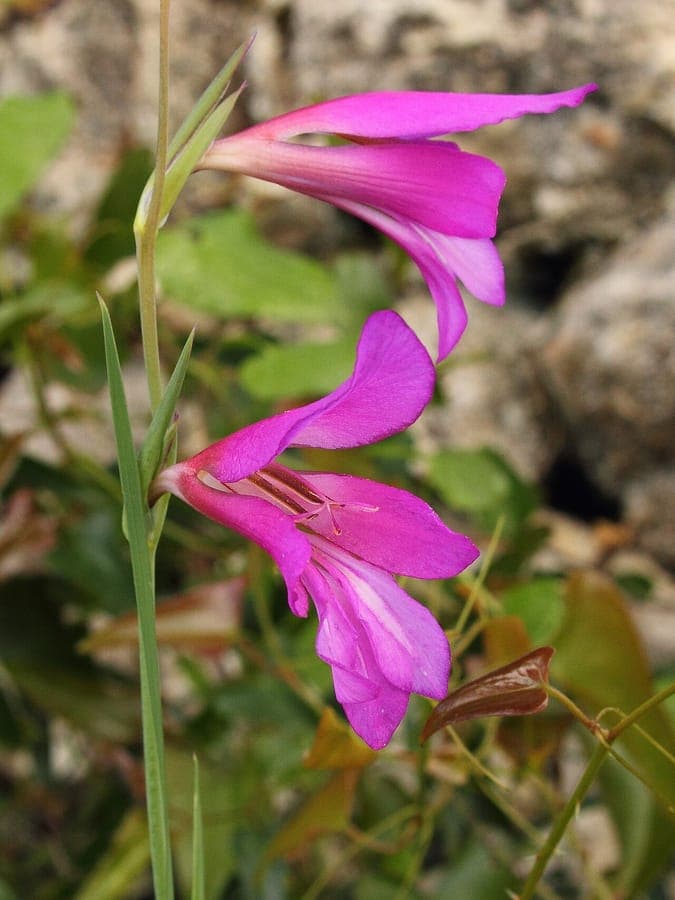
Luis nunes alberto / CC BY-SA 3.0, via Wikimedia Commons
Wild gladiolus: complete guide
Gladiolus illyricus
Want to see Wild gladiolus: complete guide in your garden?
1 minute, no credit card
Overview
Gladiolus illyricus, commonly known as the wild gladiolus, is a striking perennial bulb native to the Mediterranean basin. It thrives in regions like southern Italy, Greece, the Balearic Islands, and southern France. In temperate climates such as the UK and parts of northern Europe, it adapts well to sunny, well-drained spots. This species reaches heights of 60–90 cm and produces vivid purple flowers from April through July. It belongs to the Iridaceae family and is often found in rocky slopes, dry meadows, and open scrublands. Its resilience to dry conditions makes it a smart choice for low-water gardens.
On gardenworld.app, you can generate a custom planting plan that accounts for sun exposure and spacing, ideal for integrating Gladiolus illyricus into your garden design.
Appearance & bloom cycle
The plant features upright, sword-shaped leaves that are dark green and ribbed, forming a narrow clump. The flower spike emerges mid-spring, with buds opening progressively from the base upward. Blooms are a deep purple with subtle lighter veining, acting as nectar guides for pollinators. Each flower lasts about a week, and the sequential opening ensures a blooming period of up to ten weeks. The flowers have a faint, sweet scent, most noticeable in warm afternoons.
The bloom cycle typically starts in April in warmer zones (USDA 7–8), peaking in May and June, and tapering off in July. In cooler regions (USDA 6), flowering may start in late May. After blooming, seed capsules form and can be left to self-seed in suitable conditions, though this is slow and not always reliable.
Ideal location
This gladiolus demands full sun - around 8 out of 10 on the light scale. Aim for at least 6–8 hours of direct sunlight daily. It performs best in south-facing borders, rock gardens, or raised beds with excellent drainage. Avoid shady spots or areas prone to waterlogging. In containers, use terracotta pots with drainage holes and place them on sunny patios or balconies.
Gravel mulch helps reduce moisture retention and mimics its natural habitat. Consider using low stone walls or rock groupings to create microclimates. On gardenworld.app, use the seasonal sunlight tracker to pinpoint the best planting spot based on your garden's layout.
Soil requirements
Prefers light, sandy, or loamy soils with a pH of 7.0–7.5. Avoid acidic or heavy clay soils, which increase the risk of bulb rot. If your soil is dense, amend it with horticultural grit or coarse sand to improve drainage. Do not enrich the soil with compost or manure - this species evolved in nutrient-poor conditions, and too much fertility leads to lush foliage but fewer flowers.
Free design
Want to see Wild gladiolus: complete guide in your garden? Make a free design now.
Watering
Water moderately during active growth (March to July). Once a week is sufficient in dry spells, but let the soil dry between waterings. Reduce watering from August onward. During dormancy (October to February), the bulbs require almost no water, especially in well-drained soils. If growing in pots, move them to a sheltered spot during winter to prevent prolonged wetness.
Pruning
No pruning is needed. Allow the foliage to die back naturally - this process feeds the bulb for next year's growth. Cut the flower spike only after it has fully browned, leaving a 10 cm stub to avoid damaging the bulb. Never remove green leaves, as they are vital for energy storage.
Maintenance calendar
- Jan: Dormant, no action
- Feb: Check bulbs for rot, plant new corms from late February
- Mar: Plant corms 5–7 cm deep, start light watering
- Apr: Growth begins, watch for aphids, light moisture
- May: Bloom starts, no feeding
- Jun: Peak flowering, protect from strong winds
- Jul: Last blooms, seed heads form
- Aug: Reduce watering, let foliage yellow
- Sep: Soil dry, consider lifting corms in wet soils
- Oct: Dormancy begins, stop watering
- Nov: Keep dry, protect from persistent damp
- Dec: Dormant, store lifted corms at 5–10°C
Winter hardiness
Hardy in USDA zones 7–9. In zone 6, it may survive mild winters but risks bulb rot in wet conditions. In colder or wetter regions, lift corms in September and store in dry sand or peat at 5–10°C. In free-draining soils, mulch lightly with gravel or pine bark to shed moisture.
Companion plants
Pair with drought-tolerant perennials like Lavandula angustifolia, Salvia officinalis, or Eryngium variifolium. These share similar cultural needs. Add texture with low-growers like Sedum spurium or Achillea ptarmica. Avoid moisture-loving plants like Astilbe or Hosta, which create conflicting conditions.
Closing
Gladiolus illyricus brings vertical elegance and long-lasting colour to gardens with minimal effort. Its bold purple spikes contrast beautifully with silver-foliage plants and add drama to wildflower meadows. With proper siting and care, it can naturalise over time. Find planting inspiration and seasonal guides on gardenworld.app. Available at garden centres across the UK, especially from March onwards, or online through specialty bulb suppliers.
Want to see Wild gladiolus: complete guide in your garden? Make a free design now.
Upload a photo, pick a style, and get a photorealistic design with plant list in under a minute.
No credit card required


Similar plants
Iris tingitana: complete guide
Iris tingitana
Iris tingitana, the Morocco iris, is the bulb species behind the Dutch iris: early blue-violet blooms that need a sunny, well-drained position.
Iris hookeri: complete guide
Iris hookeri
Hooker's Iris is a compact North American native plant with blue flowers. Low-growing and moisture-loving water plant.
Siskiyou iris: complete guide
Iris bracteata
Complete guide to Iris bracteata, the Siskiyou iris: location, soil, bloom cycle, watering, pruning and companion plants for this rare Pacific Coast iris.