
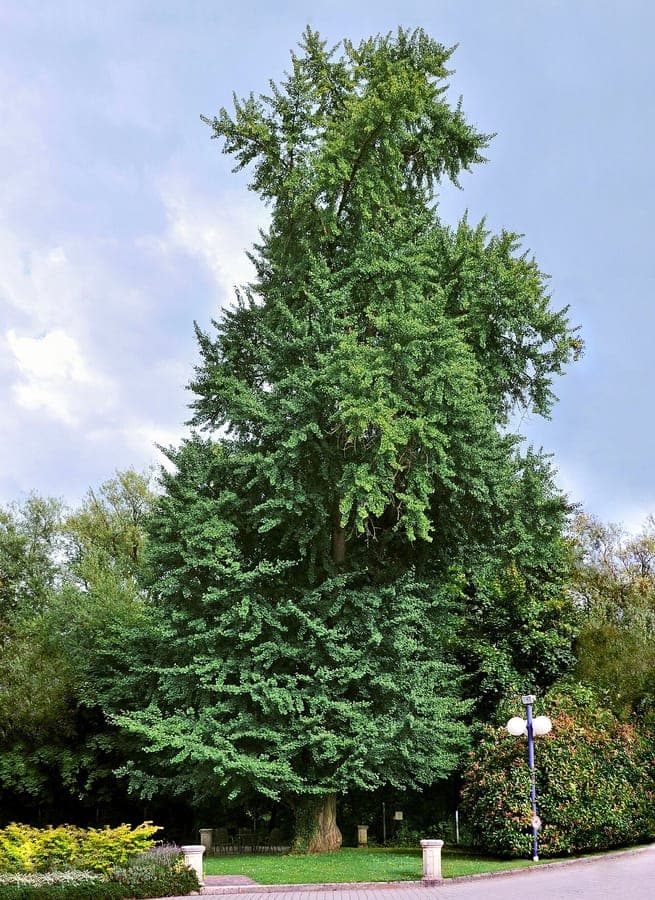
EecherplazGinkgo06.jpg: Cayambe derivative work: Ginkgotree (talk) / CC BY-SA 3.0, via Wikimedia Commons
Ginkgo: complete guide
Ginkgo biloba
Want to see Ginkgo: complete guide in your garden?
1 minute, no credit card
Overview
Ginkgo biloba, commonly known as ginkgo or maidenhair tree, stands as one of the most unique and ancient trees in cultivation. It's the last survivor of a prehistoric lineage, often called a 'living fossil'. Though commonly associated with Japan, the ginkgo is actually native to southeastern China, where wild populations are now rare. Thanks to its resilience and beauty, it's now grown worldwide in gardens, parks and urban landscapes.
In temperate climates like the UK and northern Europe, ginkgo grows slowly at first, gaining about 20–30 cm per year when young, then accelerating slightly with age. Mature trees reach 15–25 meters tall with a spread of 8–12 meters. They have a pyramidal shape when young, becoming broadly columnar or irregularly rounded over decades. Ginkgos are long-lived - some specimens in Asia are over 1,000 years old.
This tree is fully hardy to USDA zone 5 (-29°C) and tolerates city pollution, compacted soil and salt, making it ideal for urban gardens. On gardenworld.app, you can visualise how a ginkgo will mature in your space, including its eventual height and shade footprint.
Appearance & bloom cycle
The ginkgo's most striking feature is its fan-shaped leaves, which turn a brilliant, luminous yellow in autumn. The colour change is rapid and dramatic, usually occurring in late October. One day the tree is green, the next it's golden - and within 48 hours, the leaves may all drop at once, creating a bright yellow carpet below.
Ginkgo biloba is dioecious: individual trees are either male or female. Only female trees produce fruit, which ripens in autumn and emits a foul odour - often compared to rancid butter or vomit - due to butyric acid in the pulp. For this reason, nearly all ginkgos sold in garden centres are male clones like 'Autumn Gold' or 'Fastigiata'. The 'flowers' are inconspicuous and not true flowers; they're reproductive structures that appear in spring.
Ideal location
Plant your ginkgo in full sun to light shade. It thrives with at least 6 hours of direct sunlight daily. Full sun encourages denser growth and a more intense autumn display. Give it plenty of space - a mature ginkgo can spread widely, so keep it at least 4–5 meters from buildings, driveways or underground utilities.
It performs well in both rural and city gardens. Due to its pollution tolerance, it's often used in street planting. Consider the leaf fall: while not messy in a damaging way, the sudden drop can create a thick layer. Leaves break down quickly and can be left as mulch or composted. Use gardenworld.app to plan your ginkgo's placement, checking for root spread and seasonal shade patterns.
Free design
Want to see Ginkgo: complete guide in your garden? Make a free design now.
Soil requirements
Ginkgo biloba is adaptable to a wide range of soils, as long as drainage is good. It tolerates pH from 5.2 to 7.5 - acidic to slightly alkaline. It grows well in sandy, loamy or clay soils, but avoid waterlogged conditions. If planting in heavy clay, amend with coarse grit or organic matter to improve drainage.
No fertiliser is needed. Ginkgos evolved in nutrient-poor environments and can thrive without feeding. If you choose to fertilise young trees, use a slow-release organic option like compost or well-rotted manure in early spring. Over-fertilising, especially with nitrogen, leads to weak, sappy growth.
Watering
Young ginkgos need consistent watering for the first 2–3 years, especially during dry spells. Give 10–15 litres per week in summer if rainfall is low. Mulch around the base with bark chips to retain moisture and suppress weeds. Mature trees are highly drought-tolerant and rarely need supplemental watering.
Water deeply but infrequently to encourage deep root development. Avoid frequent light watering. In extreme droughts, even established trees may benefit from a deep soak once a month.
Pruning
Pruning is rarely necessary. Ginkgos naturally develop a strong central leader and balanced shape. Only remove dead, damaged or crossing branches, ideally in late winter (January–February) before bud break. Avoid heavy pruning - recovery is slow.
When shaping cultivars like 'Fastigiata', light formative pruning in winter can maintain a tight column. Note that ginkgos can produce epicormic shoots after cuts, so monitor the trunk for new sprouts. Remove them in summer if desired.
Maintenance calendar
- Jan–Feb: Inspect for damage; prune if needed
- Mar: Light organic feed for young trees
- Apr–May: Monitor new growth; no care required
- Jun–Aug: Check for drought stress; water young trees during dry periods
- Sep: Stop feeding; prepare for autumn
- Oct: Leaf drop - leave as mulch or rake up
- Nov–Dec: No maintenance; tree is dormant
Winter hardiness
Ginkgo biloba is hardy to USDA zone 5 (-29°C). It loses all leaves in autumn and remains dormant through winter. Young trees may suffer tip dieback in harsh winters but usually recover well. No winter protection is needed in most temperate regions. Mulching the base of very young trees in colder zones can help insulate roots.
Companion plants
Underplant with shallow-rooted, drought-tolerant species. Good choices include Heuchera, Sedum, Hellebores, Pachysandra or Anemone hupehensis. Avoid aggressive groundcovers that compete for water.
For formal gardens, pair with boxwood or cherry laurel. In a Japanese-style garden, combine with Fargesia bamboo, Japanese forest grass (Hakonechloa), or mosses for a serene effect.
Closing
The ginkgo is a low-maintenance, disease-resistant tree that delivers unmatched autumn colour and architectural presence. Choose a male cultivar to avoid smelly fruit, and plant it where it won't be crowded in 50 years. Young specimens (60–80 cm) are widely available at garden centres across the UK and Europe. With patience - and a quick check on gardenworld.app for spacing and design - your ginkgo will become a centrepiece for generations.
Want to see Ginkgo: complete guide in your garden? Make a free design now.
Upload a photo, pick a style, and get a photorealistic design with plant list in under a minute.
No credit card required


Similar plants
Acer pycnanthum: complete guide
Acer pycnanthum
Acer pycnanthum, the Japanese swamp maple, is a fast-growing tree with early red flowers and brilliant autumn color, ideal for damp garden settings.
Freeman maple: complete guide
Acer × freemanii
Everything about the Freeman maple (Acer x freemanii): a fast-growing shade tree with spectacular autumn colour for large gardens.
Silver vine: complete guide
Actinidia polygama
Discover silver vine (Actinidia polygama): a hardy climbing plant with silvery foliage, loved by gardeners and cats alike.