
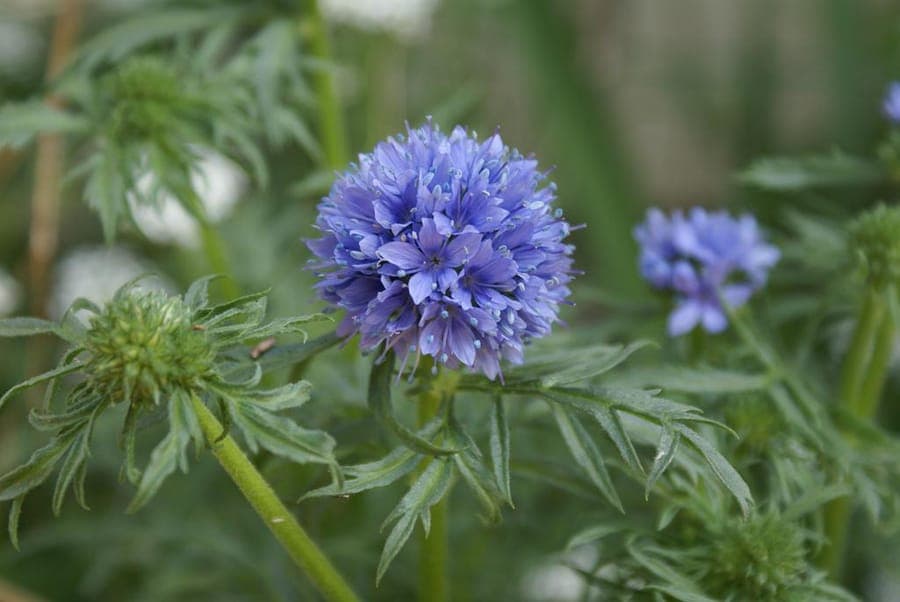
parande / CC BY-SA 3.0, via Wikimedia Commons
Blue thimble-flower: complete guide
Gilia capitata
Want to see Blue thimble-flower: complete guide in your garden?
1 minute, no credit card
Overview
Blue thimble-flower (Gilia capitata) is an annual forb in the Polemoniaceae family, native to dry meadows and open slopes from California to Washington. With its soft, pillow-like clusters of tiny bell-shaped flowers and finely divided foliage, it brings a touch of wild elegance to cottage gardens and pollinator borders. Growing 30–50 cm tall, this plant thrives in lean, well-drained soils and full sun, making it a smart pick for low-maintenance, water-wise landscapes.
I've used Blue thimble-flower in several front-yard designs where clients wanted colour without constant upkeep. It's one of those plants that looks intricate but asks for almost nothing in return. On gardenworld.app, you can map out a garden layout that highlights this species alongside other drought-tolerant annuals.
Appearance & bloom cycle
The bloom period runs from late June through September in most temperate zones. Plants begin flowering roughly 6–8 weeks after germination, so direct sowing in early to mid-spring (April–May) ensures a solid summer display. Each flower head is 3–5 cm wide, densely packed with dozens of small, tubular blooms in shades of sky blue, pale lavender, or near-white. The centre often has a soft yellow throat, adding subtle contrast.
Foliage is fern-like and delicate, forming a lacy base under the compact floral domes. The overall habit is bushy and mound-forming, ideal for the front or middle of borders. In favourable conditions, it self-seeds reliably, popping up in gravel paths or between pavers the following year. I've seen it reappear two seasons later with no intervention.
Ideal location
Full sun is non-negotiable. Aim for at least 6–8 hours of direct sunlight daily. In partial shade, stems stretch, flowering thins out, and the plant loses its tidy form. Choose open, airy spots with good air circulation to prevent mildew and fungal issues. It performs best in rock gardens, raised beds, or along dry retaining walls.
Avoid crowded planting schemes. Blue thimble-flower doesn't compete well with aggressive spreaders or tall perennials that shade it out. On gardenworld.app, you can preview sun exposure across your yard to find the best microclimate for this sun-loving annual.
Soil requirements
This plant prefers lean, fast-draining soil. Sandy or gravelly loam with a pH of 6.0–7.5 works best. Heavy clay soils must be amended with coarse sand or grit to improve drainage. Avoid rich compost or manure – excess fertility leads to leggy growth and fewer blooms.
The natural habitat of Gilia capitata includes rocky outcrops and disturbed soils, so mimic that: keep it poor, dry, and open. If your soil retains water, consider growing it in containers with a cactus mix.
Free design
Want to see Blue thimble-flower: complete guide in your garden? Make a free design now.
Watering
Once established, Blue thimble-flower is highly drought-tolerant. Water young seedlings regularly until they're 10–15 cm tall and well-rooted. After that, rely on rainfall except during prolonged dry spells (10+ days without rain). In such cases, a deep soak once a week is enough.
Overhead watering should be avoided – it encourages fungal diseases. Use a soaker hose or water at the base. In containers, check moisture by inserting a finger 2–3 cm into the soil; if dry, water lightly.
Pruning
Deadheading isn't required but extends bloom time by up to two weeks. Snip off spent flower heads with clean scissors to encourage new buds. If you want self-seeding, leave the last flush of flowers in late summer to set seed.
Staking isn't needed unless grown in overly rich soil or heavy shade, which causes weak stems.
Maintenance calendar
- Jan: No action
- Feb: No action
- Mar: Start seeds indoors at 18°C, 6–8 weeks before last frost
- Apr: Sow directly outdoors after last frost; keep soil moist until germination
- May: Thin seedlings to 20 cm apart; transplant if started indoors
- Jun: First blooms appear; begin deadheading
- Jul: Peak bloom; monitor for aphids or spider mites
- Aug: Continue bloom; water sparingly during drought
- Sep: Allow final flowers to set seed
- Oct: Collect seeds or let them scatter naturally
- Nov: Clear debris; avoid mulching over potential seedlings
- Dec: No action
Winter hardiness
As an annual, Blue thimble-flower doesn't survive winter. However, it often self-seeds if seed heads are left intact. In USDA zones 5–9, volunteer seedlings typically emerge in April–May. Don't use winter mulch – it traps moisture and can rot dormant seeds. In colder zones, collect seeds in autumn for spring sowing.
Companion plants
Pair Blue thimble-flower with other low-water annuals like Nemophila menziesii or Linum perenne. It complements silvery foliage plants such as Artemisia or Santolina. In pollinator gardens, it works well with yarrow (Achillea), coreopsis, and dwarf lavender.
Avoid pairing with heavy feeders or dense groundcovers that smother seedlings. In mixed borders, plant it in front of upright perennials like Echinacea or Salvia.
You'll find seeds at garden centres like those carrying Thompson & Morgan or local native seed suppliers. For visual planning, gardenworld.app helps you simulate companion plantings with accurate spacing and height data.
Closing
Blue thimble-flower earns its place in any sun-baked garden bed. It's not flashy, but it's dependable – a quiet performer that brings bees, butterflies, and soft colour without demanding attention. Sow it in spring, give it sun and space, and step back. It'll do the rest. And if you're designing a new border, check gardenworld.app to test how it fits with your existing plants.
Want to see Blue thimble-flower: complete guide in your garden? Make a free design now.
Upload a photo, pick a style, and get a photorealistic design with plant list in under a minute.
No credit card required


Similar plants
Phlox alyssifolia: complete guide to Alyssum-leaf Phlox
Phlox alyssifolia
Alyssum-leaf phlox is a compact alpine pink bloomer from North America. Discover care, location and all growing requirements.
Phlox richardsonii: complete guide to Richardson's Phlox
Phlox richardsonii
Richardson's phlox is an arctic bloomer exceptionally robust. Learn cultivation in extreme conditions and complete care guide.
Polemonium foliosissimum: complete guide
Polemonium foliosissimum
Polemonium foliosissimum is a vigorous Rocky Mountain perennial with blue-purple summer flowers that attract pollinators and thrive in borders.