
Didier Descouens / CC BY-SA 4.0, via Wikimedia Commons
Bennet's-root: complete guide
Geum urbanum
Want to see Bennet's-root: complete guide in your garden?
1 minute, no credit card
Overview
Geum urbanum, commonly known as Bennet's-root, is a resilient yet unassuming perennial that thrives in the quieter corners of the garden. Native to much of central and western Europe, including the UK, Belgium, and France, it naturally grows along woodland edges, hedgerows, and in open beech or oak forests. As a member of the Rosaceae family, it shares traits with other meadow and woodland flowers, but stands out with its long blooming season and aromatic roots.
This herbaceous plant reaches a height of 20 to 40 cm and spreads slowly via rhizomes, forming small clumps over time. It's fully winter hardy down to -20°C (USDA zone 5), making it a reliable choice for temperate gardens. The plant blooms from May through September, an impressively long window for a wildflower-type perennial.
On gardenworld.app you can design a planting scheme that integrates Bennet's-root with other shade-loving species like lungwort or foxglove for a naturalistic look.
Appearance & bloom cycle
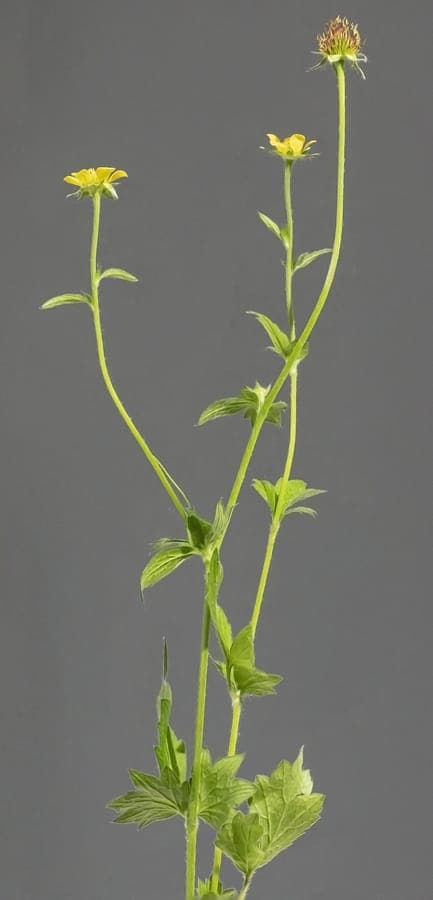
The flowers of Bennet's-root are small, about 1.5–2 cm across, with five bright yellow petals. They sit atop slender, hairy stems that rise above the foliage. Below each flower are reflexed green sepals, a key identification feature. The blooms are not flashy but have a quiet charm, especially when seen en masse in dappled light.
The leaves are basal, deeply lobed, and hand-shaped with 3–5 pointed segments. They're dark green, slightly hairy, and emit a faint clove-like or garlic scent when crushed-hence the name "nagelkruid" (nail herb) in Dutch, referring to the clove resemblance.
Flowering begins in late May and continues steadily through summer. Deadheading spent blooms encourages repeat flowering and extends the season into early autumn. In mild years, a few straggler flowers may appear into October.
Ideal location
Bennet's-root performs best in partial shade, scoring a 5 on the light scale (1–10). It likes dappled sunlight or morning sun with afternoon shade. Ideal spots include the edge of a deciduous woodland, beneath light-canopy shrubs, or in a north- or east-facing border.
Avoid hot, south-facing beds with full afternoon sun, as this leads to scorched leaves and stressed plants. Deep, dense shade will result in leggy growth and sparse flowering. A spot with 3–4 hours of gentle morning light is ideal.
Soil requirements
It prefers moist, well-drained loam or clay-loam with a pH between 6.5 and 7.0. While adaptable, it thrives in soil rich in organic matter. At planting time, mix in a generous amount of compost or well-rotted manure to boost fertility.
Mulch with 2–3 cm of leaf mould or composted bark in spring to retain moisture and suppress weeds. Avoid peat-based mulches due to environmental concerns and poor rewetting ability.
Free design
Want to see Bennet's-root: complete guide in your garden? Make a free design now.
Watering
Bennet's-root has moderate water needs. It dislikes drying out, especially during dry spells in June and July. Water deeply once a week during prolonged dry periods-about 10 litres per square metre.
Use rainwater when possible, particularly in areas with hard tap water. Over time, lime buildup can raise soil pH and affect growth. Avoid overhead watering in the evening to reduce the risk of fungal diseases.
Pruning
Pruning is minimal. Deadhead spent flowers regularly to encourage new blooms and prevent self-seeding, which can be modest but not aggressive. Cut back flower stems to just above a healthy leaf node.
In late autumn or early winter, cut back all remaining foliage to about 5 cm above ground level. This tidies the plant and reduces overwintering pests and diseases.
Maintenance calendar
- January: Check for frost heave; keep mulch layer intact.
- February: Clear debris; prepare soil for spring.
- March: Remove old leaves; lightly fork soil around plants.
- April: Apply compost; watch for emerging shoots.
- May: First flowers appear; begin deadheading.
- June – August: Maintain consistent moisture; deadhead weekly.
- September: Final blooms fade; stop deadheading.
- October: Cut back foliage; apply fresh mulch.
- November – December: Minimal care; protect young plants if exposed.
Winter hardiness
Fully hardy to USDA zone 5 (-20°C). The crown and roots survive winter dormancy with no protection in most gardens. A light mulch of leaf litter or compost helps insulate the base, especially in open or windy sites.
New growth emerges in March. Avoid heavy mulching that might smother new shoots.
Companion plants
Bennet's-root pairs well with other woodland perennials:
- Lungwort (Pulmonaria officinalis)
- Foxglove (Digitalis purpurea)
- Primrose (Primula vulgaris)
- Ferns (e.g., Dryopteris filix-mas)
- Bluebell (Hyacinthoides non-scripta)
Its yellow flowers contrast nicely with blue and purple tones. Use it as an understory plant beneath shrubs like hazel or dogwood.
For a cohesive planting plan, use gardenworld.app to visualise combinations that match bloom times, heights, and light needs.
Closing
Bennet's-root won't grab attention like a peony or delphinium, but it's a quietly dependable performer. With its long bloom season, ease of care, and adaptability to shade, it's a smart choice for naturalistic gardens. Plant it in a sheltered spot with fertile soil, give it a spring compost boost, and enjoy its cheerful yellow flowers year after year. Widely available at UK garden centres and online nurseries, it's an underrated gem worth trying.
Want to see Bennet's-root: complete guide in your garden? Make a free design now.
Upload a photo, pick a style, and get a photorealistic design with plant list in under a minute.
No credit card required


Similar plants
Siberian crab apple: complete guide
Malus x robusta
Complete guide to the Siberian crab apple (Malus x robusta): location, soil, pruning, winter hardiness and the best companion plants for your garden.
Chinese flowering crabapple (Malus x spectabilis): complete guide
Malus x spectabilis
Meet the Chinese flowering crabapple (Malus x spectabilis): a classic spring bloomer with carmine buds and pink blossom.
Potentilla crassinervia: complete guide
Potentilla crassinervia
Potentilla crassinervia, the Corsican cinquefoil, grows wild on Corsica and Sardinia's peaks. Discover how to grow this hardy alpine rock garden gem.