
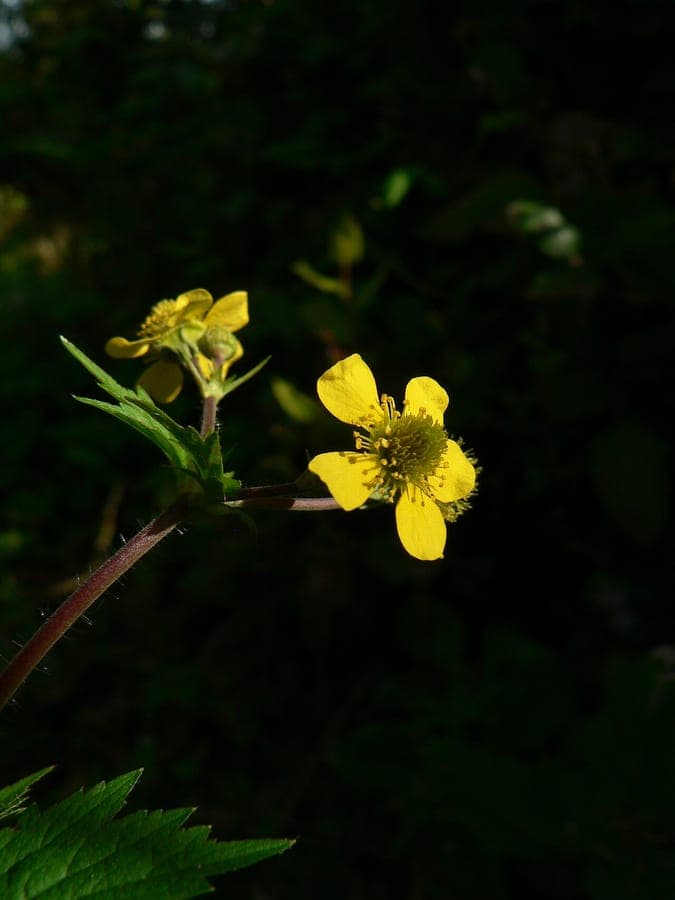
Walter Siegmund / CC BY 2.5, via Wikimedia Commons
Big-leaf avens: complete guide
Geum macrophyllum
Want to see Big-leaf avens: complete guide in your garden?
1 minute, no credit card
Overview
Big-leaf avens (Geum macrophyllum) is a dependable yet underrated perennial that brings quiet charm to naturalistic planting schemes. Native to cool temperate zones across North America and parts of East Asia - including British Columbia, Alaska, and Japan - this member of the Rosaceae family thrives in woodland margins and moist, partly shaded areas. It forms a neat clump of lush green foliage, reaching 30–50 cm in height and spreading 30–40 cm wide. Hardy in USDA zones 5 to 8, it's perfectly suited to UK, Pacific Northwest, and northeastern US gardens. Its modest presence belies its resilience: it tolerates light foot traffic, resists most pests, and requires minimal care once established.
On gardenworld.app, you can map your garden's light patterns to find the ideal spot for Big-leaf avens, especially in dappled or partial shade.
Appearance & bloom cycle
The standout feature of Geum macrophyllum is its large, deeply lobed leaves, which are palmate and softly hairy on the underside. These basal leaves form a low rosette, staying green through much of the year and turning a soft bronze in autumn. From late May through June, wiry, hairy stems rise above the foliage to hold up to 20 bright yellow flowers per plant. Each bloom is about 2–3 cm across, with five rounded petals and a cluster of golden stamens. The flowers are held singly or in loose cymes and attract native bees and hoverflies. After blooming, the seed heads develop hooked styles that cling to animal fur - a clever natural dispersal method.
By late summer, the plant focuses on leaf regeneration, and by September, small new rosettes may appear around the parent plant, indicating gentle self-seeding.
Ideal location
Big-leaf avens prefers partial to full shade, especially in warmer climates (zones 7–8). In cooler areas (zones 5–6), it can handle morning sun as long as afternoon shade is provided. Avoid hot, south-facing spots with reflected heat. It performs best under deciduous trees like maples or birches, where it gets early spring light before canopy closure. It's also well-suited to north-facing borders, shaded rock gardens, or under open shrubs like Ribes or Philadelphus.
Avoid planting in dry, compacted soil beneath dense evergreens. The combination of shade and root competition will stunt growth. Use gardenworld.app to visualize microclimates and shade gradients when planning your layout.
Soil requirements
This plant grows best in moist, well-drained soil rich in organic matter. Ideal pH ranges from 5.0 to 7.0 - slightly acidic to neutral. Heavy clay soils should be amended with leaf mould or composted bark to improve drainage. Sandy soils benefit from added humus or compost to retain moisture. While adaptable, Geum macrophyllum does not tolerate drought or waterlogged conditions. Avoid high-nitrogen fertilizers; they promote weak, leggy growth and reduce flowering.
Free design
Want to see Big-leaf avens: complete guide in your garden? Make a free design now.
Watering
During the first growing season, water weekly if rainfall is below 2.5 cm. Once established, it relies mostly on natural rainfall but appreciates supplemental watering during prolonged dry spells (over 14 days without rain). Water at the base to prevent foliar diseases like powdery mildew. In containers, check soil moisture every 3–4 days in summer; potted plants dry out faster and may need watering twice a week.
Pruning
Pruning is minimal. After flowering finishes in late June, cut back spent flower stems to just above the leaf rosette to maintain tidiness and prevent excessive self-seeding. In early spring (March in zone 6), remove any tattered or winter-damaged leaves with clean snips. Do not cut back the entire plant unless foliage is heavily diseased.
Maintenance calendar
- January: Check for vole damage; no pruning or feeding.
- February: Clear debris; prepare tools for spring.
- March: Trim old foliage; apply 2.5 cm of compost around the base.
- April: Monitor for slugs; water during dry spells.
- May: Flowers emerge; watch for aphids on new growth.
- June: Peak bloom; deadhead after flowering.
- July: Let plant rest; water only if dry.
- August: Watch for seedlings; transplant if desired.
- September: No feeding; reduce watering.
- October: Rake away fallen leaves; avoid smothering crowns.
- November: Leave foliage for winter protection.
- December: Final check; protect container plants from freeze-thaw cycles.
Winter hardiness
Big-leaf avens is reliably hardy in USDA zones 5–8. It retains semi-evergreen foliage in milder winters (zones 6–8), while in colder zones, leaves may die back but re-emerge in spring. No mulch is required in-ground, but potted plants should be moved to a sheltered area or wrapped with burlap to protect roots from repeated freezing.
Companion plants
Pair with other shade-tolerant perennials like Tiarella cordifolia, Heuchera, or ferns such as Athyrium niponicum. It works well in woodland schemes alongside Epimedium, Pulmonaria, and Trillium. The yellow flowers contrast beautifully with blue-flowering Brunnera or purple Ajuga. Avoid invasive ground covers like Vinca minor, which can overwhelm its slow spread.
Closing
Big-leaf avens is a quiet achiever in the shade garden - not flashy, but dependable, long-lived, and ecologically valuable. It fills gaps with grace and blooms when few other shade plants do. Nursery-propagated plants are available in spring at garden centres across the UK and US. Look for healthy rosettes in 1-litre pots at retailers like Sainsbury's Garden Centres, Home Depot, or local independents. Because it's not always widely stocked, consider ordering from specialist nurseries online. Once planted in the right conditions, it asks for little and gives back for years.
Want to see Big-leaf avens: complete guide in your garden? Make a free design now.
Upload a photo, pick a style, and get a photorealistic design with plant list in under a minute.
No credit card required


Similar plants
Siberian crab apple: complete guide
Malus x robusta
Complete guide to the Siberian crab apple (Malus x robusta): location, soil, pruning, winter hardiness and the best companion plants for your garden.
Chinese flowering crabapple (Malus x spectabilis): complete guide
Malus x spectabilis
Meet the Chinese flowering crabapple (Malus x spectabilis): a classic spring bloomer with carmine buds and pink blossom.
Potentilla crassinervia: complete guide
Potentilla crassinervia
Potentilla crassinervia, the Corsican cinquefoil, grows wild on Corsica and Sardinia's peaks. Discover how to grow this hardy alpine rock garden gem.