
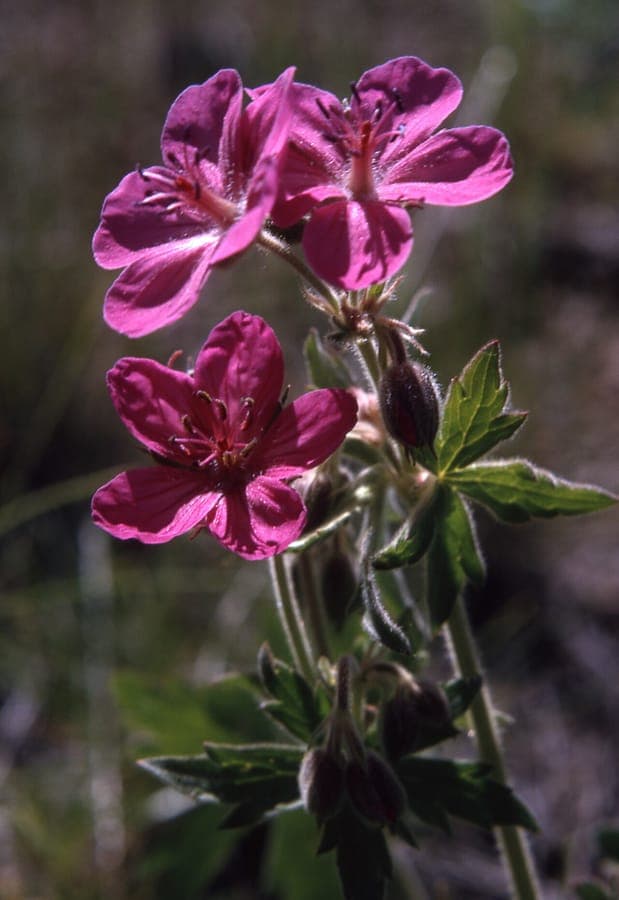
RG Johnsson / Public domain, via Wikimedia Commons
Sticky geranium: complete guide
Geranium viscosissimum
Want to see Sticky geranium: complete guide in your garden?
1 minute, no credit card
Overview
Sticky geranium (Geranium viscosissimum), also known as sticky purple geranium or purple cranesbill, is an elegant flowering herb from the Geraniaceae family native to western North America from Canada through the western United States. This native wildflower stands out for its purple flowers and sticky, scented leaves. The plant naturally grows in mountain meadows and open forest edges at varying elevations. With its attractive flowers, long bloom period, and adaptation to dry conditions, sticky geranium offers an excellent choice for native plant gardens and wildflower borders.
Appearance and bloom
Sticky geranium grows as an upright, loosely-branched plant, usually 40-80 cm tall. The stems are red-tinged and covered with sticky hairs giving the plant its name. The leaves are deeply lobed to nearly palmate, 5-10 cm wide, with rough texture. The leaves emit a pleasant fragrance when touched. The flowers are the highlight: approximately 2-3 cm diameter, in shades of pink to purple, with distinct dark veins. The flowering period extends from May through July, sometimes into August. After bloom, characteristic elongated seed pods (cranesbills) develop, providing bird food throughout fall.
Ideal location
Select a sunny to lightly shaded spot for sticky geranium. At least 4-6 hours of direct sunlight daily is ideal, though the plant tolerates up to 8 hours of shade. In very warm climates, light afternoon shade is beneficial. Do not protect from wind; this plant naturally grows in exposed mountain meadows. This is a herb that adapts to diverse light situations, but blooms best in full sun to lightly shaded locations. Plant in an airy location with good air circulation.
Soil
Sticky geranium grows on diverse soils but prefers well-drained, moderately dry to moderately moist soil. pH can be neutral to slightly acidic. This plant is not particular about soil quality and thrives on lean soils. Good drainage is essential; waterlogging can be harmful. In very heavy clay soils, work in sand and gravel for improvement. Organic matter (humus) helps in early years but is not essential once established.
Free design
Want to see Sticky geranium: complete guide in your garden? Make a free design now.
Watering
Water regularly during the first growing season (May through June) until the plant is well-rooted. Apply approximately 2-3 cm of water weekly or when the top 3 cm feels dry. Once established, this plant is very drought-tolerant and requires minimal supplemental watering. Dry summers pose no problem. Winter: no watering needed. This is a plant that tolerates reasonable drought once established.
Pruning
Minimal pruning is required. After bloom, you may remove spent flower heads to keep the plant more compact. Dead leaf material can be removed in fall/winter. If the plant has damaged parts, remove these. This is a plant you can largely leave alone. Sometimes plants self-sow, producing extra plants.
Maintenance calendar
April-May: Leaf emergence, preparation for bloom. May-July: Flowering period, regular watering. August-September: Seed setting, reduce watering. October-March: Winter dormancy, no maintenance. Year-round: Remove dead leaves, inspect for damage.
Winter hardiness
Sticky geranium is extremely hardy to USDA zones 3-4. This is a native plant that tolerates harsh North American winters without protection. No winter protection needed in temperate to cold climates. This is a very robust plant for cold regions. In very warm climates, this plant may struggle with extreme heat; provide shade and regular watering.
Companion plants
Sticky geranium combines well with other native plants and wildflowers: coneflowers, sage, lupine, Indian paintbrush, and drought-tolerant grasses. Small shrubs like Oregon grape and serviceberry are excellent neighbors. This is a plant for native plant garden schemes. In mixed borders, it also works well with other Geranium species and flowering herbs.
Closing thoughts
Sticky geranium is a valuable native herb for North American gardens, especially in mountain and western regions. The attractive purple flowers, long bloom period, and extreme winter hardiness make it valuable. This is not a plant for very warm, dry desert climates, but ideal for temperate to cold North American zones. Start with seed or young plants and provide regular watering the first year; you will see a flowering herb develop that provides bird food and beauty for years.
Want to see Sticky geranium: complete guide in your garden? Make a free design now.
Upload a photo, pick a style, and get a photorealistic design with plant list in under a minute.
No credit card required


Similar plants
Pelargonium acetosum: complete guide
Pelargonium acetosum
Discover the Sorrel-leaf Geranium: a South African plant with aromatic foliage. Perfect for containers and warm locations. Learn cultivation and care.
Erodium foetidum: complete guide
Erodium foetidum
Rock stork's-bill is a delicate alpine plant with purple flowers and fine foliage. Learn how to grow this Mediterranean charmer in your front garden.
Pelargonium crithmifolium: complete guide
Pelargonium crithmifolium
Discover Samphire-leaf pelargonium: an exotic South African geranium with distinctive foliage. Growing tips, care advice and garden inspiration.