
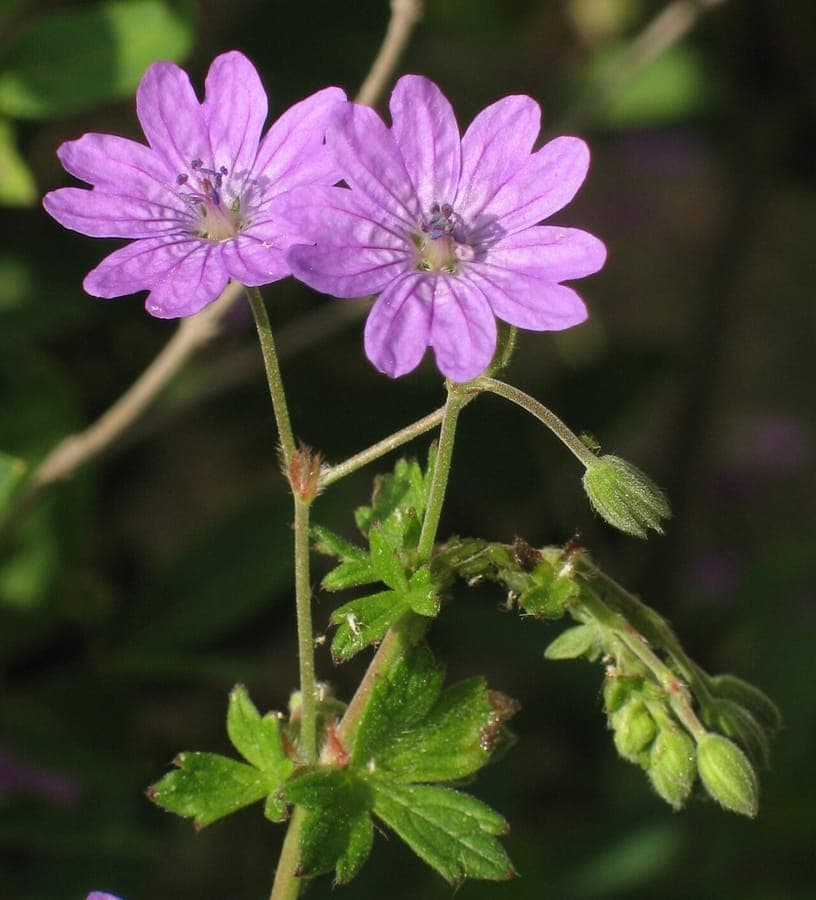
Robert Flogaus-Faust / CC BY 4.0, via Wikimedia Commons
Hedgerow crane's-bill: complete guide
Geranium pyrenaicum
Want to see Hedgerow crane's-bill: complete guide in your garden?
1 minute, no credit card
Overview
Hedgerow crane's-bill (Geranium pyrenaicum) is a graceful, clump-forming perennial that thrives along woodland edges, cottage borders, and sunny to semi-shaded garden spots. Native to regions across central and southern Europe - including France, Austria, and Greece - this member of the Geraniaceae family adapts well to UK and North American gardens, particularly in USDA hardiness zones 5 to 8. It's a reliable performer, offering both visual appeal and resilience with minimal fuss.
What sets this geranium apart is its steady, non-invasive spread through rhizomes. It forms a lush, weed-suppressing ground cover without choking out neighbours. The plant stays semi-evergreen in milder climates, holding onto its foliage through winter. If you're planning a new border, gardenworld.app lets you design a layout where Hedgerow crane's-bill fits seamlessly with other mid-height perennials.
Appearance & bloom cycle
Hedgerow crane's-bill reaches 30–50 cm in height and spreads about 40 cm wide. Its deeply lobed, palmate leaves emerge fresh green in spring and turn warm yellow-brown in autumn. The flowers - soft pink to pale purple, around 2–2.5 cm across - bloom from June through August, sometimes into September if deadheaded or cut back.
Each bloom has five notched petals with dark veining, and a prominent central style resembling a stork's bill, which gives the plant its common name. The flowering period bridges the gap between late tulips and early asters, making it ideal for extending seasonal interest in mixed borders.
Ideal location
This geranium performs best in partial sun to light shade, scoring a 7 on the light scale (1–10), meaning it needs 5–6 hours of direct sunlight daily. A spot with morning sun and afternoon dappled shade works perfectly, especially in hotter climates. In cooler zones, it can handle more direct sun.
Avoid deep shade, where flowering diminishes and stems become leggy. In full sun on sandy soils, monitor moisture carefully. When designing your planting scheme, gardenworld.app helps you assess sun exposure throughout the day so you can place Hedgerow crane's-bill exactly where it'll thrive.
Soil requirements
Geranium pyrenaicum prefers well-drained, moderately fertile soil with a pH between 7.0 and 7.5 - neutral to slightly alkaline. Acidic soils below pH 6.5 may cause yellowing leaves and poor growth. If needed, amend with a light dusting of garden lime, but avoid over-application.
The soil can be loamy, sandy, or clay-loam as long as it doesn't stay waterlogged. Standing water promotes root rot. At planting, mix in compost or aged manure to improve structure. Don't over-fertilise with nitrogen - it encourages leafy growth at the expense of blooms.
Free design
Want to see Hedgerow crane's-bill: complete guide in your garden? Make a free design now.
Watering
Young plants need consistent moisture in their first growing season (April–June). Once established, they're fairly drought-tolerant. During prolonged dry spells, water once a week, focusing on the base to prevent fungal issues.
Rainwater is ideal; tap water with high lime content can affect soil pH over time. In containers, check moisture regularly - pots dry out faster. Avoid overhead watering, especially in humid conditions.
Pruning
After the main flush of flowers in July, cut the plant back by half. This encourages fresh foliage and often triggers a second, lighter bloom in late summer. Use clean, sharp shears and cut just above a leaf node.
Leave the foliage intact over winter unless it's heavily damaged. The old leaves insulate the crown and protect the roots. In early spring (February–March), remove any tattered growth to make room for new shoots.
Maintenance calendar
- January: Check for winter damage; remove severely damaged leaves.
- February: Clear away old foliage; keep the crown uncluttered.
- March: Apply a thin layer of compost or organic fertiliser.
- April: Monitor new growth; water during dry spells.
- May: Keep soil moist; watch for slugs.
- June–August: Primary flowering period; water during drought.
- July–August: Cut back by half for rebloom.
- September: Reduce watering; let plant prepare for dormancy.
- October–December: Leave foliage; no feeding.
Winter hardiness
Hedgerow crane's-bill is hardy in USDA zones 5–8. In the UK and most of the US, it remains outdoors year-round. Foliage often persists through winter, especially in milder regions. In harsh winters, top growth may die back, but the rhizomes survive and re-sprout in spring.
Mulching isn't essential, but a light layer of compost or leaf mould in December helps on sandy or exposed sites. Avoid thick, impermeable mulches that trap moisture.
Companion plants
This geranium pairs beautifully with Allium 'Purple Sensation', Nepeta, Salvia, and Lavandula. Its soft pink blooms complement purple, blue, and white hues. It also works well alongside ferns, Hellebores, and Hostas in shadier corners.
Avoid aggressive ground covers like ivy or mint that could overwhelm it. Plant in groups of 3–5 for a naturalistic effect. It's excellent for softening edges and filling gaps between shrubs.
Closing
Hedgerow crane's-bill is a low-maintenance, high-reward plant that earns its place in any garden. With a long bloom time, attractive foliage, and excellent adaptability, it's a go-to for both novice and experienced gardeners. You'll find it at garden centres across the UK and North America, often near other hardy perennials.
Whether you're revamping a border or starting a new wildlife-friendly garden, this geranium delivers. And with gardenworld.app, you can easily visualise spacing and companion pairings before you plant.
Want to see Hedgerow crane's-bill: complete guide in your garden? Make a free design now.
Upload a photo, pick a style, and get a photorealistic design with plant list in under a minute.
No credit card required


Similar plants
Pelargonium acetosum: complete guide
Pelargonium acetosum
Discover the Sorrel-leaf Geranium: a South African plant with aromatic foliage. Perfect for containers and warm locations. Learn cultivation and care.
Erodium foetidum: complete guide
Erodium foetidum
Rock stork's-bill is a delicate alpine plant with purple flowers and fine foliage. Learn how to grow this Mediterranean charmer in your front garden.
Pelargonium crithmifolium: complete guide
Pelargonium crithmifolium
Discover Samphire-leaf pelargonium: an exotic South African geranium with distinctive foliage. Growing tips, care advice and garden inspiration.