
Hectonichus / CC BY-SA 3.0, via Wikimedia Commons
Knotted crane's-bill: complete guide
Geranium nodosum
Want to see Knotted crane's-bill: complete guide in your garden?
1 minute, no credit card
Overview
Geranium nodosum, commonly known as knotted crane's-bill, is a dependable, creeping perennial that thrives in shaded corners and understorey plantings. Native to southern Europe - particularly Corsica, France, Italy, Spain, and former Yugoslavia - it adapts well to temperate climates, including the UK and northern Europe. In the garden, it forms a neat, spreading mound that stays in place without becoming invasive, making it ideal for gardeners who want structure and control.
What sets this geranium apart is its resilience. It rarely suffers from pests or diseases, handles moderate foot traffic, and blooms for five full months. It's a quiet achiever - not flashy, but always reliable. You can use gardenworld.app to design a shade border where Geranium nodosum complements ferns and hostas with soft texture and steady colour.
Appearance & bloom cycle
This plant reaches 30–45 cm in height, with a spread of up to 50 cm. The stems are distinctly knotted at the joints - hence the name 'nodosum' - and carry deeply lobed, palmate leaves resembling those of sanicle. The foliage is fresh green, slightly glossy, and remains attractive all season.
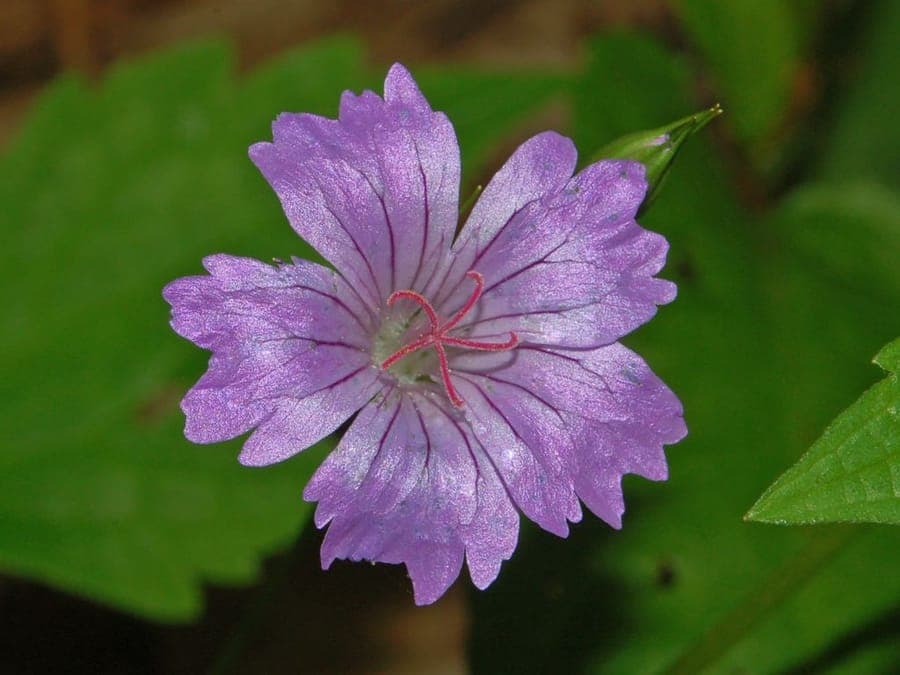
From May to September, it produces small, saucer-shaped purple flowers, usually in groups of two or three. Each bloom is about 2 cm across, with a deeper purple vein pattern and a subtle magenta flush at the centre. After flowering, the seed pods develop into long, beak-like structures typical of geraniums, adding visual interest into autumn.
Ideal location
Knotted crane's-bill prefers partial shade, scoring around 4/10 on the light scale. It does best under light tree canopies, on north- or east-facing banks, or at the base of shrubs like hydrangeas or rhododendrons. It tolerates morning sun but should be protected from harsh afternoon rays, especially in warmer regions.
Full sun can lead to scorched leaves and reduced flowering. If your garden has dappled shade, this is the perfect candidate. Use gardenworld.app to map out a planting scheme where Geranium nodosum fills in gaps beneath taller perennials without overcrowding.
Soil requirements
It grows well in average, well-drained soil with a pH between 7.0 and 7.5. While it prefers humus-rich, moisture-retentive ground, it adapts to poorer soils as long as they don't dry out completely. Avoid waterlogged areas, particularly in winter, as this can cause root rot.
Clay soils benefit from added grit or compost to improve drainage. Sandy soils may need extra organic matter to retain moisture. A mulch of leaf mould in spring helps maintain both moisture and root protection.
Free design
Want to see Knotted crane's-bill: complete guide in your garden? Make a free design now.
Watering
During active growth (April to September), water regularly but moderately. Check the soil weekly - if the top 2–3 cm feel dry, it's time to water. In hot, dry spells, increase frequency to twice a week, especially in shaded areas where evaporation is slower but air circulation is poor.
Established plants show decent drought tolerance, but young ones need consistent moisture in their first year. Use rainwater if possible, especially on alkaline soils, to prevent lime buildup.
Pruning
Minimal pruning is required. After the peak bloom in August, deadhead spent stems just above a leaf node to encourage a second flush in September. This keeps the plant tidy and extends flowering.
In late autumn or early winter, cut back all remaining foliage to about 5 cm above ground level. This reduces the risk of fungal diseases overwintering in old leaves and gives the bed a clean look.
Maintenance calendar
- Jan: No action needed; plant dormant
- Feb: Check for early shoots; remove any winter debris
- Mar: Clear old foliage; apply a thin layer of compost
- Apr: Begin regular watering; watch for slugs
- May: Flowers appear; ensure soil stays moist
- Jun: Peak bloom; optional feed with liquid organic fertiliser
- Jul: Continue watering during dry spells
- Aug: Deadhead to promote late flowering
- Sep: Final flowering month; reduce watering gradually
- Oct: Cut back dead stems; leave soil undisturbed
- Nov: Protect roots with leaf litter if in exposed areas
- Dec: Dormant period; avoid disturbing soil
Winter hardiness
Geranium nodosum is hardy down to -15 °C (USDA zone 7). It survives most UK and northern European winters without protection. In colder zones or exposed sites, a light mulch of straw or leaves can help insulate the crown.
The plant dies back to ground level in winter and re-emerges strongly in spring. Don't panic if it seems slow - new growth often appears as late as mid-April.
Companion plants
This geranium pairs well with other shade-loving perennials:
- Hosta (for bold foliage contrast)
- Lamium maculatum (for silver-veined leaves)
- Athyrium filix-femina (for feathery texture)
- Pulmonaria (for early spring colour)
- Alchemilla mollis (for soft yellow highlights)
These combinations can be previewed using the garden planner on gardenworld.app, where you can visualise spacing and seasonal flow.
Closing
Geranium nodosum is a quiet powerhouse in the shade garden. It delivers long-lasting blooms, minimal upkeep, and blends seamlessly into naturalistic designs. Whether you're filling a corner under a tree or softening a north-facing border, it does the job with grace.
Find it at garden centres across the UK, or order online from trusted suppliers. When planning your layout, remember that spacing matters - allow 40–50 cm between plants. For help designing your ideal planting scheme, try the tools on gardenworld.app, where you can simulate growth and bloom patterns over time.
Want to see Knotted crane's-bill: complete guide in your garden? Make a free design now.
Upload a photo, pick a style, and get a photorealistic design with plant list in under a minute.
No credit card required


Similar plants
Pelargonium acetosum: complete guide
Pelargonium acetosum
Discover the Sorrel-leaf Geranium: a South African plant with aromatic foliage. Perfect for containers and warm locations. Learn cultivation and care.
Erodium foetidum: complete guide
Erodium foetidum
Rock stork's-bill is a delicate alpine plant with purple flowers and fine foliage. Learn how to grow this Mediterranean charmer in your front garden.
Pelargonium crithmifolium: complete guide
Pelargonium crithmifolium
Discover Samphire-leaf pelargonium: an exotic South African geranium with distinctive foliage. Growing tips, care advice and garden inspiration.