
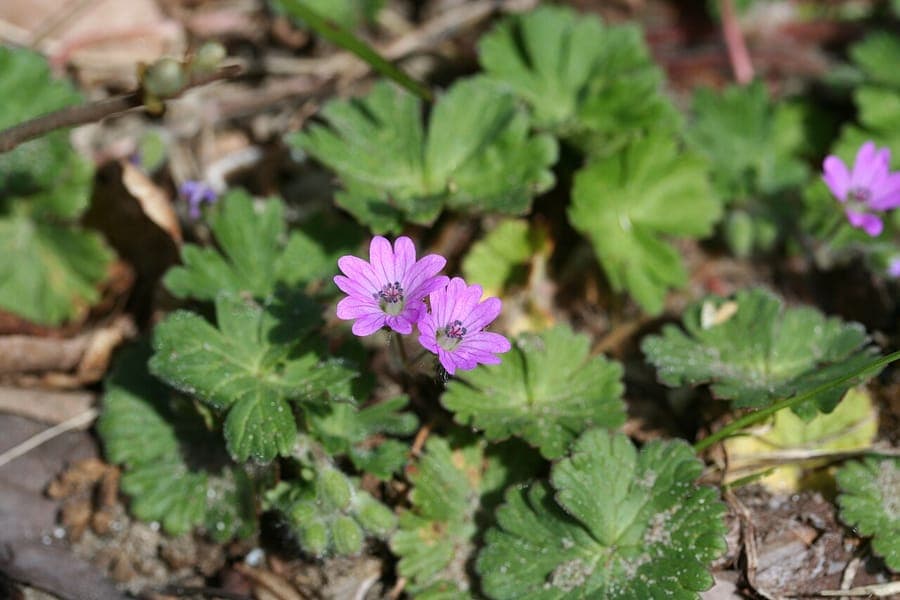
No machine-readable author provided. Svdmolen assumed (based on copyright claims). / CC BY 2.5, via Wikimedia Commons
Wild geranium: complete guide
Geranium molle
Want to see Wild geranium: complete guide in your garden?
1 minute, no credit card
Overview
Wild geranium (Geranium molle) might not dominate the border, but it earns its place with quiet resilience. Native across much of Europe, this perennial thrives in woodlands, hedgerows, and open grasslands where conditions are moist but well-drained. It's a compact spreader, forming soft mounds of foliage that slowly expand through self-seeding-never aggressively, always considerately. For gardeners seeking understated elegance and reliable performance in tricky spots, this is a go-to plant.
On gardenworld.app, you can design a border scheme where Wild geranium complements taller woodland species and blends seamlessly into naturalistic plantings.
Appearance & bloom cycle
Wild geranium reaches 15–30 cm in height and spreads to about 25 cm wide. The deeply lobed, kidney-shaped leaves are soft to the touch and lightly hairy, giving the plant its 'molle' (soft) name. From late spring to midsummer-typically May through July-it produces delicate pink to pale magenta flowers, each about 1 cm across, held on slender stalks. The blooms have distinct veining, adding depth and charm to the display.
After flowering, the seed pods form the classic geranium 'crane's bill' shape, which dramatically twist open when dry to fling seeds a short distance. This feature adds late-season interest and supports natural regeneration in the garden.
Ideal location
This geranium prefers partial to full shade, making it ideal for planting under deciduous trees, along shaded borders, or as an understory in mixed perennial beds. While it tolerates full sun, especially in cooler climates, it will require consistent moisture to prevent leaf scorch and premature dieback. The sweet spot is dappled light-enough to support flowering, but sheltered from the harsh midday sun.
Mass it under shrubs or weave it through ferns and hostas for a layered, woodland feel. It works especially well in cottage gardens and naturalised areas.
Soil requirements
Grow Wild geranium in moist, well-drained loam or clay-loam soils. It copes with average fertility but performs poorly in nutrient-poor sands or waterlogged clay. Improve sandy soils with compost or leaf mould to boost water retention. A slightly acidic to neutral pH (5.8–7.0) is ideal. Avoid heavy mulching with bark-this can smother the shallow roots. Instead, use a light layer of leaf litter, which mimics its natural forest floor habitat.
Free design
Want to see Wild geranium: complete guide in your garden? Make a free design now.
Watering
Moderate watering is sufficient. Young plants need weekly watering during dry springs, but established clumps are fairly drought-tolerant once rooted. Still, they flower best and stay greener longer when soil moisture remains consistent. Water at the base to protect foliage from fungal issues. In prolonged dry spells, give a deep soak every 7–10 days.
Pruning
Minimal pruning required. After flowering fades in late summer, shear the plant back by about half to encourage fresh foliage and possibly a light second flush. Avoid cutting into old wood-this species regrows from leaf nodes, not bare stems. Use clean shears and tidy up any ragged growth to keep the patch looking neat.
Maintenance calendar
- Jan: Check for winter damage; remove any collapsed foliage.
- Feb: Plant new divisions or seedlings in prepared beds.
- Mar: Clear away winter debris to allow new growth to emerge.
- Apr: Apply a thin compost top-dress to support early growth.
- May: Bloom begins; monitor for slugs on young leaves.
- Jun: Peak flowering; enjoy pollinators visiting the blooms.
- Jul: Trim back after bloom; watch for seed dispersal.
- Aug: Allow seed heads to mature if self-sowing is desired.
- Sep: Natural seedlings may appear; transplant if needed.
- Oct: Leave spent foliage for winter texture.
- Nov: Minimal care; plant remains semi-evergreen in milder zones.
- Dec: Inspect for slug activity; avoid wet mulch in cold months.
Winter hardiness
Wild geranium is reliably hardy in USDA zones 6–8, surviving temperatures down to -20°C. In zone 9, it may struggle with summer heat unless planted in deep shade. Foliage often persists through winter in milder regions, providing subtle green structure. No winter protection is needed, even in harsher zone 6 gardens.
Companion plants
Pair Wild geranium with hostas, ferns, pulmonarias, or epimediums for a shade-rich planting scheme. It contrasts beautifully with the bold texture of ligularia or the fine leaves of maidenhair fern. Combine with spring bulbs like daffodils or bluebells-the geranium foliage fills in as the bulbs fade. Avoid pairing with vigorous spreaders like mint or bishop's weed.
Using gardenworld.app, you can preview how Wild geranium integrates with companion plants in your garden layout before planting.
Closing
Wild geranium isn't flashy, but it's dependable. It covers ground gently, blooms with quiet charm, and asks for little in return. Perfect for beginners or those tired of high-maintenance borders. It's widely available at garden centres across the UK and Ireland, especially in native plant sections. Look for it at local independents or larger chains. Try it under a hawthorn or in a forgotten corner-it might just become your favourite understory performer.
Want to see Wild geranium: complete guide in your garden? Make a free design now.
Upload a photo, pick a style, and get a photorealistic design with plant list in under a minute.
No credit card required


Similar plants
Pelargonium acetosum: complete guide
Pelargonium acetosum
Discover the Sorrel-leaf Geranium: a South African plant with aromatic foliage. Perfect for containers and warm locations. Learn cultivation and care.
Erodium foetidum: complete guide
Erodium foetidum
Rock stork's-bill is a delicate alpine plant with purple flowers and fine foliage. Learn how to grow this Mediterranean charmer in your front garden.
Pelargonium crithmifolium: complete guide
Pelargonium crithmifolium
Discover Samphire-leaf pelargonium: an exotic South African geranium with distinctive foliage. Growing tips, care advice and garden inspiration.