
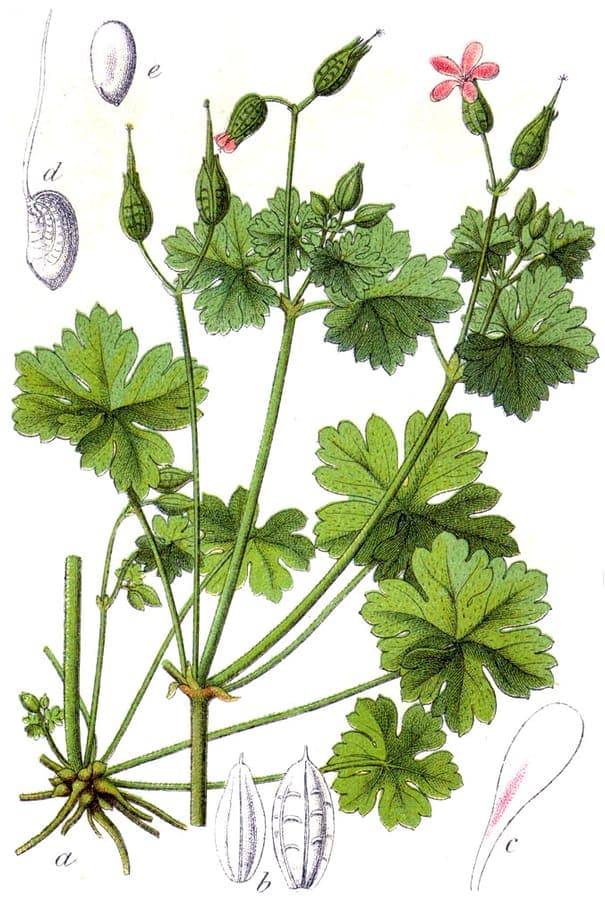
Johann Georg Sturm (Painter: Jacob Sturm) / Public domain, via Wikimedia Commons
Shining crane's-bill: complete guide
Geranium lucidum
Want to see Shining crane's-bill: complete guide in your garden?
1 minute, no credit card
Overview
Shining crane's-bill, or Geranium lucidum, is a quiet achiever in the perennial border. Native to parts of Europe, including woodland edges in Belgium and the Baltic States, this herbaceous plant thrives in conditions where flashier perennials often struggle. It's not the kind of plant that stops people in their tracks, but it earns its place through reliability, subtle beauty, and minimal care requirements. If you're working with shady corners or naturalistic planting schemes, this geranium is a solid choice.
On gardenworld.app, you can design a planting plan that integrates Shining crane's-bill seamlessly into a shaded garden layout, balancing bloom times and foliage textures.
Appearance & bloom cycle
Geranium lucidum grows 15–25 cm tall with a creeping, spreading habit. The stems trail along the ground, rooting at the nodes, and form dense mats over time. The leaves are kidney-shaped to heart-shaped, deeply lobed, and have a distinctive glossy sheen - hence the name 'shining'. They remain semi-evergreen in mild winters, providing year-round interest.
From late April to mid-June, the plant produces delicate flowers in soft pink to pale purple. Each bloom is about 1–1.5 cm across, with five slightly irregular petals and prominent stamens. The flowering period bridges the gap between early spring bulbs and summer perennials, adding quiet charm to the transitional season.
Ideal location
This geranium prefers partial to full shade. A light rating of 5 out of 10 (where 10 is full sun) is ideal. It performs best under deciduous trees, along north-facing walls, or in woodland gardens where it receives dappled light. Avoid hot, south-facing spots, especially in clay soils that retain heat.
It's an excellent option for urban gardens with limited sunlight, such as between buildings or beneath hedges. Because it spreads slowly but steadily, it works well as a ground cover in low-traffic areas. Give it space to form colonies, and it will suppress weeds naturally.
Soil requirements
Shining crane's-bill is adaptable but prefers well-drained, neutral to slightly alkaline soils with a pH between 7.0 and 7.5. It tolerates clay, loam, and sandy soils as long as they don't dry out completely in summer. Avoid highly acidic conditions (below pH 6.0), where growth may be stunted.
Organic matter is beneficial - a thin layer of leaf mould or compost in autumn improves moisture retention and soil structure. This mimics its natural forest floor habitat and supports healthy root development.
Free design
Want to see Shining crane's-bill: complete guide in your garden? Make a free design now.
Watering
Once established, Geranium lucidum is moderately drought-tolerant, but consistent moisture during spring and early summer promotes better flowering and denser foliage. Water deeply during prolonged dry spells, especially in the first year after planting. Aim for the base of the plant to prevent fungal issues on the leaves.
Mulching with bark or leaf litter helps retain moisture and keeps roots cool. In garden beds exposed to wind or reflected heat, monitor soil moisture more closely. Overwatering, particularly in heavy clay, can lead to root rot.
Pruning
This species requires little pruning. In early spring (February–March), you can cut back any tattered or winter-damaged foliage to make way for fresh growth. After flowering, a light trim of the top 5–8 cm encourages bushier regrowth and prevents the plant from looking leggy.
Use clean, sharp shears to avoid disease transfer. No feeding is necessary - in fact, excess nutrients can cause weak, floppy growth that collapses under rain.
Maintenance calendar
- Jan: Check for frost damage
- Feb: Remove old leaves
- Mar: New growth emerges
- Apr: Rapid growth phase, watch for slugs
- May: Peak bloom, supplement water if dry
- Jun: Flowering ends, optional trim
- Jul-Aug: Dormant period, minimal care
- Sep: Natural reseeding begins
- Oct: Leave foliage for winter protection
- Nov: Leaf drop in colder zones
- Dec: Dormant
Winter hardiness
Geranium lucidum is hardy in USDA zones 6–9 (-20°C to -7°C). In most of the UK and northern Europe, it survives winter without protection. The foliage may yellow or brown in severe cold but usually rebounds in spring. In milder regions, it stays semi-evergreen, offering visual interest during winter months.
No winter mulch is needed unless you're in a zone with fluctuating freeze-thaw cycles. Even then, a light covering of leaves is sufficient.
Companion plants
Pair Shining crane's-bill with other shade-tolerant perennials like Epimedium, Alchemilla mollis, or Tiarella. It works beautifully beneath shrubs such as Fatsia or under light canopies of birch or hazel. For spring interest, plant it with Anemone blanda or Scilla siberica.
Avoid aggressive spreaders like mint or ground elder, which can overwhelm it. On gardenworld.app, you can preview plant combinations to ensure spacing and light needs are balanced.
Closing
Shining crane's-bill won't win any beauty contests, but it's a dependable, low-fuss plant that earns its spot in any shade garden. It's ideal for gardeners who prefer subtle elegance over bold statements. You'll find it at garden centres across the UK, often labelled under its botanical name. Look for nursery-propagated stock rather than wild-collected plants to support sustainable growing. With a little care, it will form a lush carpet that returns faithfully every year.
Want to see Shining crane's-bill: complete guide in your garden? Make a free design now.
Upload a photo, pick a style, and get a photorealistic design with plant list in under a minute.
No credit card required


Similar plants
Pelargonium acetosum: complete guide
Pelargonium acetosum
Discover the Sorrel-leaf Geranium: a South African plant with aromatic foliage. Perfect for containers and warm locations. Learn cultivation and care.
Erodium foetidum: complete guide
Erodium foetidum
Rock stork's-bill is a delicate alpine plant with purple flowers and fine foliage. Learn how to grow this Mediterranean charmer in your front garden.
Pelargonium crithmifolium: complete guide
Pelargonium crithmifolium
Discover Samphire-leaf pelargonium: an exotic South African geranium with distinctive foliage. Growing tips, care advice and garden inspiration.