
Alvesgaspar / CC BY-SA 3.0, via Wikimedia Commons
Cut-leaf crane's-bill: complete guide
Geranium dissectum
Want to see Cut-leaf crane's-bill: complete guide in your garden?
1 minute, no credit card
Overview
Cut-leaf crane's-bill, or Geranium dissectum, is a herbaceous perennial that brings airy texture and subtle color to garden beds. Native across much of Europe and parts of Western Asia, it thrives in open woodlands, grassy slopes, and along country paths. Reaching heights of 40 to 60 cm, this upright-growing forb blooms from May through August with delicate purple flowers. It's a member of the Geraniaceae family and adapts well to both cottage gardens and naturalistic planting schemes.
On gardenworld.app, you can design a planting plan that matches the growth habits of Cut-leaf crane's-bill with complementary species. It prefers a light level of 7-meaning it does best in partial sun, where it gets morning light and afternoon shade. Full sun works if soil moisture is maintained, but deep shade will reduce flowering and cause leggy growth. This plant self-seeds modestly, so you may find seedlings appear in nearby cracks or borders the following spring.
Appearance & bloom cycle
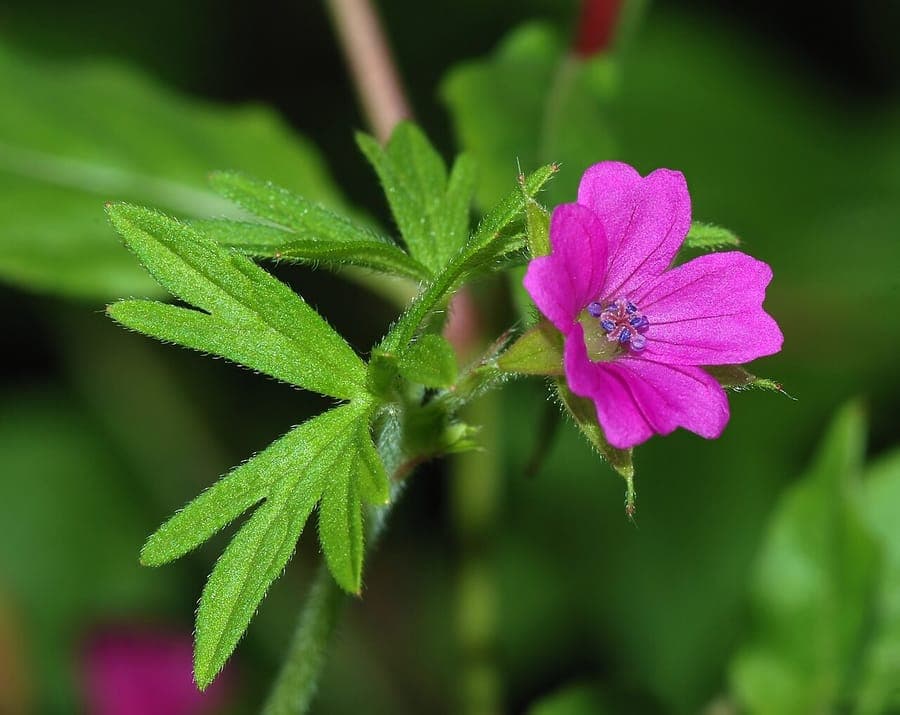
The foliage is what gives this plant its common name. Leaves are deeply divided into narrow, fern-like segments, giving them a lacy, open appearance. They're medium green, soft to the touch, and grow alternately along slender stems. The flowers are small, about 1.5 cm across, with five petals in a soft lavender-purple. Each bloom lasts only a few days, but new buds open continuously from late spring to midsummer, ensuring a long display.
Bees, hoverflies, and small butterflies visit the flowers for nectar. The plant produces distinctive long seed capsules that spring open when mature, flinging seeds several feet-typical of many geraniums. This natural dispersal method means you might see new plants pop up in unexpected spots, which some gardeners enjoy as part of a relaxed garden aesthetic.
Ideal location
Plant in areas with dappled sunlight or morning sun and afternoon shade. Avoid deep shade under dense tree canopies, as growth will be weak. A spot at the edge of a shrub border or in a meadow-style planting works well. It also does fine in rock gardens or along stone paths where soil drains quickly. Pair it with other upright perennials like Campanula or upright fescue grasses to create layered interest.
Using gardenworld.app, you can visualize how Cut-leaf crane's-bill fits into your garden's seasonal flow. The platform helps you place plants according to height, spread, and bloom time, so you avoid overcrowding and ensure year-round structure.
Free design
Want to see Cut-leaf crane's-bill: complete guide in your garden? Make a free design now.
Soil requirements
This geranium prefers well-drained soil with a pH between 7.5 and 8.0-slightly alkaline to neutral. It tolerates chalky or limestone-rich soils very well. Avoid acidic soils below pH 6.5 unless amended with ground limestone. It doesn't need rich compost; in fact, too much fertility leads to floppy stems and fewer flowers. Sandy or gravelly soils are ideal, as long as they don't dry out completely in summer.
Watering
Once established, Cut-leaf crane's-bill is drought tolerant. Young plants need consistent moisture during their first growing season, especially in dry spells. Water at the base to prevent fungal diseases on leaves. In average UK or northern European climates, rainfall is usually sufficient after establishment. During prolonged droughts, a weekly deep soak helps maintain vigor.
Pruning
Deadheading isn't necessary, but cutting back by one-third after peak bloom in July can encourage fresh foliage and possibly a second, lighter flush of flowers in late summer. Use clean shears and cut just above a leaf node. This also helps prevent self-seeding if you want to control spread.
Maintenance calendar
- Jan: Dormant; no action
- Feb: Check for early growth
- Mar: Clear debris, prepare soil
- Apr: Monitor for new shoots
- May: Begin blooming; water if dry
- Jun: Full bloom; watch for pests
- Jul: Optional trim after flowering
- Aug: Seed development; reduce watering
- Sep: Allow seeds to disperse; transplant seedlings
- Oct: Cut back dead stems if desired
- Nov: Dormancy begins
- Dec: No care needed
Winter hardiness
Hardy in USDA zones 5 to 8. In zone 8, it remains semi-evergreen in mild winters. The top growth dies back in autumn, but the root system survives frost and snow. No mulching is required, even in colder parts of its range. In zone 5, a light mulch may help in exposed sites, but avoid smothering the crown.
Companion plants
Excellent companions include Alchemilla mollis, Nepeta, and upright sedges like Carex elata 'Aurea'. It blends well with wildflowers such as Campanula rotundifolia or Leucanthemum vulgare. Avoid aggressive spreaders like mint or goldenrod that could overwhelm it.
Closing
Cut-leaf crane's-bill is a reliable, low-fuss plant that adds subtle charm to any garden. Its delicate blooms and fine foliage make it ideal for naturalistic designs. You can find it at garden centres in spring, especially at independents or native plant suppliers. With minimal care and the right spot, it'll return year after year. For layout ideas, check gardenworld.app to explore combinations that enhance texture and bloom timing.
Want to see Cut-leaf crane's-bill: complete guide in your garden? Make a free design now.
Upload a photo, pick a style, and get a photorealistic design with plant list in under a minute.
No credit card required


Similar plants
Pelargonium acetosum: complete guide
Pelargonium acetosum
Discover the Sorrel-leaf Geranium: a South African plant with aromatic foliage. Perfect for containers and warm locations. Learn cultivation and care.
Erodium foetidum: complete guide
Erodium foetidum
Rock stork's-bill is a delicate alpine plant with purple flowers and fine foliage. Learn how to grow this Mediterranean charmer in your front garden.
Pelargonium crithmifolium: complete guide
Pelargonium crithmifolium
Discover Samphire-leaf pelargonium: an exotic South African geranium with distinctive foliage. Growing tips, care advice and garden inspiration.