
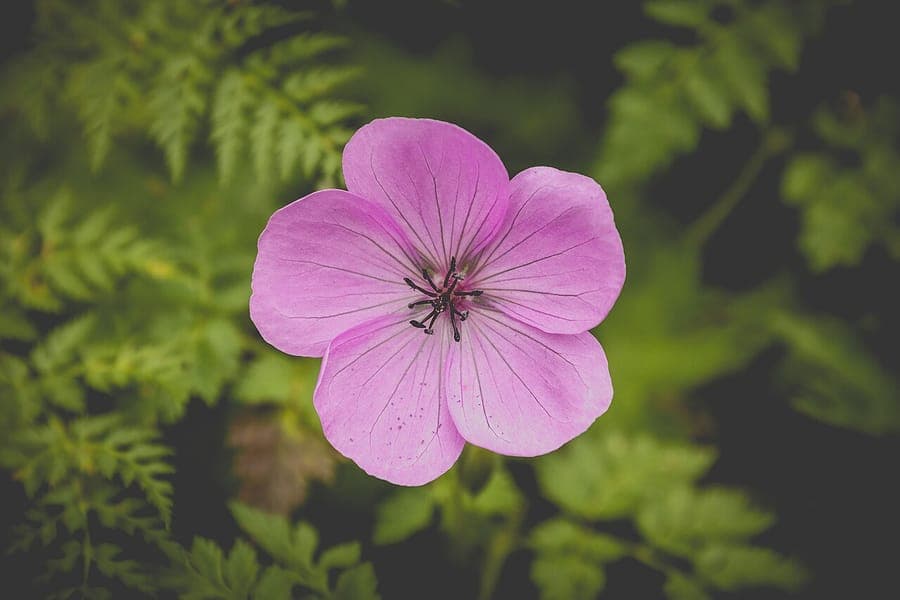
Bijay Chaurasia / CC BY-SA 4.0, via Wikimedia Commons
Ashy cranesbill: complete guide
Geranium cinereum
Want to see Ashy cranesbill: complete guide in your garden?
1 minute, no credit card
Overview
Geranium cinereum, commonly known as ashy cranesbill, is a compact, creeping perennial that thrives in temperate gardens across Europe. Native to rocky slopes in southern France and northern Spain, it's adapted to well-drained, acidic soils and moderate rainfall. In the UK and similar climates (USDA zones 5–8), it performs best in full sun to light shade, reaching just 15–20 cm in height with a spread of up to 40 cm.
This hardy geranium is a top choice for rock gardens, alpine beds, or as a ground cover under light-canopy shrubs. Its long blooming season and low maintenance needs make it a staple for cottage and informal garden styles. Use gardenworld.app to design a planting scheme that highlights its spreading habit and rich floral display.
Appearance & bloom cycle
From June through August, Geranium cinereum produces vibrant purple flowers, each 2–3 cm in diameter, with five notched petals radiating from a central eye. The blooms appear singly or in small clusters atop short, hairy stems. Beneath them, the foliage forms a dense mat of deeply lobed, silvery-green leaves that feel slightly fuzzy to the touch.
The leaves are palmate, divided into five to seven segments, and retain their attractive color all season. In autumn, they may develop subtle reddish or bronze tints before overwintering. Unlike some geraniums, this species is semi-evergreen in milder climates, providing year-round structure.
Ideal location
Aim for a site with a light rating of 7/10-full sun to light dappled shade. In hotter regions, afternoon shade helps prevent scorching and keeps the plant compact. Avoid deep shade, which leads to leggy growth and fewer flowers.
This geranium works beautifully in crevices between paving stones, along gravel paths, or spilling over retaining walls. It's also effective at the front of borders or among low shrubs like lavender or dwarf roses. gardenworld.app offers visual tools to help you position this plant for maximum impact in mixed perennial beds.
Soil requirements
Geranium cinereum prefers acidic soil with a pH between 4.0 and 4.5. It struggles in alkaline or heavy clay soils, which retain too much moisture. Improve drainage by mixing in grit, coarse sand, or pine bark. A humus-rich top layer helps retain moisture without waterlogging.
Raised beds or sloped areas are ideal, especially in wetter gardens. Avoid liming the soil-this can cause yellowing leaves due to iron deficiency.
Free design
Want to see Ashy cranesbill: complete guide in your garden? Make a free design now.
Watering
Once established, this plant is drought-tolerant and only needs watering during prolonged dry spells. In the first growing season, keep the soil consistently moist to help roots establish. Water deeply once a week rather than frequent shallow sprinkles.
Use rainwater when possible, especially on acid-loving plants. Tap water, particularly in hard water areas, can gradually raise soil pH over time.
Pruning
After flowering ends in late summer, cut back the plant by about one-third to encourage a neat shape and possibly a second, lighter flush of blooms. Avoid cutting into old wood, as regrowth may be slow. Deadheading isn't essential, but it keeps the look tidy.
In early spring, remove any damaged or old foliage before new growth emerges. This improves airflow and reduces the risk of fungal issues.
Maintenance calendar
- Jan: Check for winter damage, protect from heavy snow
- Feb: No action needed
- Mar: Clear dead leaves, apply light organic feed
- Apr: Begin regular watering if dry
- May: Monitor for aphids, feed if growth is weak
- Jun: Flowers begin, watch for moisture stress
- Jul: Peak bloom, avoid fertilizing
- Aug: Trim after flowering, remove spent stems
- Sep: Reduce watering, allow natural drying
- Oct: Leave seed heads for self-seeding, or deadhead for neatness
- Nov: No pruning, mulch lightly if in containers
- Dec: Dormant period, check for wet soil
Winter hardiness
Hardy in USDA zones 5–8, Geranium cinereum survives most UK and northern European winters without protection. However, wet, cold soil is its main enemy. In poorly drained spots, add grit or plant in raised beds.
Container-grown plants should be moved to a sheltered spot or wrapped with hessian in harsh winters. A light mulch of pine needles helps insulate the roots without raising pH.
Companion plants
Pair with other acid-loving plants like heathers (Erica spp.), heucheras, or dwarf rhododendrons. The purple blooms contrast beautifully with silver foliage such as artemisia or helichrysum.
Excellent companions include Thymus, Sedum 'Autumn Joy', Arabis, and small ferns like Dryopteris filix-mas. Avoid aggressive spreaders like mint or large hostas that could overwhelm its delicate form.
Closing
Geranium cinereum is a reliable, long-blooming perennial that brings color and texture to the garden with minimal effort. Its silvery foliage and rich purple flowers make it a standout in rockeries, borders, and ground cover schemes.
Find it at local garden centres, especially during spring and early summer. Look for healthy 9 cm or 1-litre pots at trusted retailers. For layout ideas and planting combinations, visit gardenworld.app-where you can create a custom garden design based on your soil, light, and climate conditions.
Want to see Ashy cranesbill: complete guide in your garden? Make a free design now.
Upload a photo, pick a style, and get a photorealistic design with plant list in under a minute.
No credit card required


Similar plants
Pelargonium acetosum: complete guide
Pelargonium acetosum
Discover the Sorrel-leaf Geranium: a South African plant with aromatic foliage. Perfect for containers and warm locations. Learn cultivation and care.
Erodium foetidum: complete guide
Erodium foetidum
Rock stork's-bill is a delicate alpine plant with purple flowers and fine foliage. Learn how to grow this Mediterranean charmer in your front garden.
Pelargonium crithmifolium: complete guide
Pelargonium crithmifolium
Discover Samphire-leaf pelargonium: an exotic South African geranium with distinctive foliage. Growing tips, care advice and garden inspiration.