
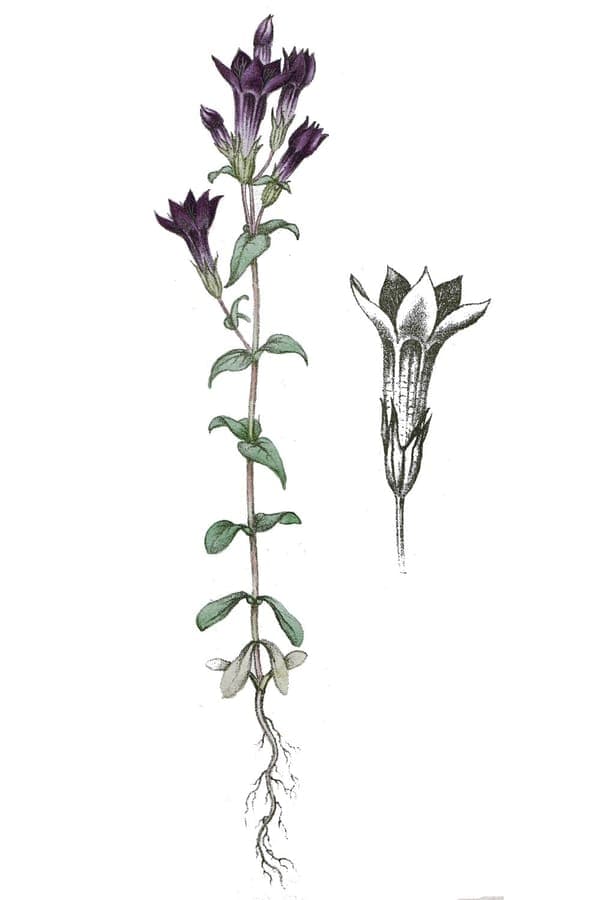
Wikimedia Commons / Public domain, via Wikimedia Commons
Gentianella amarella: complete guide
Gentianella amarella
Want to see Gentianella amarella: complete guide in your garden?
1 minute, no credit card
Overview
Gentianella amarella, the slender or bitter gentian, is an elegant herbaceous plant belonging to the Gentianaceae family. This plant is naturally widely distributed in temperate regions of the northern hemisphere, ranging from Europe to North America and Mexico.
Although primarily wild-growing, Gentianella amarella is becoming increasingly popular in temperate European wildflower gardens. The plant is renowned for its striking blue flower crowns appearing from August through October. This is actually the primary reason this plant is so valuable: it provides color at a time when many other plants are fading away.
The plant grows especially on nutrient-poor terrain and is therefore ideal for sustainable gardens where artificial feeding should be avoided.
Appearance and bloom
Gentianella amarella reaches approximately 10 to 30 cm height, variably depending on growing conditions. The plant grows from a small basal rosette.
The plant has very fine, narrow, linear foliage arranged densely. The foliage has a delicate appearance.
The flowers are highly characteristic: they are trumpet-shaped, approximately 1.5 to 2 cm long, and intensely blue in color. Sometimes color varies to purple-blue or even white. Each flowering stem carries a dense arrangement of blooms at the top.
The flowering is very striking: from August through October, massive quantities of flowers appear. This makes the plant especially valuable as it extends flowering into autumn when many other plants are fading. Fascinatingly, this plant is usually annual or biennial, meaning it spreads its lifespan over two seasons.
Ideal location
Gentianella amarella prefers full sun to half shade. At least 6 hours of sun daily is recommended for optimal bloom. In very hot climates, some afternoon shade may prove beneficial.
The plant grows wild on heathland, grasslands, and dry slope locations. In gardens it is therefore ideal for open locations with minimal shading.
Plant Gentianella amarella in clusters of 5 to 10 for optimal effect. Depending on conditions it may reach 30 cm, so do not plant it behind other low-growing plants.
Soil
Gentianella amarella demands nutrient-poor, well-drained soil. This is essential. In nature, this plant grows on extremely nutrient-poor meadows and boggy soils. Rich, well-fertilized soils lead to weak, floppy growth without blooming.
The pH may be neutral to acidic (pH 5.5 to 7.0). The plant cannot tolerate heavy clay and demands sandy, humus-poor material.
Perfect mix: sand (60%), clay or loam (20%), and garden compost (20%). Preference is actually for almost pure sand with minimal organic material.
Free design
Want to see Gentianella amarella: complete guide in your garden? Make a free design now.
Watering
Gentianella amarella requires regular water, especially during dry periods. The soil may never completely dry but also must not remain wet. It is a delicate balance.
In gardens where rain falls regularly, extra watering is often unnecessary. During dry periods, carefully provide water, especially for young plants.
Stagnant water must absolutely be avoided. Good drainage is essential.
Pruning
Gentianella amarella requires no actual pruning. Remove spent flowers and flower stems as soon as they wilt. This sometimes stimulates additional bloom.
Once foliage completely withers (usually October-November), the entire plant can be removed provided seeds can ripen if you wish to collect them. However, this is optional.
Maintenance calendar
Gentianella amarella follows a simple maintenance rhythm.
Spring (March-May): Start seeds or plant young plants from nursery seedlings. Water regularly during dry periods. No fertilization.
Summer (June-July): Plant grows without much maintenance. Water if dry. No pruning or care needed.
Autumn (August-October): Bloom appears. Water regularly. Remove spent flowers optionally.
Winter (November-February): Plant dies back. Allow seeds to ripen if desired. Plant may regenerate from seed next season.
Winter hardiness
Gentianella amarella is fully hardy in temperate Northern Europe. Frost periods do not harm the plant. However, because the plant is usually annual or biennial, it rarely survives the full winter and regenerates from seed.
Young plants can, however, grow from seed in spring to become mature blooming specimens by autumn.
Companion planting ideas
Gentianella amarella combines perfectly with other autumn-blooming alpine and wild plants:
- With Erica cinerea (bell heather) for texture contrast
- With Calluna vulgaris (Scottish heather) for color variation
- With Silene acaulis (cushion pink) for height variation
- With wild Carex grasses for foliage structure
- With Saxifraga species for miniature contrast
These combinations create a very attractive heathland-like effect.
Closing
Gentianella amarella is an elegant, autumn-blooming gentian indispensable for wildflower gardens and nutrient-poor terrain. With minimal maintenance and striking blue autumn blooming, it is a valuable addition.
Gentianella amarella seed is available from some seed specialists. Young plants are less available. Seed prices range around EUR 1-3, for plants EUR 3-5.
Gardenworld.app can help you integrate this wildflower into your front yard, especially on nutrient-poor or experimental terrain where you wish to implement sustainable planting schemes. Our tools help you visualize how this autumn bloomer shines in your own garden.
Want to see Gentianella amarella: complete guide in your garden? Make a free design now.
Upload a photo, pick a style, and get a photorealistic design with plant list in under a minute.
No credit card required


Similar plants
Branched gentianella: complete guide
Gentianella ramosa
Full growing guide for Gentianella ramosa, the branched Alpine gentianella of the SW Alps - location, soil, watering, winter care and companion plants.
Spiked centaury: complete guide
Schenkia spicata
Full growing guide for Schenkia spicata (spiked centaury): sunny position, dry soil, bloom season and garden companions.
Narrow-leaf gentian: complete guide
Gentiana angustifolia
Narrow-leaf gentian growing guide: intense blue trumpet flowers in May-July on well-drained limestone. Full cultivation tips.