
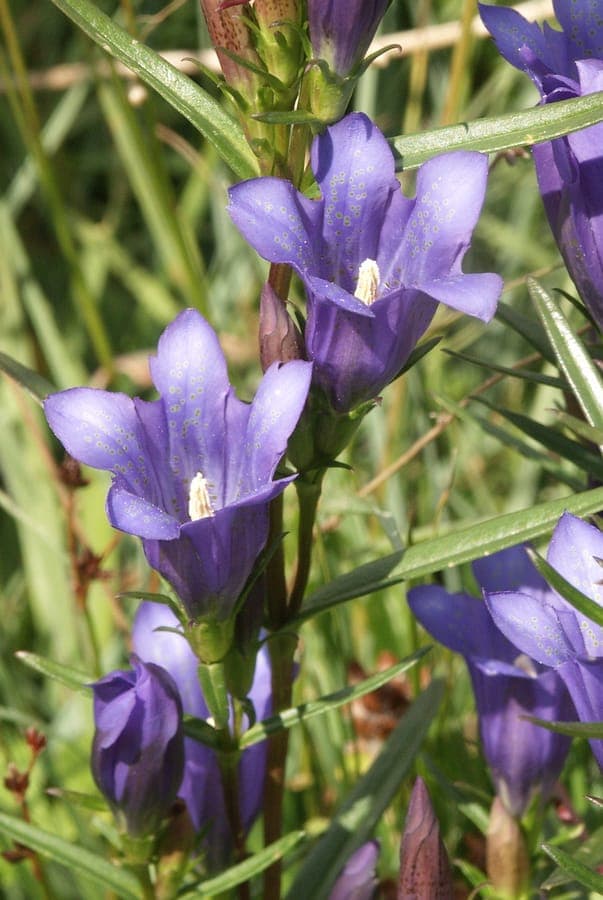
Bernd Haynold / CC BY-SA 2.5, via Wikimedia Commons
Marsh gentian: complete guide
Gentiana pneumonanthe
Want to see Marsh gentian: complete guide in your garden?
1 minute, no credit card
Overview
The marsh gentian (Gentiana pneumonanthe) is a striking herbaceous perennial known for its vivid deep blue, bell-shaped flowers that bloom in late summer and autumn. Native to wet heaths, fens, and peat bogs across northern and central Europe, this plant thrives in conditions that challenge most garden perennials. In cultivation, it brings a rare splash of intense color when many other plants are winding down. With a height of 30 to 50 cm, it forms compact clumps that slowly spread through underground rhizomes.
Finding this plant in garden centres can be difficult - it's not commonly stocked due to specific growing requirements. However, specialist nurseries and garden centres occasionally carry it in late summer. For accurate planning, use gardenworld.app to design a moisture-rich garden layout that mirrors its natural habitat, ensuring optimal placement and long-term success.
Appearance & bloom cycle
The marsh gentian produces lance-shaped, dark green leaves arranged in opposite pairs along upright stems. From July through October, it bears tubular, downward-facing flowers that are a brilliant cobalt blue, often with fine greenish streaks at the base of the petals. Each flower measures 4 to 5 cm in length and opens slightly at the mouth, revealing a subtle yellow throat. Bloom peaks in August and September, but cooler autumns can extend flowering into October.
Pollinators, especially bumblebees, are drawn to the nectar-rich blooms. The plant's long flowering season makes it a valuable addition to late-season gardens, particularly in USDA hardiness zones 4 to 8. Its quiet elegance stands out in naturalistic plantings, bog gardens, or beside slow-moving streams.
Ideal location
Aim for a site with full sun to light shade, scoring about 7 on a 10-point light scale. This translates to 5 to 6 hours of direct sunlight daily. Full sun enhances flower color and density, but in hotter climates, light afternoon shade helps prevent stress. Avoid deep shade, which leads to leggy growth and fewer blooms.
Ideal spots include the edge of a pond, a damp meadow corner, or a rain garden. The plant does best in open areas without aggressive root competition. On gardenworld.app, you can simulate microclimates to identify the perfect spot for moisture-loving plants like the marsh gentian.
Soil requirements
This species demands acidic soil with a pH between 5.0 and 5.5. Neutral or alkaline soils will quickly lead to chlorosis and decline. The ideal substrate is peaty, rich in organic matter, and consistently moist. Avoid clay-heavy or sandy soils unless amended with generous amounts of sphagnum moss and leaf humus.
Never add lime or chalk-based fertilizers. Use rainwater whenever possible, as tap water can gradually raise pH. Test soil pH annually and amend with acidifying agents like pine needle mulch if needed.
Free design
Want to see Marsh gentian: complete guide in your garden? Make a free design now.
Watering
Consistent moisture is non-negotiable. The root zone should never dry out completely. During dry spells, water deeply two to three times per week, preferably with collected rainwater. Use a soaker hose or drip irrigation to maintain steady soil moisture without disturbing the surface.
Avoid overhead watering, which can promote fungal diseases. Instead, water at the base. In container culture, ensure pots have excellent drainage but retain moisture - a mix of peat, perlite, and composted pine bark works well.
Pruning
Minimal pruning is required. In early spring, remove old, dead stems to make way for new growth. Use clean, sharp shears and avoid cutting into live crowns. Some gardeners leave stems intact over winter to protect the crown from frost; this is advisable in zone 4 or colder.
Do not cut back during active growth or flowering. Deadheading isn't necessary but can improve appearance. Leave seed heads if you want to encourage self-seeding, though this is rare in garden settings.
Maintenance calendar
- Jan: Check mulch cover and root protection
- Feb: Monitor for frost heave; leave old growth if present
- Mar: Remove dead foliage; inspect for new shoots
- Apr: Test soil pH; add sphagnum if needed
- May: Ensure consistent moisture; watch for new growth
- Jun: Maintain watering; inspect for pests
- Jul: First blooms appear; increase watering if dry
- Aug: Peak bloom; watch for wilting
- Sep: Continue watering; remove spent blooms
- Oct: Allow final blooms to fade; reduce watering
- Nov: Stop fertilizing; apply light mulch
- Dec: Monitor snow cover; avoid heavy compaction
Winter hardiness
The marsh gentian is hardy to USDA zone 4 (-34°C). In colder zones, a light mulch of pine needles or straw helps insulate the crown. Avoid wet, heavy mulches like fresh manure, which can rot the base.
For container plants, wrap pots in burlap or move to an unheated greenhouse. Use containers with drainage holes, and consider elevating them to prevent waterlogging.
Companion plants
Pair with moisture-loving, acid-tolerant companions: Molinia caerulea, Eriophorum angustifolium, Carex nigra, and Sanguisorba officinalis. These share similar soil and water needs. Late-blooming asters or goldenrods add complementary color.
Avoid plants that prefer alkaline soils or heavy feeding, such as lavender or yarrow. These disrupt the delicate balance the marsh gentian requires.
Closing
The marsh gentian isn't for every garden, but for those willing to meet its needs, it's a rewarding perennial with few equals in late-season color. Its vivid blue blooms are a rarity in autumn, and its ecological value for pollinators is significant. With patience and the right conditions, it can thrive for years.
Use gardenworld.app to design a garden tailored to moisture-dependent perennials like the marsh gentian. From soil prep to planting layout, the platform helps you create a sustainable, beautiful ecosystem where this striking plant can flourish.
Want to see Marsh gentian: complete guide in your garden? Make a free design now.
Upload a photo, pick a style, and get a photorealistic design with plant list in under a minute.
No credit card required


Similar plants
Branched gentianella: complete guide
Gentianella ramosa
Full growing guide for Gentianella ramosa, the branched Alpine gentianella of the SW Alps - location, soil, watering, winter care and companion plants.
Spiked centaury: complete guide
Schenkia spicata
Full growing guide for Schenkia spicata (spiked centaury): sunny position, dry soil, bloom season and garden companions.
Narrow-leaf gentian: complete guide
Gentiana angustifolia
Narrow-leaf gentian growing guide: intense blue trumpet flowers in May-July on well-drained limestone. Full cultivation tips.