
Bernd Haynold / CC BY-SA 2.5, via Wikimedia Commons
Great yellow gentian: complete guide
Gentiana lutea
Want to see Great yellow gentian: complete guide in your garden?
1 minute, no credit card
Overview
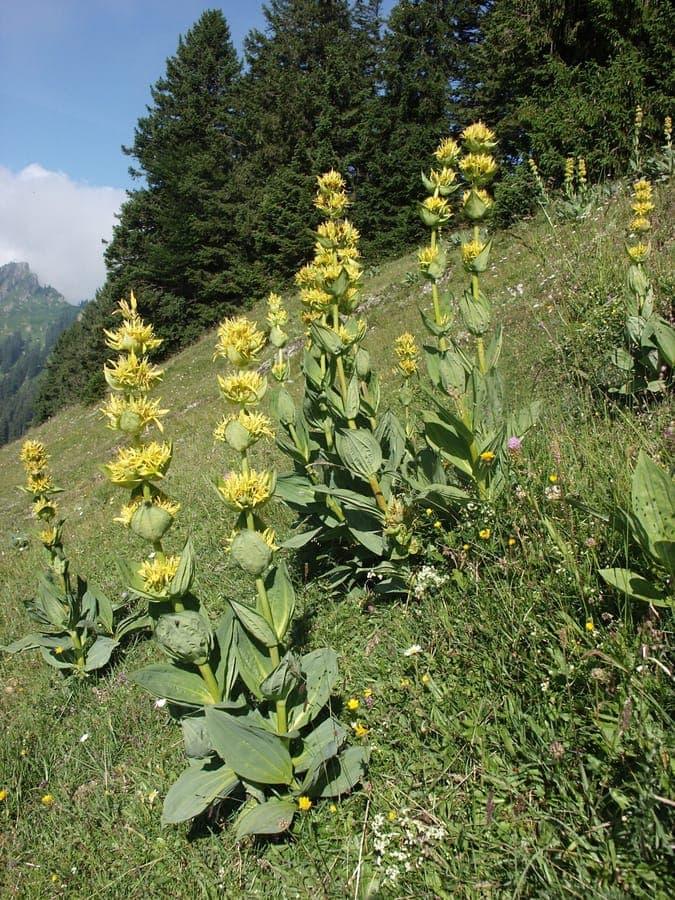
Gentiana lutea, commonly known as the great yellow gentian, is a striking herbaceous perennial that thrives in rocky, alpine meadows across southern Europe. As a member of the Gentianaceae family, it brings bold yellow flowers and architectural presence to gardens that mimic its native habitat. While not native to the UK or North America, it adapts well to temperate gardens with proper conditions. Gardeners on gardenworld.app often feature it in naturalistic designs that reflect its wild origins.
This plant reaches 60 to 120 cm in height and spreads slowly via seed. It's long-lived and grows steadily, though blooming typically begins only in the second or third year. The plant is known for its thick, fleshy rootstock - historically used for bitter tonics - but modern gardeners value it purely for its ornamental strength. It's not a flashy plant, but one that earns its place through resilience and seasonal beauty.
Appearance & bloom cycle
From June through August, the great yellow gentian produces dense panicles of vibrant yellow, bell-shaped flowers. Each bloom is about 3 cm long, with prominent green veining and a deeply lobed corolla. The flowers grow in upright clusters along a sturdy central stem, creating a strong vertical accent. The foliage forms opposite pairs of oblong, mid-green leaves that can reach up to 30 cm in length.
In its first year, the plant usually establishes a basal rosette of leaves. True flowering stems emerge only after the plant has stored enough energy. Self-seeding can occur in ideal conditions, but it's rarely invasive. The bloom period is long-lasting, and spent flowers can be left to provide winter interest.
Ideal location
Gentiana lutea thrives in full sun, scoring a 7 on the light scale (1-10). This means it needs at least 6 hours of direct sunlight daily. A south- or southeast-facing slope or bed works best. Avoid deep shade or areas with heavy tree canopy - these lead to weak stems and poor flowering.
Think alpine: rocky outcrops, dry stone walls, and well-drained slopes. In garden design, it fits perfectly in rock gardens, gravel beds, or naturalized zones. When planning your layout, use gardenworld.app to model a sun-drenched, stony garden corner where this plant can truly shine.
Soil requirements
The great yellow gentian prefers well-drained, acidic to slightly acidic soil with a pH between 5.0 and 5.5. Heavy clay or waterlogged soil causes root rot. It naturally grows in poor, rocky substrates, so avoid excessively fertile mixes.
A blend of loam, coarse sand, and leaf compost works well. Add grit or small stones to improve drainage. Avoid liming the soil - alkaline conditions are detrimental. Organic mulch is fine, but keep it away from the crown to prevent rot.
Free design
Want to see Great yellow gentian: complete guide in your garden? Make a free design now.
Watering
Once established, Gentiana lutea is drought-tolerant. During the first growing season, water regularly, especially in dry spells. Water deeply but infrequently, allowing the top few centimeters of soil to dry between sessions.
After the first year, supplemental watering is rarely needed. Use rainwater when possible, as tap water can raise pH over time. Drip irrigation or watering at the base prevents fungal issues from wet foliage.
Pruning
Pruning is minimal. After flowering, cut back spent flower stalks to just above the basal leaves. This keeps the plant tidy and discourages excessive self-seeding. Use clean, sharp shears to prevent disease.
Leave the foliage through winter - it provides insulation for the crown. In early spring, remove any damaged or old leaves before new growth appears.
Maintenance calendar
- January: No action. Let snow cover protect the crown.
- February: Remove damaged foliage if needed.
- March: Check soil drainage. Add grit if compacted.
- April: Light top-dressing with compost. No fertilizer.
- May: Monitor for emerging stalks. Water if dry.
- June-August: Bloom period. Avoid wetting leaves.
- September: Let seed heads develop or remove for control.
- October-November: Leave as-is. No feeding.
- December: Protect young plants with pine boughs in harsh winters.
Winter hardiness
Hardy to USDA zone 5 (-29°C), Gentiana lutea withstands most UK and northern European winters. Mature plants need little protection, but mulching with gravel or pine needles helps in areas with freeze-thaw cycles.
Potted plants are more vulnerable. Move containers to a sheltered spot or wrap them with hessian. Avoid wet, cold winters - the main threat is waterlogged soil, not cold itself.
Companion plants
Pair with other sun-loving, drought-tolerant perennials. Good companions include Echinacea purpurea, Sedum 'Matrona', Thymus vulgaris, and Nepeta racemosa. These share similar soil and water needs and create a textured, naturalistic planting scheme.
For contrast, plant alongside blue-flowered species like Salvia x sylvestris or Campanula lactiflora. Avoid overly aggressive spreaders like mint or ground ivy. Use low edging stones to define the planting zone.
Closing
The great yellow gentian isn't a plant for instant gratification - it demands patience and the right conditions. But once established, it's a low-maintenance, long-lived addition with architectural blooms and quiet elegance.
Available at garden centres across the UK and US, including local independents and chains. Look for healthy rootstock with firm, pale-yellow flesh. When designing your space, consider using gardenworld.app to visualize how this plant fits into a sun-drenched, gravel-filled border.
Want to see Great yellow gentian: complete guide in your garden? Make a free design now.
Upload a photo, pick a style, and get a photorealistic design with plant list in under a minute.
No credit card required


Similar plants
Branched gentianella: complete guide
Gentianella ramosa
Full growing guide for Gentianella ramosa, the branched Alpine gentianella of the SW Alps - location, soil, watering, winter care and companion plants.
Spiked centaury: complete guide
Schenkia spicata
Full growing guide for Schenkia spicata (spiked centaury): sunny position, dry soil, bloom season and garden companions.
Narrow-leaf gentian: complete guide
Gentiana angustifolia
Narrow-leaf gentian growing guide: intense blue trumpet flowers in May-July on well-drained limestone. Full cultivation tips.