
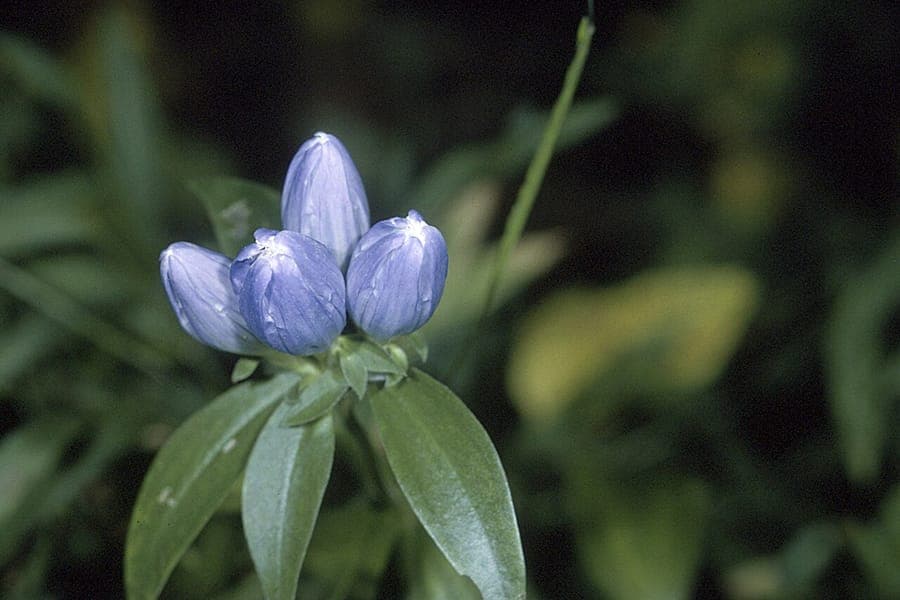
USDA / Public domain, via Wikimedia Commons
Bottle gentian: complete guide
Gentiana clausa
Want to see Bottle gentian: complete guide in your garden?
1 minute, no credit card
Overview
Gentiana clausa, commonly known as bottle gentian, blind gentian or closed gentian, belongs to the family Gentianaceae and is one of the most distinctive native perennials of eastern North America. The species was formally described by Constantine Samuel Rafinesque-Schmaltz in 1828 and grows naturally from southern Québec southward through the Appalachian Mountains to North Carolina. Despite its North American origins, this plant adapts remarkably well to European gardens that offer a cool, moist situation with acidic soil.
What sets Gentiana clausa apart from most other flowering plants is its permanently closed corolla: the petals never unfurl, giving each flower the appearance of a tightly sealed deep-blue or blue-purple flask. This is not a sign of undevelopment but a highly sophisticated evolutionary trait. Only bumblebees are strong enough to force open the petals and reach the nectar and pollen within, making them the sole pollinators. In a garden with healthy bumblebee populations, you can expect small brown seed capsules to form reliably each autumn.
Taxonomically, the species belongs to the 'Pneumonanthe' group of gentians, a group that also includes the European marsh gentian (Gentiana pneumonanthe). Gardeners familiar with marsh gentian will recognise the kinship immediately, but Gentiana clausa tends to be slightly more robust and flowers somewhat later in the season - typically September into October - making it an invaluable component of any late-season border.
Synonyms include Pneumonanthe clausa (Raf.) Greene, and older literature may also list it as Gentiana andrewsii var. intermedia. It is worth distinguishing it from the similar Gentiana andrewsii, which has a very slightly different floral structure but shares most cultivation requirements.
Appearance and bloom cycle
Gentiana clausa produces upright, unbranched stems reaching 30 to 60 cm in height under good conditions. The leaves are oppositely arranged, lance-shaped to elliptical, with a noticeably coarse texture and a rich green colour that persists well into autumn. Individual leaves measure approximately 5 to 10 cm long and 1.5 to 3 cm wide; the uppermost leaf pairs are crowded close together beneath the flowers, providing a lush, leafy frame.
Flowers appear from late August through October, carried in terminal clusters and in the axils of the upper leaves. Each blossom is cylindrical to slightly urn-shaped, measuring 3 to 4 cm long. Colour ranges from a deep navy blue to blue-violet, sometimes with subtle greenish veining or a whitish fringe on the exterior. A rare white-flowered form, Gentiana clausa f. albiflora (described by House), produces near-white flowers with just a hint of pale blue-green.
After the blooming period, small, oblong seed capsules develop, containing numerous fine brown seeds that are dispersed by wind. Above-ground growth dies back completely in winter, and the plant overwinters as a fleshy rootstock. New shoots typically emerge in April as soil temperatures rise, beginning the growth cycle anew.
Ideal location
Gentiana clausa thrives in a partially shaded to fully shaded position that mirrors its natural habitat: the moist woodland edges, clearings and stream banks of eastern North America. A spot receiving morning sunshine with afternoon shade is ideal. Full sun exposure during the hottest part of the day can cause the foliage to scorch and flowers to fade prematurely.
The plant also tolerates deeper shade, though flowering may be somewhat reduced. In practice, placement beneath deciduous trees or tall shrubs works very well: the plant benefits from the extra light in early spring before the tree canopy closes, while enjoying cooling shade throughout summer.
Avoid spots with a high water table that results in standing water, as permanently waterlogged soil will cause the roots to rot. A gentle slope or a slightly raised bed helps maintain soil moisture while ensuring good drainage.
Regarding climate, Gentiana clausa is well suited to northern and central European conditions. It is hardy in USDA zones 3 to 7, encompassing the Netherlands, Belgium, Germany, and the cooler regions of France.
Soil requirements
Soil requirements are the most critical factor in successfully cultivating Gentiana clausa. The ideal growing medium is moist, humus-rich and acidic, with a pH of 5.8 to 7.2. Although this range is broader than that of some alpine gentians, the plant performs best in slightly acidic soil around pH 6.0 to 6.5.
On heavy clay soils, incorporate generous quantities of well-rotted garden compost and coarse horticultural grit to improve structure and drainage. Ericaceous (lime-free) compost, peat, pine bark or composted leaf mould are excellent organic amendments for lowering soil pH and increasing humus content. On chalky or neutral soils, consider constructing a dedicated raised bed filled with a mixture of ericaceous compost, garden topsoil and coarse sand in roughly equal proportions.
The plant has a relatively shallow root system and responds very well to a 5 to 8 cm mulch of organic material. Shredded leaves, pine needles or composted bark all work excellently. Mulch retains soil moisture, moderates root temperature, suppresses weeds and gradually acidifies the soil as it breaks down. Replenish the mulch layer each spring.
In nutrient-poor soils, a modest spring application of a slow-release, organic fertiliser - such as a light dressing of well-rotted compost or a blood-based granular feed - can be beneficial. Avoid high-nitrogen feeds, which promote lush leaf growth at the expense of flowering.
Free design
Want to see Bottle gentian: complete guide in your garden? Make a free design now.
Watering
Consistently moist soil is the key to a healthy, free-flowering Gentiana clausa. Regular watering is essential during dry spells in summer and early autumn, particularly when flower buds are forming and opening in August and September. Water stress at this critical stage can result in reduced flower size, colour fading or even complete failure to bloom.
Water preferably in the morning, so that any moisture on the foliage has time to dry before nightfall, reducing the risk of fungal disease. Where possible, use collected rainwater rather than tap water, as hard tap water gradually raises soil pH, which is detrimental to this lime-sensitive species.
During periods of adequate rainfall, supplementary watering is barely necessary. In dry summers, two to three waterings per week may be needed depending on soil type and mulch coverage. Push a finger 5 cm into the soil to check: if still moist at that depth, watering can wait.
During winter dormancy, no watering is required. Resume light watering in early spring as the first shoots emerge from the rootstock.
Pruning
Gentiana clausa requires minimal pruning. After the blooming period and seed set, the stems gradually die back and may be left standing until early spring. The dried stems add structure to the winter garden, and the small seed capsules provide food for finches and other seed-eating birds. Cut back the dead stems to ground level once the risk of hard frost has passed, usually in March or early April.
If you wish to allow self-seeding, leave the flowering stems undisturbed until the capsules have opened and dispersed their seeds. To prevent unwanted spreading, remove the capsules in October before they ripen and open.
No shaping or hard cutting back is needed. The plant produces fresh stems from its rootstock each year without any encouragement.
Maintenance calendar
January – February: Plant is fully dormant. No action required. Check that the mulch layer is still intact; top up if necessary.
March – April: Remove old stems once hard frost has passed. First new shoots emerge. Apply a light top-dressing of well-rotted compost. Begin moderate watering.
May – June: Rapid vegetative growth. Maintain consistent soil moisture. Watch for slug damage on emerging shoots. Renew the mulch layer.
July: Stems approach full height. Ensure adequate watering during hot, dry periods. First flower buds become visible.
August – September: Full flowering. The deep purple, bottle-shaped flowers are at their finest. Keep soil evenly moist. Bumblebees are the exclusive pollinators.
October – November: Seed formation. Decide whether to allow seeds to disperse or remove capsules. Plant begins to die back.
December: Full dormancy. Mulch may be topped up if severe frosts are forecast.
Winter hardiness
Gentiana clausa is exceptionally cold-hardy, tolerating temperatures down to at least -20 °C, equivalent to USDA hardiness zone 4 and even zone 3. In its native range in Québec and New England, severe winters are the norm, and the plant has adapted perfectly to long periods of frozen ground and deep snow cover.
Throughout the Netherlands, Belgium, Germany and the milder parts of France, the species overwinters without any protection. Only in regions combining exceptionally harsh winters with minimal snow cover (which acts as natural insulation) might an additional 10 to 15 cm mulch layer over the rootstock be advisable.
The one winter threat worth noting is prolonged standing water. Always ensure free-draining soil, particularly during the wet winter months. A gently sloping site or a raised bed is beneficial in high-rainfall areas.
Companion plants
Gentiana clausa combines beautifully with other plants sharing its preference for moist, partially shaded, acidic soil. Excellent companion plants include:
- Astilbe: The feathery plumes in pink, red or white flower earlier in the season, extending the display period considerably. Plant 40 to 50 cm apart.
- Hosta: The large, bold foliage of hostas provides a striking contrast to the more upright, narrow form of the gentian. Choose blue-green or golden cultivars such as Hosta sieboldiana 'Elegans' or Hosta 'Sum and Substance'.
- Ferns: Japanese painted fern (Athyrium niponicum 'Pictum'), lady fern (Athyrium filix-femina) or autumn fern (Dryopteris erythrosora) form a soft, textural backdrop for the deep purple flowers.
- Tiarella and Heuchera: Low, spreading ground covers that keep the soil cool and moist while providing additional interest.
- Tricyrtis (toad lily): Flowers simultaneously with or just after Gentiana clausa in September and October, sharing the same cultivation requirements.
For a richly textured autumn border, Gentiana clausa is an indispensable plant. You can find design inspiration for shade and woodland gardens at gardenworld.app, where seasonal border combinations are regularly featured.
Closing thoughts
Gentiana clausa is a remarkable, underappreciated perennial that rewards the gardener willing to provide a soil and position that match its natural habitat. The deep purple, permanently closed flowers are a talking point in any garden, attracting curious visitors and the occasional lucky bumblebee. With proper soil preparation, consistent moisture and a partially shaded location, this gentian will perform reliably year after year, delivering an unrivalled autumn display. For detailed garden design advice on integrating shade-loving perennials like bottle gentian into a cohesive planting plan, gardenworld.app offers personalised garden design. Specialist perennial nurseries and online plant suppliers are the most reliable sources; look for pot-grown plants in spring or autumn for the best establishment results.
Want to see Bottle gentian: complete guide in your garden? Make a free design now.
Upload a photo, pick a style, and get a photorealistic design with plant list in under a minute.
10,000+ gardens designed already
No credit card required


Similar plants
Branched gentianella: complete guide
Gentianella ramosa
Full growing guide for Gentianella ramosa, the branched Alpine gentianella of the SW Alps - location, soil, watering, winter care and companion plants.
Spiked centaury: complete guide
Schenkia spicata
Full growing guide for Schenkia spicata (spiked centaury): sunny position, dry soil, bloom season and garden companions.
Narrow-leaf gentian: complete guide
Gentiana angustifolia
Narrow-leaf gentian growing guide: intense blue trumpet flowers in May-July on well-drained limestone. Full cultivation tips.