
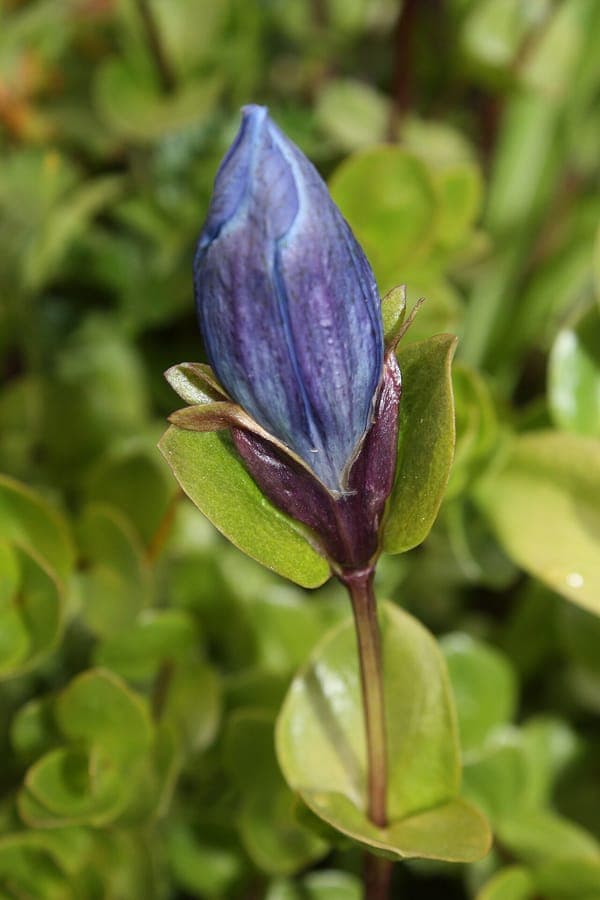
Walter Siegmund (talk) / CC BY-SA 3.0, via Wikimedia Commons
Gentiana calycosa: complete guide
Gentiana calycosa
Want to see Gentiana calycosa: complete guide in your garden?
1 minute, no credit card
Overview
Gentiana calycosa, commonly known as the Rainier pleated gentian, mountain bog gentian, or explorer's gentian, is one of the most striking alpine perennials native to western North America. It belongs to the family Gentianaceae and was formally described by the Russian-German botanist Alexander von Grisebach in 1837. Its natural range extends from the subalpine and alpine zones of Alberta and British Columbia southward through Washington, Oregon, Idaho, Montana, Wyoming, Utah, Nevada, and California - always at elevation, in moist mountain meadows, along streamsides, and on rocky, shaded slopes.
For gardeners, Gentiana calycosa offers something genuinely rare: a combination of delicate, jewel-like appearance with remarkable toughness in cold and wet conditions. The flowers are a deep royal blue to violet-blue, among the most saturated colours achievable in a late-summer border. Gardenworld.app regularly features rock garden designs built around this species and other mountain gentians, providing seasonal colour combinations for alpine-inspired layouts.
The species epithet calycosa refers to the conspicuously large calyx that surrounds each flower - a feature that readily distinguishes this species from most other gentians. Older botanical synonyms such as Pneumonanthe calycosa and Gentiana obtusiloba occasionally appear in legacy references, but Gentiana calycosa Griseb. is the currently accepted name.
The plant is classified as a forb/herb with a multiple-stem growth form, capable of rapid growth during the active growing season. It remains relatively compact - typically 10 to 30 cm tall - forming dense clumps that expand slowly over the years.
Appearance and bloom cycle
The stems of Gentiana calycosa are erect to slightly arching and reach 10 to 30 cm in height. The leaves are opposite, ovate to lance-shaped, deep green, and glossy, with a fine texture that is characteristic of the gentian family. Leaf pairs are closely spaced along the stem, giving the plant a neat, compact appearance that works well in a formal rock garden composition.
The flowers are the unmistakable highlight. They are trumpet- to funnel-shaped, deep royal blue to violet-blue, and typically 3 to 5 cm long. The calyx lobes are conspicuously large and clearly visible - the defining character of this species. The petal tips are sometimes lightly pleated or folded (hence the common name 'pleated gentian'), and small secondary lobes sit between the main corolla lobes, giving each flower a full, richly textured appearance.
Flowering occurs from August through September, often extending into October in mild years. This positions Gentiana calycosa as one of very few perennials capable of delivering an exuberant colour display at the tail end of the gardening season. Seeds are small, dark to black, and relatively inconspicuous. After flowering, the above-ground parts die back and the plant overwinters as a dormant rhizome.
Several botanical varieties are recognised. Var. monticola (Rydb.) remains slightly more compact than the type. Var. asepala (Maguire) has greatly reduced calyx lobes. The rare yellow-flowered var. xantha can occasionally be sourced from specialist alpine nurseries.
Ideal location
Gentiana calycosa thrives in full sun to light partial shade. In its natural habitat it grows in subalpine meadows and along mountain streams at elevations from 1,500 to over 3,000 metres. In a garden setting, this translates to a position that receives direct sunlight in the morning and early afternoon, with some relief from the hottest midday sun in warmer climates.
Good air circulation is important: the plant dislikes stagnant humid air that promotes fungal disease. A rock garden, a raised alpine bed, or a well-drained slope are all ideal situations. The front of a border, along stone steps, or as an accent among low-growing alpine plants are all effective placements.
Gentiana calycosa is fully winter-hardy, tolerating temperatures of -30 °C or colder without protection - corresponding to USDA hardiness zone 3. In cooler temperate climates this means it is completely reliable outdoors year-round. Protection against wet winters is only necessary where drainage is inadequate; waterlogged roots are far more dangerous to this plant than low temperatures.
In mild, maritime climates with damp winters, placing the plant on a slightly elevated, well-drained site and ensuring good air movement around the foliage will significantly reduce the risk of collar rot and fungal problems.
Soil requirements
The ideal soil for Gentiana calycosa is acidic to slightly acidic, with a pH between 5.6 and 7.5. In nature the plant grows on moist yet free-draining mountain soils rich in organic matter but low in available nutrients. In the garden you can replicate these conditions by preparing a mix of loam, coarse grit (2 to 4 mm particle size), fine gravel, and well-rotted leafmould or compost in a ratio of approximately 2:2:1:1.
Free drainage is non-negotiable. Heavy clay soils or those that stay wet for extended periods are unsuitable and quickly lead to crown and root rot. When working with heavier soils, incorporate generous quantities of horticultural grit or perlite to open up the structure before planting.
Gentiana calycosa is not a heavy feeder. Excessive nitrogen promotes lush leafy growth at the expense of flower production, and also increases susceptibility to disease. A light top-dressing of a potassium-rich, low-nitrogen organic fertiliser applied in early spring (early March) is sufficient to support a good flowering display. Organic alternatives such as well-rotted garden compost or worm castings work well without overstimulating vegetative growth.
If the natural soil pH is above 7.5, acidifying with sulphur chips or incorporating ericaceous compost will gradually bring it into range. Soil-testing kits and pH meters are readily available at most garden centres.
Free design
Want to see Gentiana calycosa: complete guide in your garden? Make a free design now.
Watering
Water management is critical for Gentiana calycosa. The plant requires a consistently moist root zone but absolutely cannot tolerate waterlogging. The guiding principle is: moist but never wet. In its mountain habitat, spring snowmelt and summer rain keep the soil continuously moist, but mountain terrain ensures rapid drainage.
In garden practice this means regular watering during dry periods from May through September - ideally in the early morning to allow foliage to dry during the day. Water deeply enough to saturate the root zone, then allow the surface to partially dry before the next application. Avoid overhead irrigation in the evening to reduce the risk of fungal infection.
From autumn onwards, reduce watering significantly: the plant is approaching dormancy and needs much less moisture. Before the winter rains begin, check that drainage from the bed is adequate. If the soil remains saturated for weeks in December and January, raising the bed level or moving the plant to a better-drained position is advisable.
A 3 to 5 cm layer of pine-needle mulch or fine grit around - but not directly against - the crown of the plant helps maintain even soil moisture through summer while improving drainage in winter. Mulch also moderates soil temperature fluctuations, which gentians appreciate.
Pruning
Gentiana calycosa requires minimal pruning. After the flowers fade in September or October, the dead flower stems can be removed for neatness, though this is entirely optional. The leaves persist until the first hard frost and provide some protection to the crown.
In early spring - once the risk of hard frost has largely passed, typically from late March into April - remove the previous year's dead stems and foliage to encourage fresh growth. Cut back to just above the base of the plant, leaving a few centimetres of old stem to protect the developing buds beneath.
If you wish to divide an established clump for propagation, do so in early spring just as growth is resuming. Use a sharp, clean knife to cut the clump into sections, each containing at least three to five stems. Replant the divisions immediately at the same depth as the original plant and water them in thoroughly.
Maintenance calendar
The annual care routine for Gentiana calycosa is straightforward and undemanding. Here is a summary by month:
March: Remove the previous season's dead stems and foliage. Check and adjust soil pH if needed. Apply a light dressing of low-nitrogen organic fertiliser.
April to May: Growth resumes. Water regularly during dry spells. Watch for slug and snail damage, which is most severe on the tender young shoots at this stage.
June to July: Full vegetative growth. Maintain even soil moisture. Ensure any neighbouring plants are not shading the gentian too heavily.
August to September: Flowering period. Enjoy the intense blue display. Leave seed heads in place if you want to collect seed for propagation.
October to November: Seed dispersal and die-back of above-ground growth. Apply a mulch layer in very cold regions.
December to February: Dormancy. Minimal watering. Check periodically that drainage remains free.
Winter hardiness
Gentiana calycosa is among the hardiest of all gentian species. It tolerates temperatures of -30 °C or lower without protection and is rated for USDA hardiness zones 3 to 7. In temperate European climates it is fully reliable outdoors in all but the most exposed, waterlogged situations.
The primary winter hazard is not cold per se but the combination of cold and saturated soil. Roots sitting in standing water when temperatures drop below freezing can rot or freeze, destroying the plant. Free-draining soil and a raised planting position are the most effective protections against this.
A natural snow cover of 10 cm or more insulates the root zone and protects against extreme temperature swings. Where reliable snow cover cannot be guaranteed during hard frost periods, a light covering of conifer branches or horticultural fleece from November to late February provides adequate protection.
Companion plants
Gentiana calycosa combines beautifully with other alpine and rock garden plants that share its preference for well-drained, slightly acidic, cool and moist conditions. Some especially effective combinations:
Pulsatilla vulgaris (pasque flower): blooms from March to April, well before the gentian, extending the seasonal colour display. The feathery silver seed heads remain ornamental through summer.
Dianthus alpinus (alpine pink): forms dense cushions of pink to crimson flowers in June and July, bridging the gap between the earliest spring plants and the late-summer gentian.
Sedum acre (stonecrop) and other small sedums: fill gaps between stones and larger plants, keep the soil covered, and help suppress weeds without competing aggressively.
Thymus serpyllum (wild thyme): low aromatic ground cover with purple flowers from June to August, tolerant of the same conditions as the gentian.
Campanula cochleariifolia (fairy thimble): tiny nodding blue or white bells from July to August, ideal for crevices in stone walls or among paving, and a natural companion to the deep blue of the gentian.
Avoid placing plants with high nitrogen requirements or vigorous spreading habits directly adjacent to Gentiana calycosa, as they will quickly outcompete it.
Closing thoughts
Gentiana calycosa is a genuine treasure for any rock garden, alpine border, or nature-inspired garden seeking a spectacular blue-flowering perennial for late summer and early autumn. It asks for attention to soil structure and drainage, but repays that care with year after year of the same intense, saturated blue that is so rare and so beautiful in the late-season garden.
For more ideas on designing with alpine plants and creating year-round colour combinations in small spaces, visit gardenworld.app, where you will find detailed planting schemes and design inspiration to help bring your outdoor spaces to life. Whether you are planning a compact rock garden or a sweeping mountain-inspired border, gardenworld.app offers tailored design tools to match plants to your specific soil, aspect, and climate.
Want to see Gentiana calycosa: complete guide in your garden? Make a free design now.
Upload a photo, pick a style, and get a photorealistic design with plant list in under a minute.
10,000+ gardens designed already
No credit card required


Similar plants
Branched gentianella: complete guide
Gentianella ramosa
Full growing guide for Gentianella ramosa, the branched Alpine gentianella of the SW Alps - location, soil, watering, winter care and companion plants.
Spiked centaury: complete guide
Schenkia spicata
Full growing guide for Schenkia spicata (spiked centaury): sunny position, dry soil, bloom season and garden companions.
Narrow-leaf gentian: complete guide
Gentiana angustifolia
Narrow-leaf gentian growing guide: intense blue trumpet flowers in May-July on well-drained limestone. Full cultivation tips.