
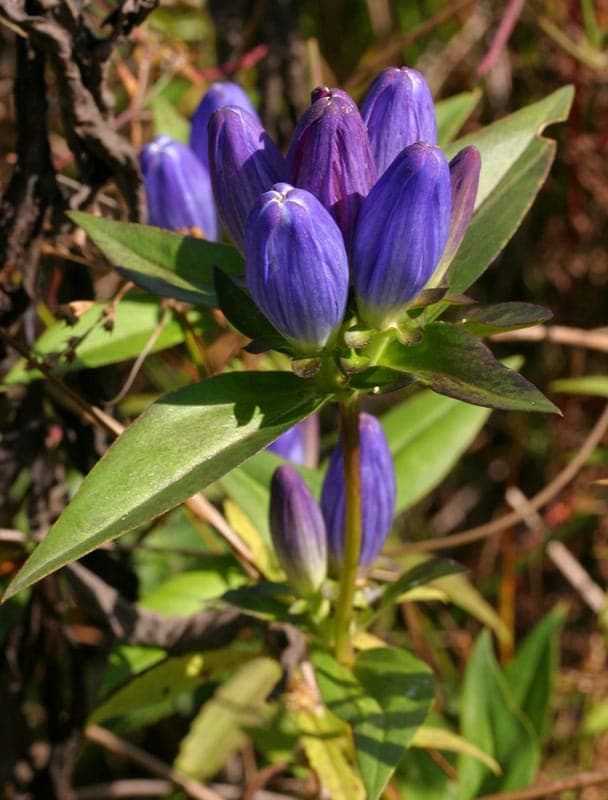
Hugowolf at en.wikipedia / CC BY 2.5, via Wikimedia Commons
Bottle gentian: complete guide
Gentiana andrewsii
Want to see Bottle gentian: complete guide in your garden?
1 minute, no credit card
Overview
Bottle gentian (Gentiana andrewsii) is one of North America's most distinctive native perennials, and a genuinely rewarding choice for gardeners who want strong late-season colour after most other plants have finished. Belonging to the family Gentianaceae, it is named after the English botanical artist Henry Charles Andrews and is sometimes called closed gentian or Andrews' gentian in reference to its most striking characteristic: the flower petals never fully open, remaining fused at the tips to form a rounded, bottle-shaped blossom in deep violet-blue to purple.
In the wild, bottle gentian grows across a vast range from southeastern Manitoba and southern Quebec through the central and eastern United States as far west as Colorado. It is a plant of moist prairies, fens, stream banks and wet woodland edges - habitats where the soil stays reliably damp through summer without becoming waterlogged for extended periods. This ecological background tells gardeners most of what they need to know: consistent moisture is non-negotiable, while good drainage prevents root rot.
For the gardener willing to provide those conditions, bottle gentian offers rewards that few autumn perennials can match. Its bloom period extends from late August through October, at a time when the garden palette is dominated by asters and goldenrods, and it brings an almost jewel-like quality of colour that photographs cannot quite capture. Bumblebees are essentially its only pollinators - they are strong enough to force their way into the closed corolla - making this plant a valuable late-season resource for these important insects. If you are planning a naturalistic autumn border, gardenworld.app offers useful inspiration for combining species with staggered bloom times and complementary heights.
Appearance and bloom cycle
Bottle gentian forms tidy, upright clumps of unbranched or lightly branched stems reaching 30 to 60 cm in height. The leaves are opposite, lance-shaped to oval, 5 to 10 cm long, and a fresh mid-green with fine texture and smooth margins. Through spring and early summer the plant builds vegetative growth quietly, giving little indication of what is to come.
Flowering begins in late August and continues until hard frosts end the season in October or November. Flowers are borne in terminal clusters and in the upper leaf axils, with each individual bloom measuring 3 to 4 cm in length. The corolla is deeply tubular, the tips fused and slightly pleated, and the colour ranges from rich violet-blue to deep purple. In good light the flowers have an almost luminescent quality. There are no widely available named cultivars of Gentiana andrewsii; it is generally sold as the straight species.
After flowering, inconspicuous seed capsules develop. Seeds require cold, moist stratification for 60 to 90 days before germination - a process you can replicate by sowing seed in pots of damp compost and placing them in an unheated greenhouse or cold frame over winter. The perennial rootstock is long-lived and the plant slowly spreads to form a modest clump over three to five years.
Ideal location
Bottle gentian thrives in full sun to partial shade. In gardens with heavy or moist soils, a position in full sun suits it well provided watering is consistent. Where soils dry quickly, a spot with morning sun and afternoon shade reduces moisture stress. The plant does not tolerate prolonged drought at any stage of the growing season.
Ideal positions include rain gardens, pond margins, moist borders alongside streams or ditches, and naturally damp low spots in the garden. Plant in groups of three to five or more for the best visual impact and for more effective pollination; space plants 30 to 40 cm apart. Bottle gentian also performs well in large, moisture-retentive containers.
Avoid dry, free-draining soils and deep shade under dense tree canopies where both light and moisture are lacking. On thin, sandy soils the plant survives poorly and rarely flowers to its full potential.
Soil requirements
The preferred soil is humus-rich, consistently moist and slightly acidic to neutral, with a pH between 5.8 and 7.2. Outside this range - particularly on strongly alkaline or chalky soils - the plant may develop iron chlorosis, with yellowing leaves indicating nutrient lock-up.
Before planting, work a generous amount of well-rotted compost or leaf mould into the planting area to a depth of 25 to 30 cm. On sandy soils add clay-based soil improver or extra compost to increase water retention. On heavy clay, incorporate grit and compost to improve structure and prevent waterlogging. A 5 to 8 cm mulch of leaf mould, wood chips or bark applied around the plants after planting helps maintain soil moisture and keeps surface roots cool.
Avoid over-fertilising with nitrogen-rich products, which promote lush leafy growth at the expense of flowering. A single application of a balanced slow-release fertiliser in early spring, such as Vitax Q4 available at garden centres, provides sufficient nutrition for the entire season.
Free design
Want to see Bottle gentian: complete guide in your garden? Make a free design now.
Watering
Consistent moisture is the single most important cultural requirement for bottle gentian. In its native habitats it grows where the soil never fully dries out, and in the garden this must be replicated. During dry spells in summer and early autumn, water two to three times a week, always at the base of the plant rather than overhead to reduce the risk of fungal problems.
Drip irrigation or soaker hoses on a timer are ideal for maintaining consistent moisture without manual effort. Mulching the root zone significantly reduces evaporation and can halve the frequency of watering needed during dry periods. After flowering finishes in late autumn, the water requirements drop sharply; through winter the dormant rootstock needs little supplemental irrigation unless the winter is exceptionally dry.
While bottle gentian likes moist soil, it cannot tolerate standing water for extended periods. Ensure the planting site has reasonable drainage so that excess rainfall moves away within a day or two.
Pruning
Bottle gentian requires minimal pruning. In early spring, when new growth appears (usually March to April depending on region), cut the previous year's stems back to 5 cm above ground level. This tidies the plant and gives young shoots room to develop. No summer pruning is needed.
After the main flowering period ends in October, you have a choice: deadhead to keep the border tidy, or leave the seed capsules intact through winter. The dried stems and seed capsules provide modest structural interest and a food source for seed-eating birds. Remove all remaining top growth in late February or early March, just before new growth emerges.
Division of established clumps is best carried out in early spring (March-April) or immediately after flowering (October-November). Use a sharp spade or fork to lift the clump and separate rooted sections, replanting at the same depth as before. Pot divisions into moisture-retentive compost and water well until re-established.
Maintenance calendar
February-March: Cut back old stems. Spread a 3 cm layer of well-rotted compost around plants, avoiding direct contact with emerging shoots.
April-May: Monitor soil moisture and begin regular watering during dry spells. Apply slow-release fertiliser if growth appears weak.
June-July: Maintain consistent moisture. Weed around plants. Watch for aphids or powdery mildew, treat early if spotted.
August-September: Enjoy peak flowering. Maintain watering. Observe bumblebee activity - a reliable indicator of plant health.
October-November: Flowers finish. Decide whether to leave or remove seed capsules. Reduce watering.
December-January: Minimal maintenance. Apply additional mulch (5-8 cm) around rootstocks if severe frost without snow cover is expected.
Winter hardiness
Bottle gentian is an exceptionally cold-hardy perennial, tolerating temperatures down to -30 °C or below (USDA Hardiness Zone 3). Above-ground growth dies back completely in autumn and the plant overwinters via its deep rootstock. In most UK and northern European gardens (typically Zones 8-9) frost damage to the rootstock is essentially unknown.
Newly planted specimens in their first winter benefit from a protective mulch of 5 to 8 cm of straw or fallen leaves spread over the root zone. Established plants three years and older need no winter protection in temperate maritime climates. The plant's exceptional cold tolerance, combined with its preference for moist soils, makes it ideal for low-lying gardens with naturally damp ground.
Companion plants
Bottle gentian pairs particularly well with other moisture-loving species and late-season bloomers:
- New England aster (Symphyotrichum novae-angliae 'Alma Pötschke') - its rose-magenta flowers complement the deep blue-purple of bottle gentian superbly in late September and October.
- Blue mistflower (Conoclinium coelestinum) - similar moisture requirements and produces soft, hazy blue-violet flowers in late summer.
- Joe Pye weed (Eutrochium purpureum) - a tall, architectural species providing background height and attracting the same pollinators.
- Cardinal flower (Lobelia cardinalis) - brilliant red flowers in August that extend the colour interest before bottle gentian takes centre stage.
- Swamp milkweed (Asclepias incarnata) - attractive summer bloomer with similar moisture preferences.
- Siberian iris (Iris sibirica) - early summer flowering, similar upright habit, tolerates moist soil.
Avoid pairing bottle gentian with drought-tolerant Mediterranean herbs such as lavender, rosemary or thyme; their very different moisture requirements make them unsuitable neighbours regardless of aesthetic compatibility.
Closing
Bottle gentian rewards the patient gardener who can offer moist soil and some shade with a spectacular display of deep blue-purple flowers just when most perennial borders are winding down. Its unusual closed blooms, its partnership with bumblebees, and its cheerful insistence on flowering deep into autumn make it genuinely irreplaceable in a thoughtfully planted naturalistic garden. Visit gardenworld.app to explore planting combinations that bring together the best autumn and winter interest plants for your space, and to get personalised design ideas for moist or shaded garden corners.
Want to see Bottle gentian: complete guide in your garden? Make a free design now.
Upload a photo, pick a style, and get a photorealistic design with plant list in under a minute.
10,000+ gardens designed already
No credit card required


Similar plants
Branched gentianella: complete guide
Gentianella ramosa
Full growing guide for Gentianella ramosa, the branched Alpine gentianella of the SW Alps - location, soil, watering, winter care and companion plants.
Spiked centaury: complete guide
Schenkia spicata
Full growing guide for Schenkia spicata (spiked centaury): sunny position, dry soil, bloom season and garden companions.
Narrow-leaf gentian: complete guide
Gentiana angustifolia
Narrow-leaf gentian growing guide: intense blue trumpet flowers in May-July on well-drained limestone. Full cultivation tips.