
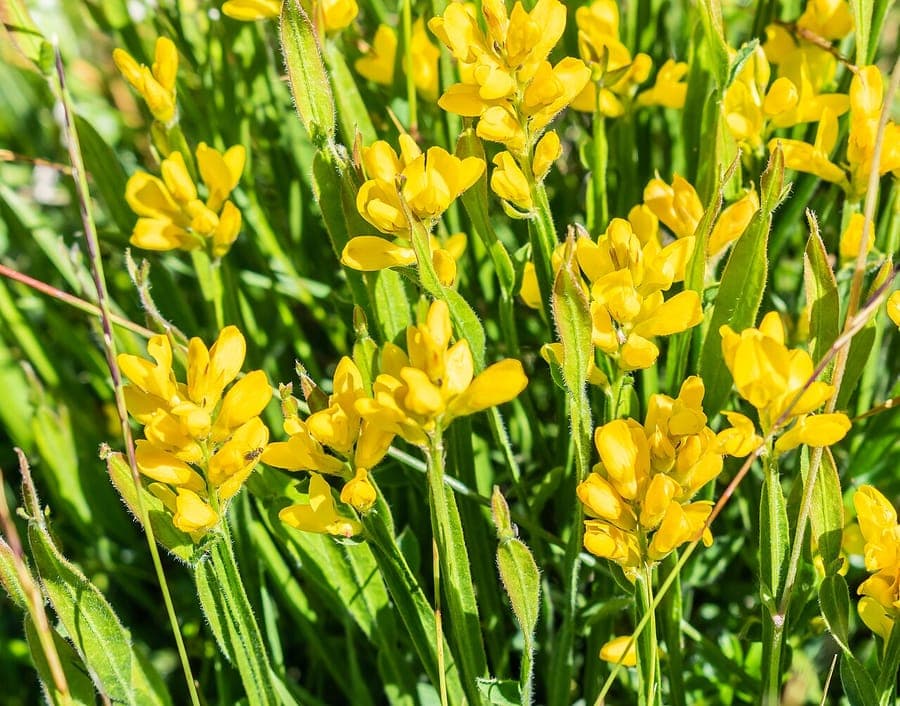
Krzysztof Golik / CC BY-SA 4.0, via Wikimedia Commons
Winged greenweed: complete guide
Genista sagittalis
Want to see Winged greenweed: complete guide in your garden?
1 minute, no credit card
Overview
Genista sagittalis, commonly known as winged greenweed, is a quietly striking subshrub that brings charm to dry, sunny corners of the garden. Native across central and southern Europe - including Belgium, Germany, and parts of France - it thrives in open grasslands, sandy slopes, and rocky outcrops. As a member of the Fabaceae family, it fixes nitrogen in the soil, improving growing conditions for neighbouring plants. Growing to 30–50 cm in height with a spread of up to 60 cm, it's perfect for the front of borders or as ground cover in rock gardens.
This is a plant for gardeners who value resilience over flash. Once established, it demands little attention and rewards with cheerful blooms and fine texture. On gardenworld.app, you can design a layout that highlights its airy form and golden flowers, placing it where sun and drainage are optimal.
Appearance & bloom cycle
Winged greenweed has slender, angular stems with distinctive wing-like ridges - the feature that gives it its common name. The leaves are narrow, arrow-shaped, and softly grey-green, arranged alternately along the stems. In early summer, typically from late May to early July, the plant erupts in clusters of bright yellow, pea-like flowers. Each bloom is small, about 1 cm long, but they appear in such numbers that the whole shrub glows in the sunlight.
The flowering period lasts four to six weeks, depending on rainfall and temperature. After blooming, flat seed pods develop and split open in autumn, scattering seeds. These self-sown seedlings often pop up nearby, which can be left for naturalisation or transplanted. The plant retains a tidy, upright form through winter, with bare green stems adding subtle structure to the dormant garden.
Ideal location
This plant thrives in full sun - rate it an 8 out of 10 for light needs. It performs poorly in shade, becoming leggy and sparse. Choose a spot with at least 6–8 hours of direct sunlight daily. South- or west-facing slopes, gravel gardens, or raised beds work best. It also does well in crevices between rocks or at the base of low walls where heat radiates.
Avoid damp, shaded corners or areas where water pools after rain. Good air circulation is essential to prevent fungal diseases. If your garden has heavy clay, consider planting in a raised mound with added grit. Check microclimate conditions on gardenworld.app to confirm whether your site gets enough sun and stays well-drained.
Soil requirements
Winged greenweed prefers poor to moderately fertile, well-drained soils. Sandy or gravelly loams with a pH between 5.0 and 5.5 are ideal. It struggles in rich, nitrogen-heavy soils, which promote excessive leafy growth at the expense of flowers. Avoid amending the soil with compost or manure - this plant evolved in nutrient-poor conditions and doesn't need feeding.
If your soil is clay-heavy, mix in coarse sand and fine gravel to improve drainage. Never let roots sit in water. The plant's nitrogen-fixing ability means it enriches the soil naturally, making it a helpful companion in poor-ground areas.
Free design
Want to see Winged greenweed: complete guide in your garden? Make a free design now.
Watering
Once established, Genista sagittalis is highly drought-tolerant. Young plants need regular watering in their first growing season, especially during dry spells. Water deeply but infrequently - once a week at most - to encourage deep root development. After year one, supplemental watering is rarely needed, even in prolonged dry periods.
Overhead watering should be avoided; wet foliage increases the risk of powdery mildew and root rot. Use a soaker hose or water at the base. This plant is not suited to humid, irrigated lawns or constantly moist beds.
Pruning
Pruning is minimal. Cut back lightly after flowering, between late July and early August, to maintain shape and prevent self-seeding. Never prune into old wood - this species doesn't regenerate well from bare stems. Remove no more than one-third of the plant at a time, using sharp, clean secateurs for clean cuts.
Older plants (6+ years) may become woody and sparse. Consider replacing them with self-sown seedlings or new plants. Transplant seedlings when they're 10–15 cm tall, ideally in autumn or early spring.
Maintenance calendar
- January: Inspect for winter damage. Sharpen tools.
- February: Clear debris around plants to prevent moisture buildup.
- March: Remove any dead stems. Prepare planting areas.
- April: Monitor for new growth. Transplant seedlings if needed.
- May: Water young plants in dry spells. No fertiliser.
- June: Peak bloom. Attract bees and pollinators.
- July: Prune lightly after flowering ends.
- August: Let plant rest. Avoid late pruning.
- September: Collect seeds if desired. Remove old pods.
- October: Keep area clean. Avoid mulching heavily.
- November: No action needed. Ensure drainage.
- December: Check for snow damage on stems.
Winter hardiness
Winged greenweed is hardy in USDA zones 6–8. In most of the UK and northern Europe, it survives winter without protection. However, wet soil in winter is its biggest enemy. Ensure the site drains well to prevent root rot. Do not apply winter mulch - it traps moisture and encourages fungal issues. Young plants can be protected with a light covering of straw or bracken, but mature plants are best left exposed.
Companion plants
Pair with other drought-tolerant, sun-loving species. Good choices include thyme (Thymus vulgaris), sedums like 'Autumn Joy', lamb's ear (Stachys byzantina), and compact lavender (Lavandula angustifolia 'Hidcote'). Also works well with small ornamental grasses such as Festuca glauca or Helictotrichon sempervirens.
Avoid moisture-loving plants like hostas or astilbes, which create damp microclimates. Winged greenweed shines in naturalistic schemes, gravel gardens, or Mediterranean-style borders.
Closing
Genista sagittalis is not a plant for those seeking instant impact. It's subtle, steady, and sustainable. Once settled, it asks for little and gives back in texture, bloom, and ecological value. Buy plants from reputable garden centres that specialise in native or Mediterranean species. Look for young stock in 1L pots, available in spring at most major retailers. With the right placement and patience, it becomes a long-term asset. Use gardenworld.app to visualise how it fits into your garden's structure, light patterns, and planting schemes.
Want to see Winged greenweed: complete guide in your garden? Make a free design now.
Upload a photo, pick a style, and get a photorealistic design with plant list in under a minute.
No credit card required


Similar plants
Tall Silky Lupine: complete guide
Lupinus elatus
Tall silky lupine is a fast-growing Californian perennial with silvery foliage and blue-purple flower spikes, ideal for a prairie-style garden.
Garfield Lupine: complete guide
Lupinus garfieldensis
The Garfield lupine is a rare, fast-growing American perennial for alkaline, dry grassland gardens, with striking blue flower spikes.
Lupinus elegans: complete guide
Lupinus elegans
Lupinus elegans, the elegant lupine, is a spectacular blooming plant from Mexico with blue flower spikes. Care, cultivation and garden use.