
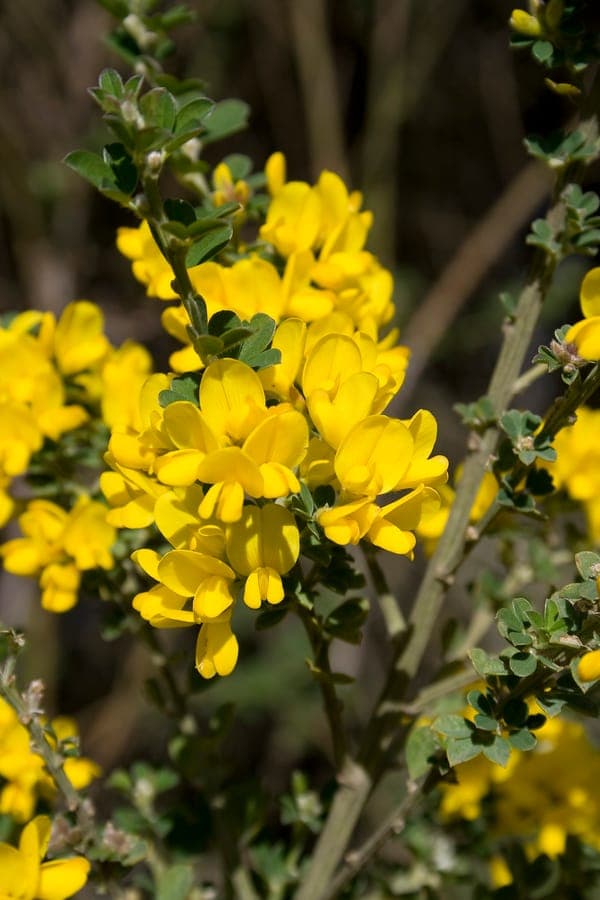
Calibas / CC BY-SA 4.0, via Wikimedia Commons
Genista monspessulana: complete guide
Genista monspessulana
Want to see Genista monspessulana: complete guide in your garden?
1 minute, no credit card
Overview
Genista monspessulana, known as Montpellier broom, cape broom, or French broom, is a widely distributed shrub originating from the Mediterranean region. This plant is a member of the legume family (Fabaceae) and is renowned for its profuse golden flowers appearing in spring.
Although Mediterranean in origin, Genista monspessulana grows well in temperate Northern European gardens provided it occupies warm, well-drained locations. The shrub is highly suited to modern, minimalist-designed gardens due to its compact growth and impressive flowering.
The plant is especially popular among garden designers due to its extended flowering period and attractive form. It is also an excellent choice for dry slopes and rock faces.
Appearance and bloom
Genista monspessulana grows to approximately 1 to 2 meters tall and wide, although this depends on climate and growing conditions. In temperate regions, the plant typically remains smaller than in southern climates.
The plant has fine, thin branches with small, linear foliage. The leaves are green and remain present year-round, so the plant is not deciduous. The vegetation has a very elegant, fine structure.
Flowers are small but extremely abundant and intensely golden yellow. Flowers appear from April to June in rich clusters. Each flowering stem carries dozens of tiny blooms. The flowering is very striking and shimmers in sunlight.
Following bloom, small legume pods form, characteristic of the Fabaceae family. These are unobtrusive and fade quietly as the season progresses.
Ideal location
Genista monspessulana demands full sunlight. Plant the shrub in a location receiving minimum 6 to 8 hours direct sunlight daily. Without adequate light, the plant will reduce flowering and grow less compactly.
The plant tolerates hard wind reasonably well, though strong winds may cause leaf drop. In very windy situations, some protection may prove useful.
Perfect locations are against warm south-facing walls, on hillsides, or in dry rock gardens. The plant also thrives in containers on terraces and balconies.
Soil
Genista monspessulana is highly tolerant of different soil types. It thrives best in poor, well-drained soils. This is essential: heavy, clayey soils must invariably be amended with sand and gravel.
The pH may be neutral to acidic (pH 5.0 to 7.0). The plant grows also on alkaline soils, although this is less ideal. In the Mediterranean, the plant grows on very calcium-rich soils.
Perfect mix: sand (50%), garden soil (30%), and organic material (20%). Ensure excellent drainage.
Free design
Want to see Genista monspessulana: complete guide in your garden? Make a free design now.
Watering
Once established, Genista monspessulana is extremely drought-tolerant. In the first year, regular watering may prove beneficial, especially during dry summers. After establishment, extra water is rarely needed.
During very dry periods, the plant may remain dry. Overwatering must strictly be avoided.
Even during dry Mediterranean summers without rain, the plant thrives well.
Pruning
Genista monspessulana requires pruning for optimal form. Annual pruning after bloom (June-July) helps keep the plant compact and ball-shaped.
Prune carefully: remove approximately one-third of annual growth. This stimulates branching and increased blooming. Never cut back into old, bare wood; this leads to poor recovery.
Optionally, light shaping pruning can occur in July-August. However, avoid leaving bare branches.
Maintenance calendar
Genista monspessulana follows a simple maintenance schedule.
Spring (March-May): Plant newly acquired specimens in warm locations. Water regularly in first season. Enjoy bloom.
Summer (June-July): Perform careful pruning after flowering. No water needed unless very dry.
Autumn (August-October): Plant accepts no feeding. Water only during extreme drought.
Winter (November-February): In much of temperate Europe no frost damage occurs. In very cold regions, protection may prove useful.
Winter hardiness
Genista monspessulana is moderately hardy. In much of temperate Europe, the plant survives frost periods well. In very severe winters (below -15 degrees Celsius), branches may freeze.
In coastal regions and southern areas, no problems occur. In higher elevations, protection may prove useful for young plants.
In case of frost damage: the plant typically recovers from underground reserves. Remove damaged parts in spring.
Companion planting ideas
Genista monspessulana combines beautifully with other Mediterranean-based gardens:
- With Santolina chamaecyparissus for texture contrast
- With Cistus (rock roses) for multiple yellow tones
- With Rosmarinus for aromatic cooperation
- With Lavandula (lavender) for color and flowering-time contrast
- With grey-leaved plants like Helichrysum for foliage harmony
These combinations create a Mediterranean garden aesthetic.
Closing
Genista monspessulana is a striking shrub for dry, warm garden locations. With extended yellow flowering, minimal maintenance, and attractive form, it is a highly suitable choice for contemporary gardens.
Genista monspessulana is available from garden centers and nurseries. Prices for potted plants range around EUR 15-25.
Gardenworld.app can help you position this Mediterranean shrub optimally in your front yard. With our garden design tools, you can visualize how the shrub grows and flowers in your specific location. Our guidance ensures you plant a Mediterranean garden accent piece with confidence.
Want to see Genista monspessulana: complete guide in your garden? Make a free design now.
Upload a photo, pick a style, and get a photorealistic design with plant list in under a minute.
No credit card required


Similar plants
Tall Silky Lupine: complete guide
Lupinus elatus
Tall silky lupine is a fast-growing Californian perennial with silvery foliage and blue-purple flower spikes, ideal for a prairie-style garden.
Garfield Lupine: complete guide
Lupinus garfieldensis
The Garfield lupine is a rare, fast-growing American perennial for alkaline, dry grassland gardens, with striking blue flower spikes.
Lupinus elegans: complete guide
Lupinus elegans
Lupinus elegans, the elegant lupine, is a spectacular blooming plant from Mexico with blue flower spikes. Care, cultivation and garden use.