
Wikimedia Commons / Public domain, via Wikimedia Commons
German greenweed: complete guide
Genista germanica
Want to see German greenweed: complete guide in your garden?
1 minute, no credit card
Overview
Genista germanica, better known as German greenweed, is a tough yet graceful shrub that thrives in tough spots where other plants struggle. Native to central Europe-Austria, Germany, France, Belarus, and parts of Russia-it's a natural fit for dry, sunny slopes and poor soils. In the UK and North America, it's still underused, but for gardeners who value resilience and quiet beauty, this plant is a gem. On gardenworld.app, you can design a garden layout that highlights German greenweed's strengths in xeriscaping and slope stabilization.
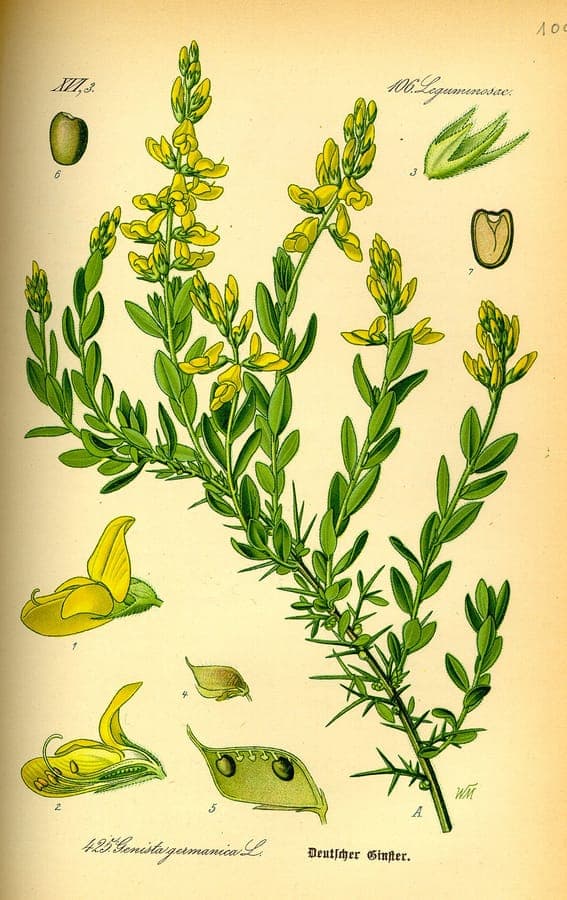
Growing 30–60 cm tall and spreading up to 80 cm wide, German greenweed has slender, green stems covered in narrow, needle-like leaves. It's semi-evergreen, meaning it holds most of its foliage through winter, though extreme cold may cause some browning. As a member of the Fabaceae family, it fixes atmospheric nitrogen, enriching the soil naturally-ideal for poor-quality sites.
Appearance & bloom cycle
The highlight of this shrub is its flowering period, which runs from late May through July. During this time, it's covered in bright yellow, pea-like flowers clustered at the tips of the stems. The blooms are small-about 1 cm long-but appear in such numbers that the whole plant glows in the sun. After flowering, flat seed pods form, turning dark brown by autumn and often persisting into winter, adding texture.
The foliage is fine and bright green, with leaves measuring 1–2 cm. Older stems become woody and slightly ribbed. While not showy in winter, the plant maintains a tidy, compact shape that fits well in structured or naturalistic designs.
Ideal location
Full sun is non-negotiable. German greenweed needs at least 6–8 hours of direct sunlight daily to flower well. It performs best on south- or west-facing banks, in rock gardens, or at the front of sunny borders. Light shade is tolerated, but flowering will be sparse.
It's perfect for dry gardens, gravel beds, or slopes where water runs off quickly. Avoid damp, shady corners-this plant hates wet feet. Use it as a low maintenance groundcover in areas where grass won't grow. For design inspiration, check gardenworld.app to pair it with drought-tolerant perennials in a water-wise layout.
Soil requirements
Well-drained soil is essential. German greenweed thrives in sandy, gravelly, or rocky soils with a pH from 5.5 to 7.0. It tolerates poor, low-fertility ground better than rich compost-heavy mixes. In fact, too much organic matter encourages leggy growth and reduces flowering.
Avoid adding manure or rich compost. This plant is built for lean conditions. On heavy clay, improve drainage with grit or plant on a raised mound. Overly fertile soil leads to weak, sprawling stems that flop open.
Free design
Want to see German greenweed: complete guide in your garden? Make a free design now.
Watering
Once established, German greenweed is extremely drought-tolerant. During the first growing season, water weekly if there's no rain, focusing on deep soakings to encourage root development.
After year one, supplemental watering is rarely needed-only during prolonged droughts lasting more than four weeks. When you do water, go deep and infrequent. Light sprinkling does little and can promote fungal issues.
Pruning
Pruning isn't required, but it helps maintain shape and prevent woody sprawl. Cut back right after flowering, between late July and mid-August. Trim up to one-third of the stems, focusing on older or straggly growth.
Never prune in spring-you'll cut off the flower buds. Use sharp, clean shears. If the plant becomes too woody at the base, cut a few old stems down to ground level to stimulate fresh shoots.
Maintenance calendar
- January–February: Check for winter damage. Remove any dead wood.
- March: No feeding needed. Prepare soil around plant if planting nearby.
- April–May: New growth emerges. Let flower buds develop undisturbed.
- June–July: Peak bloom. Water only in extreme drought.
- August: Prune lightly after flowering. Keep shape compact.
- September–October: Seed pods mature. Clean up if desired.
- November–December: Leave alone. Ensure good drainage before winter rains.
Winter hardiness
German greenweed is hardy to USDA zone 5 (down to -20°C). In zones 6–8, it needs no winter protection. In colder areas, mulch lightly with gravel-avoid organic mulch, which holds moisture and can rot the crown.
In containers, move pots to a sheltered spot or wrap with hessian. Elevate pots on feet to prevent waterlogging.
Companion plants
Pair German greenweed with other drought-tolerant perennials: Salvia nemorosa, Nepeta, Sedum, or Thymus. Its yellow flowers contrast beautifully with blue or purple blooms.
Good structural partners include Stachys byzantina, Eryngium, or ornamental grasses like Festuca glauca. Avoid moisture-loving plants like ferns or astilbe.
Closing
German greenweed is low-key but reliable. It asks for little and gives back with cheerful summer blooms and year-round structure. It supports pollinators and improves soil over time. Find it at garden centres in late spring, or check specialty nurseries. For a tailored planting plan, use gardenworld.app to visualize how this shrub fits into your sunny, dry garden zones.
Want to see German greenweed: complete guide in your garden? Make a free design now.
Upload a photo, pick a style, and get a photorealistic design with plant list in under a minute.
No credit card required


Similar plants
Tall Silky Lupine: complete guide
Lupinus elatus
Tall silky lupine is a fast-growing Californian perennial with silvery foliage and blue-purple flower spikes, ideal for a prairie-style garden.
Garfield Lupine: complete guide
Lupinus garfieldensis
The Garfield lupine is a rare, fast-growing American perennial for alkaline, dry grassland gardens, with striking blue flower spikes.
Lupinus elegans: complete guide
Lupinus elegans
Lupinus elegans, the elegant lupine, is a spectacular blooming plant from Mexico with blue flower spikes. Care, cultivation and garden use.