
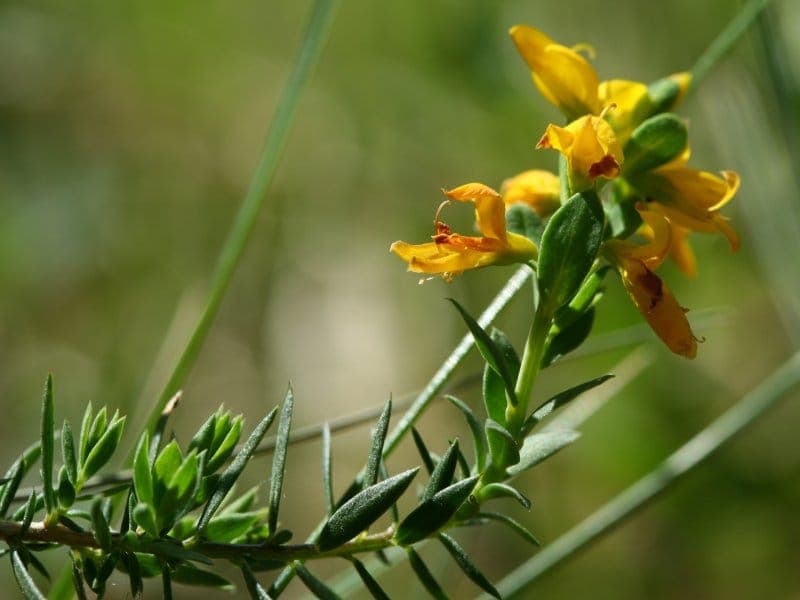
Kristian Peters -- Fabelfroh 11:04, 8 May 2007 (UTC) / CC BY-SA 3.0, via Wikimedia Commons
Petty whin: complete guide
Genista anglica
Want to see Petty whin: complete guide in your garden?
1 minute, no credit card
Overview
Petty whin, or Genista anglica, isn't the showiest plant in the garden, but it's one of the most reliable. Native to coastal heaths and dry grasslands across western Europe, it thrives in conditions that would defeat flashier shrubs. Found naturally in countries like France, Spain, and Great Britain, this subshrub brings quiet resilience to the garden. It grows up to 1 meter tall with a rounded, spreading habit, forming dense thickets over time. Unlike some ornamental shrubs, it doesn't demand attention – but once you see it glowing with golden flowers in midsummer, you'll appreciate its understated strength. On gardenworld.app you can design a planting scheme that highlights Petty whin's natural rhythm, matching it with other sun-loving, low-fertility lovers.
It's wintergreen, which means it keeps its narrow, trifoliate leaves year-round. That gives structure in winter when many other plants have died back. The stiff, slightly spiny stems deter rabbits and deer, making it a smart choice for open or rural gardens. It spreads slowly via underground runners, so it won't take over – but it will fill in gaps nicely over a few years. If you're after low-maintenance drama, this is your plant.
Appearance & bloom cycle
Petty whin has a soft, airy look despite its tough nature. The small, lance-shaped leaves grow in threes along green, slightly hairy young stems. In June through August, it bursts into bloom with clusters of bright yellow, pea-like flowers. Each flower is only about 1 cm long, but they come in dense racemes that cover the plant in a gold haze. The bloom period is long for a shrub of this type – up to eight weeks – and it often draws bees, butterflies, and hoverflies. After flowering, flat seed pods form and darken through autumn, sometimes persisting into winter and adding visual interest.
The overall effect is one of gentle movement, especially when planted in groups of three or more. It works beautifully in naturalistic plantings, gravel gardens, or as a low hedge in dry, sunny corners. The golden flowers contrast well with silvery foliage or dark green conifers.
Ideal location
Sun is non-negotiable for Petty whin. Aim for a spot with at least 7 hours of direct sunlight daily – full south or southwest exposure is ideal. It won't thrive in shade or even partial shade; stems become leggy, and flowering drops off. Choose a well-drained site, preferably on a slope or raised bed. Avoid low-lying areas where water pools after rain. In heavy clay soils, it's worth building a mound or raised bed to ensure drainage. Good air circulation also helps prevent fungal issues. On gardenworld.app you can test different layouts to find the perfect sunny spot for Petty whin in your garden.
Free design
Want to see Petty whin: complete guide in your garden? Make a free design now.
Soil requirements
This plant loves acidic, sandy, low-fertility soils. The ideal pH range is between 4.5 and 5.0. It struggles in alkaline or chalky soils, where chlorosis (yellowing leaves) often sets in. If your soil is clay-heavy or neutral, amend it with coarse sand and ericaceous compost. A mix of 60% sand and 40% acidic organic matter works well. Avoid adding manure or rich compost – Petty whin actually performs better in poor soils. It's adapted to nutrient-poor heathlands, so fertilizing can do more harm than good.
Watering
Once established, Petty whin is extremely drought-tolerant. In the first growing season after planting, water weekly during dry spells. After that, it should survive on rainfall alone, even in prolonged summer droughts. Use rainwater if possible, as tap water can raise pH over time. Overwatering is a bigger risk than underwatering – soggy roots lead to root rot. In winter, no extra watering is needed. Let nature take its course.
Pruning
Pruning isn't required, but you can shape the plant if it starts to sprawl. Never cut into old wood – it won't regrow. The best time to prune is right after flowering, between late August and early September. Remove up to one-third of the oldest stems to encourage fresh growth. Use sharp, clean secateurs and wear gloves – the stems are spiny and can snag clothing or skin. Avoid hard pruning in spring, as this removes the flowering wood for the year.
Maintenance calendar
- Jan: Monitor for frost damage
- Feb: Check for broken stems after winter storms
- Mar: Clear debris; check for pests
- Apr: Inspect for aphids; treat with soapy water if needed
- May: Apply a light dressing of acidic mulch (optional)
- Jun: Peak of bloom; enjoy pollinator activity
- Jul: Continue bloom; avoid pruning
- Aug: Bloom ends; light pruning possible
- Sep: Remove spent pods or leave for birds
- Oct: Consider transplanting if needed
- Nov: Let leaf litter accumulate as natural mulch
- Dec: Minimal care; protect young plants in exposed sites
Winter hardiness
Petty whin is hardy in USDA zones 7 to 9, surviving temperatures down to -12°C. In colder zones, it may die back but can re-sprout in spring if the roots are protected. In exposed or windy gardens, young plants benefit from a light mulch of pine needles or bracken. Mature plants are generally self-sufficient. Avoid planting in frost pockets or north-facing spots where cold air settles.
Companion plants
Pair Petty whin with other sun-loving, dry-soil plants: lavender, heather (Calluna), sea thrift (Armeria), or stipa grasses. It works well behind silver-leaved plants like Artemisia or in front of upright conifers. Avoid moisture lovers like hostas or astilbes. For pollinator appeal, combine with echinacea, sedum, or verbena. The contrast in texture and bloom time creates depth and year-round interest.
Closing
Petty whin earns its place through reliability, not flash. It doesn't need coddling, and it rewards with long-lasting blooms and structure. Available at garden centres across the UK and online, look for 3L pots from trusted suppliers. With a little planning – maybe even a layout from gardenworld.app – it becomes a quiet backbone in your garden for years to come.
Want to see Petty whin: complete guide in your garden? Make a free design now.
Upload a photo, pick a style, and get a photorealistic design with plant list in under a minute.
No credit card required


Similar plants
Tall Silky Lupine: complete guide
Lupinus elatus
Tall silky lupine is a fast-growing Californian perennial with silvery foliage and blue-purple flower spikes, ideal for a prairie-style garden.
Garfield Lupine: complete guide
Lupinus garfieldensis
The Garfield lupine is a rare, fast-growing American perennial for alkaline, dry grassland gardens, with striking blue flower spikes.
Lupinus elegans: complete guide
Lupinus elegans
Lupinus elegans, the elegant lupine, is a spectacular blooming plant from Mexico with blue flower spikes. Care, cultivation and garden use.