
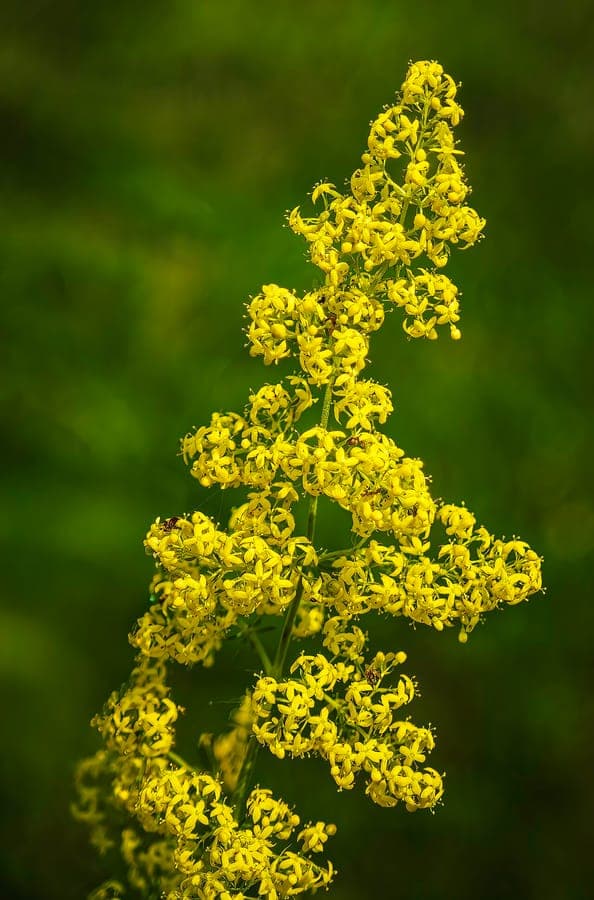
Didier Descouens / CC BY-SA 4.0, via Wikimedia Commons
Yellow bedstraw: complete guide
Galium verum
Want to see Yellow bedstraw: complete guide in your garden?
1 minute, no credit card
Overview
Yellow bedstraw (Galium verum) is a resilient herbaceous perennial that brings airy, golden blooms to sunny borders and meadows from early summer into autumn. Native across much of Europe and parts of Asia, it's a common sight in dry grasslands, roadside verges, and coastal dunes. Growing 30 to 60 cm tall with a spread of up to 50 cm, this vine-like forb spreads gently via underground rhizomes, forming dense mats over time. It's an excellent low-maintenance choice for naturalistic planting schemes and wildlife gardens.
On gardenworld.app, you can design a garden plan that integrates yellow bedstraw with compatible companions, ensuring proper spacing and seasonal rhythm. The platform helps visualize how its golden plumes will soften hardscapes or blend into wildflower meadows.
Appearance & bloom cycle
From June through September, yellow bedstraw produces clusters of tiny, star-shaped yellow flowers, each about 5 mm wide, arranged in fluffy, branched panicles. These soft, golden tufts hover above narrow, whorled leaves that grow in groups of 8–12 along square, creeping stems. The foliage is bright green and finely textured, giving the plant a delicate, lacy appearance.
The blooms emit a faint, honey-like fragrance, especially in the evening, attracting a wide range of pollinators including bees, hoverflies, and moths. After flowering, the plant develops small, hooked fruits that cling to fur and fabric-hence the name 'bedstraw', as it was historically used to stuff mattresses.
This long bloom period makes it a valuable asset in the garden, bridging the gap between early and late-season flowering plants.
Ideal location
Yellow bedstraw thrives in full sun, scoring a 7 on the light scale-meaning at least 6 hours of direct sunlight daily. It performs best in open, unshaded areas with good air circulation. It's ideal for dry, sunny borders, gravel gardens, rockeries, or natural meadows. Avoid heavily shaded spots, as the plant will become leggy and flower poorly.
It's particularly effective in informal or wildlife-focused gardens where its spreading habit can be embraced. In more structured designs, consider planting it in contained areas or with strong neighboring plants to keep its growth in check.
Soil requirements
This plant prefers well-drained, sandy or loamy soils with a pH between 7.0 and 7.5-neutral to slightly alkaline. It struggles in heavy clay or waterlogged conditions, where root rot can develop. If your soil is dense, amend it with grit or coarse sand at planting time to improve drainage.
Yellow bedstraw doesn't need rich soil; in fact, overly fertile conditions can lead to floppy growth and fewer flowers. Avoid adding compost or fertilizer. Its natural habitat includes nutrient-poor grasslands, so mimic those conditions for best results.
Using the soil analysis tool on gardenworld.app can help determine if your garden's pH and texture are suitable for yellow bedstraw, especially in regions like East Anglia or the South Downs where chalky soils are common.
Free design
Want to see Yellow bedstraw: complete guide in your garden? Make a free design now.
Watering
Once established, yellow bedstraw is highly drought tolerant. After the first growing season, it rarely needs supplemental watering, even during dry spells. Overwatering is a bigger risk than underwatering-excess moisture invites fungal diseases and weakens the root system.
During the first summer, water young plants weekly if rainfall is below 25 mm. Use rainwater when possible, as tap water-especially in hard water areas-can raise soil pH over time.
Pruning
Pruning isn't essential, but cutting back after flowering improves appearance and plant health. In late September, trim the stems to about 10 cm above ground level. This encourages fresh growth next spring and prevents old stems from becoming soggy over winter.
If you want to limit self-seeding, cut the plant back before seeds mature-around late August. The foliage can be left in place over winter to protect the crown, but remove it in early spring.
Maintenance calendar
- January: Inspect plant base; remove any damaged or matted debris.
- February: No action needed.
- March: Clear remaining old growth; prepare for new shoots.
- April: New growth emerges. Watch for slugs on young shoots.
- May: Rapid growth phase. Water only in prolonged dry periods.
- June: Flowers begin. No feeding required.
- July: Peak bloom. Rich in pollinators.
- August: Flowering winds down. Cut back if limiting spread.
- September: Finish blooming. Cut back to 10 cm.
- October: Leave debris as light mulch or clear for tidiness.
- November: Dormancy begins.
- December: Full winter rest.
Winter hardiness
Yellow bedstraw is hardy in USDA zones 5 to 9, making it suitable for most of the UK, northern Europe, and much of the northern US. The top growth dies back in autumn, but the rhizomes survive underground. No winter protection is needed, even in harsh conditions. A light layer of leaf litter can help in exposed sites, but it's rarely necessary.
Companion plants
Pair yellow bedstraw with other drought-tolerant perennials like yarrow (Achillea), sea holly (Eryngium), or catmint (Nepeta). It contrasts beautifully with spiky grasses like Deschampsia cespitosa or Stipa gigantea. For colour harmony, plant with Echinacea or Rudbeckia.
Avoid moisture-loving plants such as hostas or astilbes, which require different care and may suffer in the dry conditions yellow bedstraw prefers. Stick to plants that thrive in similar sunny, well-drained settings.
Closing
Yellow bedstraw is a tough, low-fuss perennial that delivers long-lasting colour and supports biodiversity with minimal input. Its cheerful yellow plumes and soft texture add movement and charm to sunny gardens. Give it space to spread, and it will reward you with years of reliable performance. Look for plants at garden centres in spring, or sow seeds directly from May onwards. With the right conditions-sun, sharp drainage, and lean soil-it's a near-indestructible addition to any eco-conscious garden.
Want to see Yellow bedstraw: complete guide in your garden? Make a free design now.
Upload a photo, pick a style, and get a photorealistic design with plant list in under a minute.
No credit card required


Similar plants
Oregon bedstraw: complete guide
Galium oreganum
Everything about Oregon bedstraw (Galium oreganum): shade planting, soil requirements, care and use as a low groundcover in woodland and shade gardens.
Awned woodruff: complete guide
Asperula aristata
Full guide to growing Asperula aristata, the awned woodruff: sunny location, alkaline soil, minimal watering, and companion plants for dry or rock gardens.
Purple woodruff: complete guide
Asperula purpurea
Full guide to Asperula purpurea, purple woodruff: sunny sites, chalky soil, watering, pruning, winter hardiness and companion plants for rock and dry gardens.