
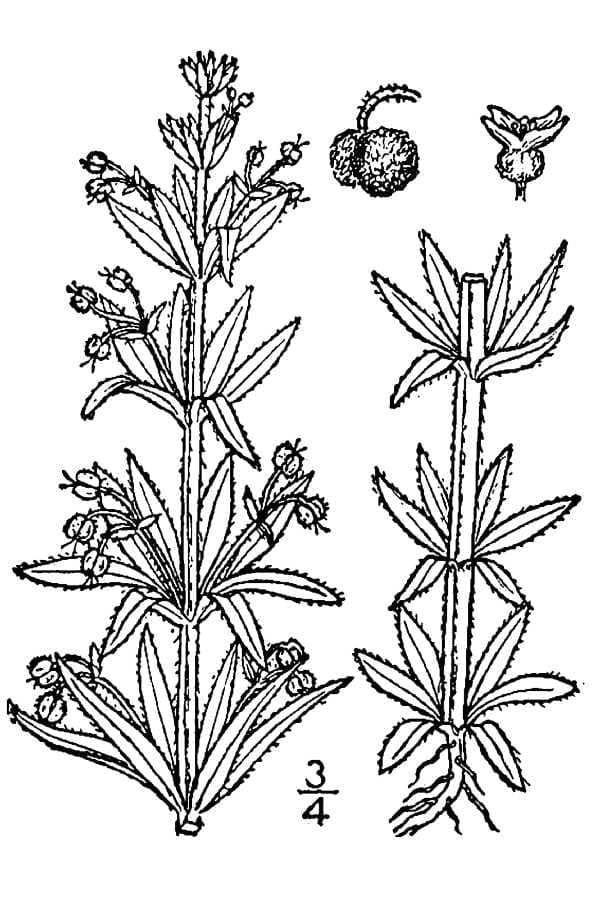
N. L. Britton & A. Brown / Public domain, via Wikimedia Commons
Corn-cleavers: complete guide
Galium tricornutum
Want to see Corn-cleavers: complete guide in your garden?
1 minute, no credit card
Overview
Corn-cleavers (Galium tricornutum) isn't the kind of plant that stops traffic, but it's a quiet achiever in the right setting. This herbaceous perennial, part of the Rubiaceae family, grows 15–30 cm tall and spreads slowly through creeping stems. Native to parts of Europe and Asia, it thrives in dry, chalky soils and is often found along roadsides or in rocky crevices. In the garden, it works well as a subtle ground cover or filler in crevices between pavers.
Hardy in USDA zones 6–9, corn-cleavers survives most UK and northern European winters without fuss. It dies back in late autumn and re-emerges in spring from its rootstock. It's not commonly sold in mainstream garden centres, but you might find it at specialist native plant suppliers. On gardenworld.app, you can design a planting scheme that highlights understated plants like this, blending texture and low impact with ecological value.
Appearance & bloom cycle
The plant has narrow, lance-shaped leaves arranged in whorls of four along square stems – a hallmark of the coffee family. From June to September, tiny white flowers, just 2–3 mm across, appear in loose clusters. They're easy to miss at first glance, but up close, they attract a steady flow of small pollinators: hoverflies, solitary bees, and tiny wasps. The flowers give way to small fruits with three distinct horn-like projections, which is where the species name tricornutum comes from.
Foliage stays fresh green throughout summer, and the plant maintains a neat, compact form without flopping. It won't dominate, but it adds movement and subtle detail to planting schemes that aim for a wilder, more natural feel.
Ideal location
Aim for a spot with light shade to partial sun – about a 7 on the light scale (where 10 is full sun). It handles dappled shade under light-canopy shrubs like elder or dogwood. Avoid deep shade or waterlogged areas. It's excellent for dry stone walls, gravel gardens, or between stepping stones where soil is thin and drainage is fast.
It's not a plant for rich, moist borders. Instead, think of it as a specialist for lean conditions. Pair it with other drought-tolerant perennials and grasses. On gardenworld.app, you can explore combinations with plants like sedum, thyme, or chalk milkwort to create a low-water, high-texture scheme.
Free design
Want to see Corn-cleavers: complete guide in your garden? Make a free design now.
Soil requirements
Chalky, well-drained soil is key. The pH should be between 7.5 and 8.0 – alkaline conditions suit it best. Sandy or gravelly loam works well. If your soil is heavy clay, amend it with grit or sharp sand to improve drainage. Don't add compost or manure; corn-cleavers prefers low-fertility ground. Too much richness leads to weak growth and poor winter survival.
Watering
Once established, it's drought-tolerant. Young plants may need watering every 10–14 days during dry spells in their first summer. After that, rainfall is usually sufficient. Water early in the morning if needed, and avoid wetting the foliage to reduce fungal risk.
Pruning
No pruning required. The plant naturally dies down in winter. In early spring, you can tidy up old stems with sharp shears if they're still visible, but it's not essential. Let nature take its course – new growth will push through regardless.
Maintenance calendar
- Jan: Dormant, no action needed
- Feb: Check for early growth
- Mar: Remove any lingering dead stems
- Apr: Lightly fork soil to aerate
- May: Monitor for pests and pollinators
- Jun: Bloom begins, keep soil dry
- Jul: Peak flowering, minimal watering
- Aug: Continue bloom, watch for seed set
- Sep: Allow seeds to mature for self-sowing
- Oct: Let plant die back naturally
- Nov: Leave debris for insulation
- Dec: Full dormancy
Winter hardiness
Corn-cleavers is fully hardy in USDA zones 6–9. It retreats underground in winter and re-sprouts in spring. No mulch or protection is needed in most climates. In colder microclimates (zone 6), a light leaf litter cover can help, but avoid heavy mulching that retains moisture.
Companion plants
Good companions include thrift, stonecrop, salad burnet, and chalk-loving grasses like Festuca ovina. It also works well with early spring bulbs like snowdrops – the cleavers fill in once the bulbs fade. Avoid aggressive spreaders like mint or ground elder that could smother it. Keep it away from wet-soil lovers like astilbe or hostas.
Closing
Corn-cleavers is a low-key but valuable plant for gardeners who appreciate subtlety and resilience. It's not flashy, but it performs reliably in tough spots. Look for it at garden centres with native plant sections, or order online. Specialist retailers sometimes stock it, but it's not a mainstream choice. Try OBI or Hornbach in Germany, Truffaut in France, or local UK growers. And remember, gardenworld.app lets you preview how this plant fits into your space before you buy – a smart way to test texture and flow in your design.
Want to see Corn-cleavers: complete guide in your garden? Make a free design now.
Upload a photo, pick a style, and get a photorealistic design with plant list in under a minute.
No credit card required


Similar plants
Oregon bedstraw: complete guide
Galium oreganum
Everything about Oregon bedstraw (Galium oreganum): shade planting, soil requirements, care and use as a low groundcover in woodland and shade gardens.
Awned woodruff: complete guide
Asperula aristata
Full guide to growing Asperula aristata, the awned woodruff: sunny location, alkaline soil, minimal watering, and companion plants for dry or rock gardens.
Purple woodruff: complete guide
Asperula purpurea
Full guide to Asperula purpurea, purple woodruff: sunny sites, chalky soil, watering, pruning, winter hardiness and companion plants for rock and dry gardens.