
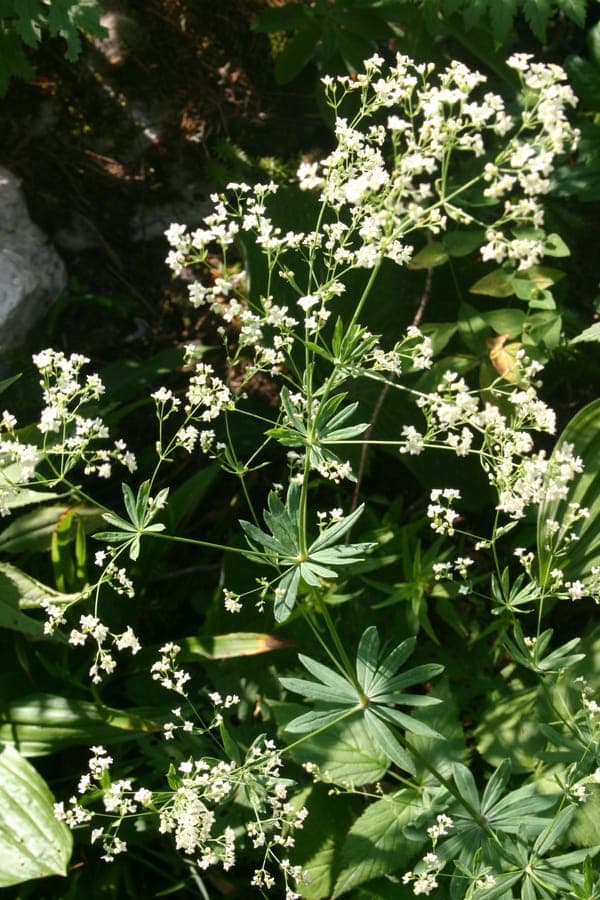
HermannSchachner / Public domain, via Wikimedia Commons
Scotch mist: complete guide
Galium sylvaticum
Want to see Scotch mist: complete guide in your garden?
1 minute, no credit card
Overview
Galium sylvaticum, commonly known as Scotch mist, is a delicate perennial that thrives in the dappled light of European woodlands. Native to countries like France, Germany, and Italy, it's slowly gaining popularity in UK and North American gardens, especially among those aiming for a naturalistic planting style. It's not flashy, but its subtle charm and low upkeep make it a standout in shaded corners where other plants struggle.
This plant spreads gently via rhizomes, forming soft mounds between 30 and 50 cm tall and about 40 cm wide. It won't take over your garden, but it will fill in gaps under shrubs and trees with a fresh, airy texture. On gardenworld.app, you can design a woodland planting scheme where Scotch mist plays a quiet but essential role in creating depth and seasonal interest.
Appearance & bloom cycle
The stems of Galium sylvaticum are square and carry narrow, lance-shaped leaves in whorls of 6–8. The foliage is a deep green, slightly glossy, and feels a bit rough to the touch due to tiny hooked hairs - a trait shared with other Galium species. These hairs helped the plant stick to animal fur in the wild, aiding seed dispersal.
From late June to early August, clusters of tiny white flowers appear at the stem tips. Each flower is only 3–4 mm across, star-shaped, and softly fragrant. While individual blooms are small, the collective effect is striking - a misty glow that lives up to its common name. The flowers attract hoverflies and small bees, contributing to the garden's biodiversity.
After blooming, the plant develops small, dry fruits with tiny hooks. These cling to clothing or animal fur, which is why plants in the Rubiaceae family are often called "cleavers" or "bedstraw."
Ideal location
Scotch mist prefers partial to full shade. It performs best under deciduous trees or on the north side of buildings where direct sun is limited. Full sun will dry out the soil too quickly and stress the plant, especially in warmer climates.
It's perfect for naturalistic gardens, woodland edges, or shaded borders. Avoid hot, south-facing spots. If you're designing a shade garden, consider using gardenworld.app to visualise how Galium sylvaticum can blend with ferns, hellebores, and hostas for a layered, year-round effect.
Soil requirements
The soil should be moist but well-drained and rich in organic matter. Think forest floor: humus-rich, slightly acidic to neutral (pH 5.5–7.0). Heavy clay soils need amending with compost or leaf mould to improve drainage, while sandy soils benefit from added compost to retain moisture.
Avoid lime-heavy or chalky soils, as Galium sylvaticum prefers neutral to slightly acidic conditions. Do not use synthetic fertilisers - a top dressing of compost in spring is all it needs.
Free design
Want to see Scotch mist: complete guide in your garden? Make a free design now.
Watering
Keep the soil consistently moist from April through August, especially during dry spells. Young plants are more vulnerable and require regular watering until established. Once mature, they tolerate short dry periods but look best when not stressed.
Mulch with leaf litter or shredded bark to conserve moisture and suppress weeds. Water at the base to prevent fungal issues on the foliage. Drip irrigation works well in larger plantings.
Pruning
Pruning isn't necessary for health, but you can tidy up the plant in early spring. After winter, the old stems turn brown and can look messy. Cut them back to 5 cm above ground level in March, before new growth emerges.
Leave the stems over winter if possible - they provide habitat for overwintering insects and add visual texture to the dormant garden. Use sharp, clean secateurs to avoid spreading disease.
Maintenance calendar
- January: Check for snow load; no action needed.
- February: Clean and sharpen tools.
- March: Cut back old growth; apply compost.
- April: Monitor moisture; watch for slugs.
- May: Mulch if needed; support emerging shoots.
- June: Bloom begins; ensure soil moisture.
- July: Peak flowering; admire the misty effect.
- August: Flowers fade; seed dispersal starts.
- September: No maintenance; let seeds scatter.
- October: Leave fallen leaves as natural mulch.
- November: No pruning; protect root zone.
- December: Observe winter structure.
Winter hardiness
Scotch mist is hardy in USDA zones 5–8 (-20°C to -10°C). The top growth dies back in autumn, but the roots survive under a protective layer of mulch or leaf litter. In colder zones, a light cover of straw or pine needles can help, but it's often unnecessary.
Avoid disturbing the soil in winter - the plant's rhizomes are shallow and easily damaged.
Companion plants
Excellent companions include ferns (Dryopteris, Athyrium), hellebores (Helleborus spp.), lungworts (Pulmonaria), and barrenworts (Epimedium). The fine texture of Galium contrasts beautifully with bold-leaved hostas or the glossy foliage of bergenias.
Avoid aggressive ground covers like Lamium maculatum or ivy, which can outcompete Scotch mist. Stick to slow-spreading, shade-tolerant perennials for a balanced planting.
Closing
Galium sylvaticum isn't a plant for those seeking instant drama. It's for gardeners who appreciate subtle beauty, seasonal rhythm, and low-input gardening. Plant it in drifts of 5–7 plants for the best effect, under light tree cover or along a shaded path.
You can find Scotch mist at garden centres across the UK and North America, especially in spring. In the UK, check Triffic or specialty nurseries; in the US, look for it at native plant sales. Always confirm the botanical name - some nurseries sell Galium odoratum instead, which spreads more aggressively.
For a custom planting plan, try gardenworld.app. You can map out a shaded border with Galium sylvaticum as a unifying layer, blending seamlessly with other woodland species for a cohesive, natural look.
Want to see Scotch mist: complete guide in your garden? Make a free design now.
Upload a photo, pick a style, and get a photorealistic design with plant list in under a minute.
No credit card required


Similar plants
Oregon bedstraw: complete guide
Galium oreganum
Everything about Oregon bedstraw (Galium oreganum): shade planting, soil requirements, care and use as a low groundcover in woodland and shade gardens.
Awned woodruff: complete guide
Asperula aristata
Full guide to growing Asperula aristata, the awned woodruff: sunny location, alkaline soil, minimal watering, and companion plants for dry or rock gardens.
Purple woodruff: complete guide
Asperula purpurea
Full guide to Asperula purpurea, purple woodruff: sunny sites, chalky soil, watering, pruning, winter hardiness and companion plants for rock and dry gardens.