
Wikimedia Commons / CC BY-SA 3.0, via Wikimedia Commons
Slender bedstraw: complete guide
Galium pumilum
Want to see Slender bedstraw: complete guide in your garden?
1 minute, no credit card
Overview
Slender bedstraw (Galium pumilum) is an understated but resilient ground cover that thrives in dry, open habitats across much of Europe. Often overlooked in favour of flashier plants, it's a quiet achiever in the garden-especially in naturalistic designs. Native to regions including southern Britain, France, Germany and the Baltic states, this species prefers chalky grasslands, heath margins and dry slopes. In the UK, it's rare in the wild but increasingly popular among gardeners seeking low-maintenance, eco-friendly ground cover.
Unlike more aggressive bedstraws like Galium aparine, Slender bedstraw grows slowly and stays well-behaved, reaching just 15–25 cm in height. It spreads through slender rhizomes, forming a soft, moss-like mat over time. It's not invasive, making it a trustworthy choice for mixed plantings. Once established, it needs almost no care and handles heat, wind and poor soil with ease.
On gardenworld.app you can design a planting scheme that complements Slender bedstraw's fine texture and drought tolerance, especially in xeriscaped areas or gravel gardens.
Appearance & bloom cycle
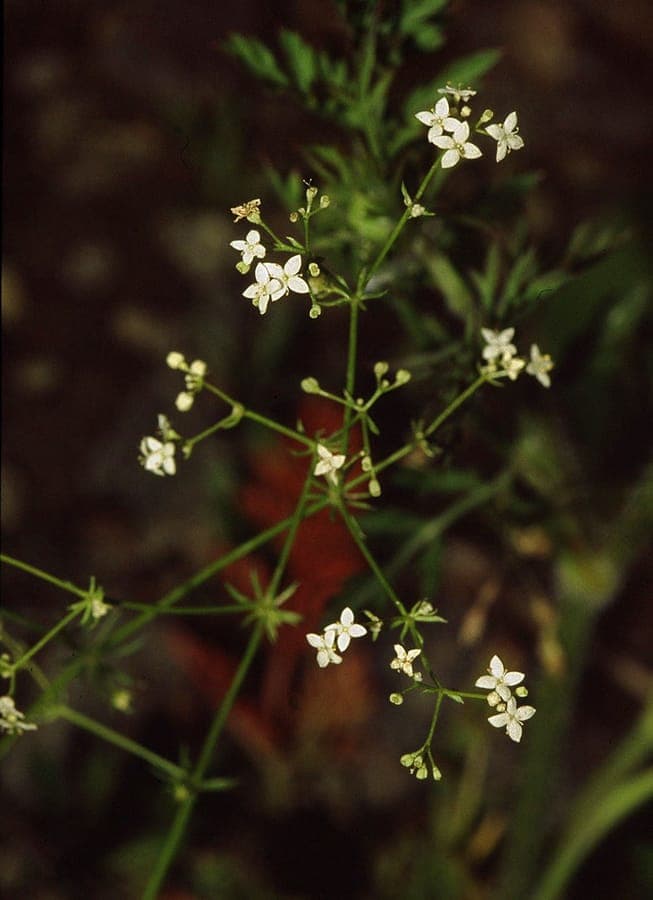
Slender bedstraw has narrow, whorled leaves arranged in groups of four to six around square stems. The foliage is bright green, slightly glossy, and gives off a fresh, hay-like scent when brushed. From late June through July, tiny white flowers appear in small, rounded clusters. These blooms are surprisingly fragrant-sweet and vanilla-like-particularly in the evening, attracting hoverflies, solitary bees and small moths.
After flowering, the plant develops small, bristly fruits that cling to fur or fabric, aiding natural dispersal. The foliage remains green through most of the year, turning a pale bronze in winter under harsh conditions, but rarely dying back completely.
Ideal location
This plant excels in full sun to light shade. In full sun, it forms a tight, floriferous carpet. In deeper shade, it grows leggy and sparse. The best spots are dry, well-drained areas: rocky slopes, gravel paths, between paving stones, or under open-canopy shrubs.
It's ideal for gravel gardens, rockeries or as a filler in wildflower meadows. It also works well at the front of borders where its fine texture contrasts nicely with bolder plants. Avoid placing it near moisture-loving species or where water pools after rain.
Soil requirements
Slender bedstraw thrives in alkaline, well-drained soils. A pH between 6.5 and 8.0 is ideal. It prefers sandy or chalky soils with low fertility-rich, clay-heavy soils will drown it or encourage competitors. If your soil is acidic, add garden lime to raise the pH. A light mix of grit or sharp sand improves drainage.
Don't add compost or fertiliser. This plant evolved in nutrient-poor conditions and will be outcompeted in rich beds. Test your soil with a simple pH kit, available at most garden centres.
Free design
Want to see Slender bedstraw: complete guide in your garden? Make a free design now.
Watering
Once established, Slender bedstraw is highly drought tolerant. Water weekly during the first growing season, giving about 5 litres per m² during dry spells. After that, it rarely needs supplemental watering-even during prolonged droughts.
Overwatering is a bigger risk than underwatering. Soggy soil leads to root rot and fungal issues. This plant is built for tough spots: south-facing walls, dry banks, or areas that bake in summer sun.
Pruning
Pruning isn't usually required. If the plant looks tired in early spring (March–April), a light trim with shears can refresh it. Cut back no more than one-third of the foliage to avoid stressing the plant. Avoid cutting during flowering to protect pollinators.
Deadheading isn't necessary-let the seed heads remain for winter interest and to support insects. Clean up any winter-damaged tips in early spring if needed.
Maintenance calendar
- Jan: Dormant; no action
- Feb: Check for winter damage
- Mar: Light trim if needed
- Apr: New growth emerges
- May: No care required
- Jun: Flowering begins
- Jul: Peak bloom, fragrance strongest
- Aug: Seeds develop, insects active
- Sep: No intervention
- Oct: Foliage remains green
- Nov: Minimal change
- Dec: Dormant phase
Winter hardiness
Slender bedstraw is hardy to USDA zone 5 (-20°C). It handles UK and northern European winters with ease. Foliage may bronze in cold snaps but rarely dies back completely. It re-sprouts reliably from rhizomes in spring.
No winter protection is needed. It tolerates snow cover and freezing temperatures without issue.
Companion plants
Pair Slender bedstraw with drought-tolerant partners like Thymus praecox, Sedum rupestre, or Allium cernuum. It contrasts well with silver-foliaged plants like Artemisia schmidtiana or Stachys byzantina. Avoid aggressive spreaders like mint or ground elder.
Good shrub companions include Cistus, Helianthemum, or low-growing junipers. The key is matching plants with similar needs: sun, dry soil, low fertility.
On gardenworld.app you can plan a full planting layout that balances colour, height and texture with Slender bedstraw as a base layer.
Closing
Slender bedstraw isn't a head-turner, but it's a dependable, low-effort workhorse for dry gardens. It asks for little, delivers soft texture and subtle summer scent, and supports wildlife. Buy it from garden centres specialising in native or alpine plants. With the right spot and minimal fuss, Galium pumilum becomes an unobtrusive yet essential part of a resilient garden.
Want to see Slender bedstraw: complete guide in your garden? Make a free design now.
Upload a photo, pick a style, and get a photorealistic design with plant list in under a minute.
No credit card required


Similar plants
Oregon bedstraw: complete guide
Galium oreganum
Everything about Oregon bedstraw (Galium oreganum): shade planting, soil requirements, care and use as a low groundcover in woodland and shade gardens.
Awned woodruff: complete guide
Asperula aristata
Full guide to growing Asperula aristata, the awned woodruff: sunny location, alkaline soil, minimal watering, and companion plants for dry or rock gardens.
Purple woodruff: complete guide
Asperula purpurea
Full guide to Asperula purpurea, purple woodruff: sunny sites, chalky soil, watering, pruning, winter hardiness and companion plants for rock and dry gardens.