
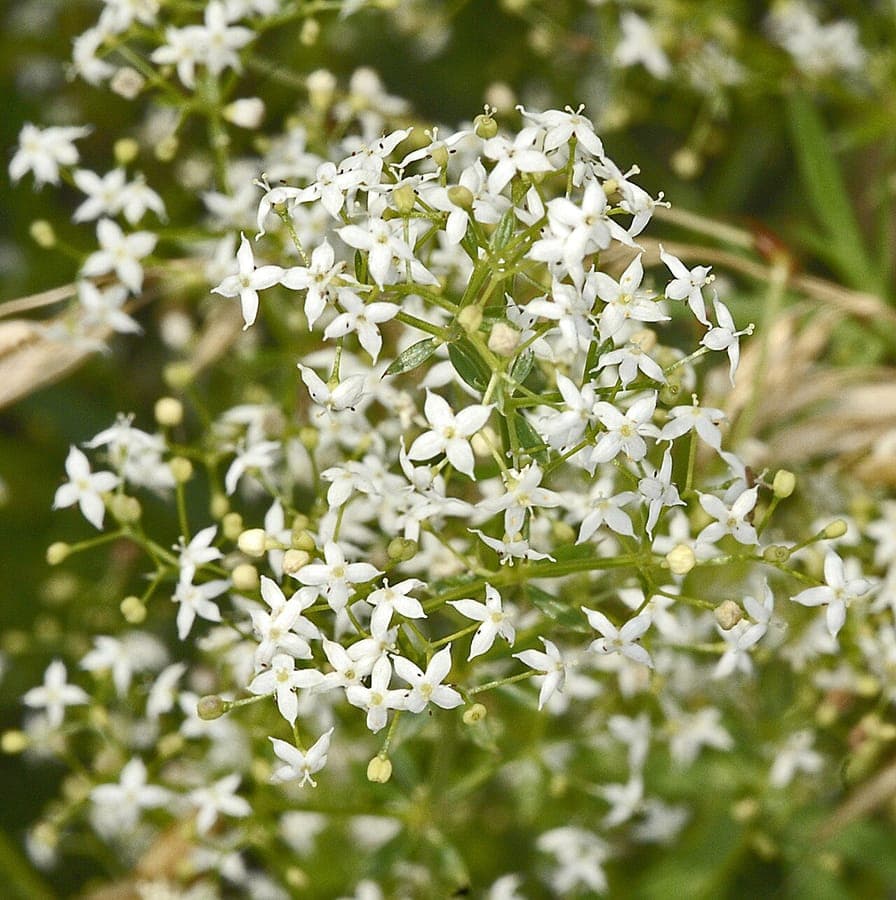
Hectonichus / CC BY-SA 3.0, via Wikimedia Commons
Hedge bedstraw: complete guide
Galium mollugo
Want to see Hedge bedstraw: complete guide in your garden?
1 minute, no credit card
Overview
Hedge bedstraw (Galium mollugo) is a graceful, herbaceous perennial that often flies under the radar in garden design. Native to parts of Central and Eastern Europe - including Austria, the Baltic States, and Belarus - it thrives in open woodlands, hedgerows, and grassy margins. In the garden, it works as a subtle ground cover with a soft, airy texture. It's hardy in USDA zones 5 through 9, making it suitable for most temperate climates. While sometimes mistaken for a weed, its ecological value and low maintenance needs make it a solid choice for naturalistic planting schemes.
On gardenworld.app, you can design a border layout that integrates Hedge bedstraw with other native species for a self-sustaining, pollinator-friendly garden. Its upright, slender form adds vertical interest without overwhelming neighboring plants.
Appearance & bloom cycle
Hedge bedstraw grows 30 to 80 cm tall, with square, slightly hairy stems and whorls of 6–8 narrow, lance-shaped leaves. The foliage is soft to the touch and pale green, giving the plant its species name mollugo (meaning 'soft'). From June to August, tiny white flowers appear in loose, branched clusters at the stem tips. Each flower is only 3–5 mm wide but appears in such numbers that the plant takes on a frosted appearance in full bloom. These blossoms attract hoverflies, small bees, and other beneficial insects.
After flowering, the plant develops small, hooked fruits that easily cling to clothing or animal fur - a clever dispersal strategy. It dies back in late autumn but regrows reliably each spring from creeping rhizomes. The overall effect is light and delicate, perfect for softening edges or filling gaps.
Ideal location
This plant prefers full sun to light shade, scoring an 8 out of 10 on the light scale. In full sun (6+ hours direct light), it grows more compact and blooms more freely. In heavy shade, it becomes leggy and may flop over. Ideal spots include sunny borders, meadow edges, or open woodland gardens. Avoid deep shade or constantly damp, dark corners where it won't compete well with more aggressive species.
Use gardenworld.app to analyze your garden's sun exposure and find the best microclimate for Hedge bedstraw. Its performance improves significantly with adequate morning and midday light.
Soil requirements
Hedge bedstraw thrives in well-drained, moderately fertile soil with a pH of 7.0 to 7.5. It tolerates sandy, loamy, or clay soils as long as water doesn't pool around the roots. Heavy clay should be amended with grit or compost to improve drainage. Avoid rich, heavily amended soils - too much fertility leads to weak stems and excessive spreading. This plant prefers average conditions and actually performs better in modest fertility.
Free design
Want to see Hedge bedstraw: complete guide in your garden? Make a free design now.
Watering
Once established, Hedge bedstraw is moderately drought-tolerant. During the first growing season (May–June), water weekly with 8–10 liters per m² during dry spells. After that, supplemental watering is rarely needed, except during prolonged droughts. Never allow the plant to sit in waterlogged soil - root rot is the main risk in poorly drained sites.
Pruning
Pruning isn't essential, but if the plant starts to sprawl or look untidy in midsummer (July), cut it back by half to 15–20 cm. This encourages bushier, more upright regrowth and can delay flowering slightly, extending seasonal interest. Avoid cutting in autumn - leave the stems standing to provide winter habitat for beneficial insects. Remove dead foliage in early spring (March) before new shoots emerge.
Maintenance calendar
- Jan: Monitor for winter damage, leave old growth
- Feb: No action needed
- Mar: Cut back dead stems
- Apr: Watch for new growth
- May: Plant or divide, light watering if dry
- Jun: Flowering begins, check for flopping
- Jul: Possible trim for reshaping, peak bloom
- Aug: Full flowering, pollinators active
- Sep: Seed dispersal, reduce watering
- Oct: Leave standing for wildlife
- Nov: No maintenance
- Dec: Winter-hardy; no protection required
Winter hardiness
Hedge bedstraw is fully hardy in USDA zones 5–9. In zone 7 and above, it may retain some green foliage through mild winters. It dies back to ground level in colder areas but reliably returns in spring. No winter protection is needed - let the old stems provide insulation and shelter.
Companion plants
Pair Hedge bedstraw with other low-maintenance perennials like Alchemilla mollis, Stachys byzantina, or Carex elata 'Aurea'. In woodland settings, it complements Anemone nemorosa, Digitalis purpurea, and Geranium sylvaticum. Its fine texture contrasts well with bold-leaved plants like Hosta or Rodgersia. Avoid pairing with overly aggressive spreaders like Japanese knotweed.
Closing
Hedge bedstraw isn't a showstopper, but it's a reliable, unobtrusive performer in the natural garden. It asks for little, supports biodiversity, and blends seamlessly into informal designs. Look for it at garden centres during spring planting season, or source it from native plant suppliers. When placed correctly, it becomes a quiet backbone in your planting scheme. On gardenworld.app, you can simulate how it interacts with neighboring plants over time, ensuring a balanced, evolving garden.
Want to see Hedge bedstraw: complete guide in your garden? Make a free design now.
Upload a photo, pick a style, and get a photorealistic design with plant list in under a minute.
No credit card required


Similar plants
Oregon bedstraw: complete guide
Galium oreganum
Everything about Oregon bedstraw (Galium oreganum): shade planting, soil requirements, care and use as a low groundcover in woodland and shade gardens.
Awned woodruff: complete guide
Asperula aristata
Full guide to growing Asperula aristata, the awned woodruff: sunny location, alkaline soil, minimal watering, and companion plants for dry or rock gardens.
Purple woodruff: complete guide
Asperula purpurea
Full guide to Asperula purpurea, purple woodruff: sunny sites, chalky soil, watering, pruning, winter hardiness and companion plants for rock and dry gardens.