
Wikimedia Commons / Public domain, via Wikimedia Commons
Cleavers: complete guide
Galium aparine
Want to see Cleavers: complete guide in your garden?
1 minute, no credit card
Overview
Cleavers (Galium aparine) is a fast-growing, sprawling herb in the Rubiaceae family, often dismissed as a weed but increasingly appreciated in naturalistic garden designs. Native across much of Europe and parts of Asia, it thrives in temperate climates and is commonly found along hedgerows, woodland edges, and disturbed soils. While its sticky stems can be a nuisance, the plant supports biodiversity and has historical uses in herbal infusions. If you're planning a wilder garden style, cleavers can be a strategic player - and on gardenworld.app, you can design a layout that integrates it effectively with companion species and structural plants.
Appearance & bloom cycle
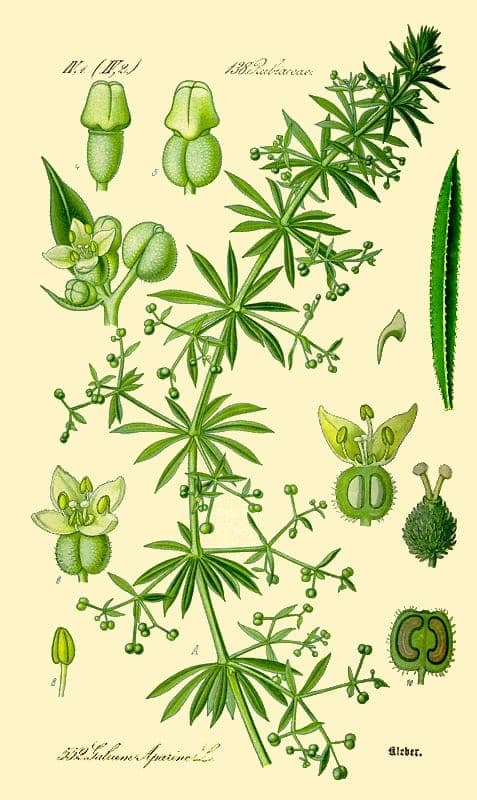
Cleavers grow as a climbing or trailing forb, reaching 60 to 120 cm in length. The square, four-angled stems are covered in tiny hooked hairs that latch onto fabric, fur, and other plants - nature's original Velcro. The narrow, lance-shaped leaves grow in whorls of 6–8, creating a star-like pattern along the stem. From June through October, small clusters of white, star-shaped flowers appear, each about 2–3 mm wide. These attract small pollinators like hoverflies and solitary bees. After blooming, the plant develops round, bristly seed pods that cling aggressively to passing animals, ensuring wide dispersal. The entire plant dies back in late autumn, leaving only overwintering seeds.
Ideal location
Cleavers prefer light shade to partial sun, scoring around 6 on a 1–10 light scale. Ideal spots include the edges of shrubberies, beneath open-canopy trees, or along fence lines where dappled light filters through. It can survive in full shade but tends to become leggy and weak. In full sun (light 8–10), it requires consistent moisture to avoid drying out. This plant works well in cottage gardens, wildlife borders, or as a temporary ground cover. Use gardenworld.app to map out where cleavers can climb without interfering with footpaths or seating areas.
Soil requirements
It's adaptable to most soils as long as they remain moist. It performs best in fertile, loamy soils rich in organic matter but tolerates sandy or clay-heavy conditions if they don't dry out completely. The ideal pH range is 5.4 to 7.2 - slightly acidic to neutral. In heavy clay, amend with compost to improve drainage. Avoid overly compacted or dry soils, which will stunt growth. A spring mulch of leaf mold or compost helps retain moisture and feeds the soil.
Free design
Want to see Cleavers: complete guide in your garden? Make a free design now.
Watering
Keep the soil consistently moist during the growing season (April to September). Water once or twice weekly during dry spells, focusing at the base to avoid wetting foliage - the hairy stems can trap moisture and encourage fungal issues. Rainwater is preferred over tap water, especially in hard water areas, as cleavers are sensitive to high calcium levels. Once established, it can handle short dry periods but will yellow and weaken if prolonged.
Pruning
Pruning isn't required for plant health but helps manage spread. Cut back rampant growth in July or August using gloves and shears - the hairs can irritate skin. Remove flowering or seeding stems before they disperse to prevent unwanted spread. Compost cuttings only if they're seed-free; otherwise, dispose of them in garden waste. Regular trimming keeps cleavers from smothering smaller plants.
Maintenance calendar
- Jan: Dormant; no action needed
- Feb: Monitor for early germination in mild winters
- Mar: Watch for seedlings; apply compost mulch
- Apr: Growth begins; water if dry
- May: Stems start climbing; provide light support if desired
- Jun: Flowers emerge; pollinators active
- Jul: Peak bloom; prune if overgrown
- Aug: Seed development; manage spread
- Sep: Ongoing flowering; check for self-seeding
- Oct: Final blooms; plant dies back
- Nov: Clear dead stems; avoid disturbing soil to limit germination
- Dec: Dormancy; prepare for next season
Winter hardiness
Cleavers is an annual, completing its life cycle in one year. It reseeds prolifically, with seeds surviving winter in the soil. It's hardy in USDA zones 5–9, germinating in spring when soil temperatures exceed 10°C. No winter protection is needed. In milder regions, some seedlings may appear in late autumn.
Companion plants
Cleavers grow well with other light climbers like honeysuckle or ivy. It's effective as understory in shrub borders with species like dogwood or brambles. Avoid planting near dense ground covers like pachysandra that block light. Good companions include stinging nettle (for butterfly larvae), yarrow (for pollinators), and wild carrot (for structure). It integrates naturally in wildlife gardens where a little chaos is welcomed.
Closing
Cleavers may not win beauty contests, but it's a resilient, ecologically valuable plant. It supports insects, stabilizes soil, and adds vertical interest with minimal care. Just keep it away from high-traffic areas - those sticky stems are no joke. Sow seeds or transplant seedlings from the wild (with permission) or buy from garden centres like B&Q, Wyevale, or local independents. With thoughtful placement and seasonal pruning, cleavers can be a dynamic part of your garden. Plan your strategy on gardenworld.app to balance wild charm with garden control.
Want to see Cleavers: complete guide in your garden? Make a free design now.
Upload a photo, pick a style, and get a photorealistic design with plant list in under a minute.
No credit card required


Similar plants
Oregon bedstraw: complete guide
Galium oreganum
Everything about Oregon bedstraw (Galium oreganum): shade planting, soil requirements, care and use as a low groundcover in woodland and shade gardens.
Awned woodruff: complete guide
Asperula aristata
Full guide to growing Asperula aristata, the awned woodruff: sunny location, alkaline soil, minimal watering, and companion plants for dry or rock gardens.
Purple woodruff: complete guide
Asperula purpurea
Full guide to Asperula purpurea, purple woodruff: sunny sites, chalky soil, watering, pruning, winter hardiness and companion plants for rock and dry gardens.