
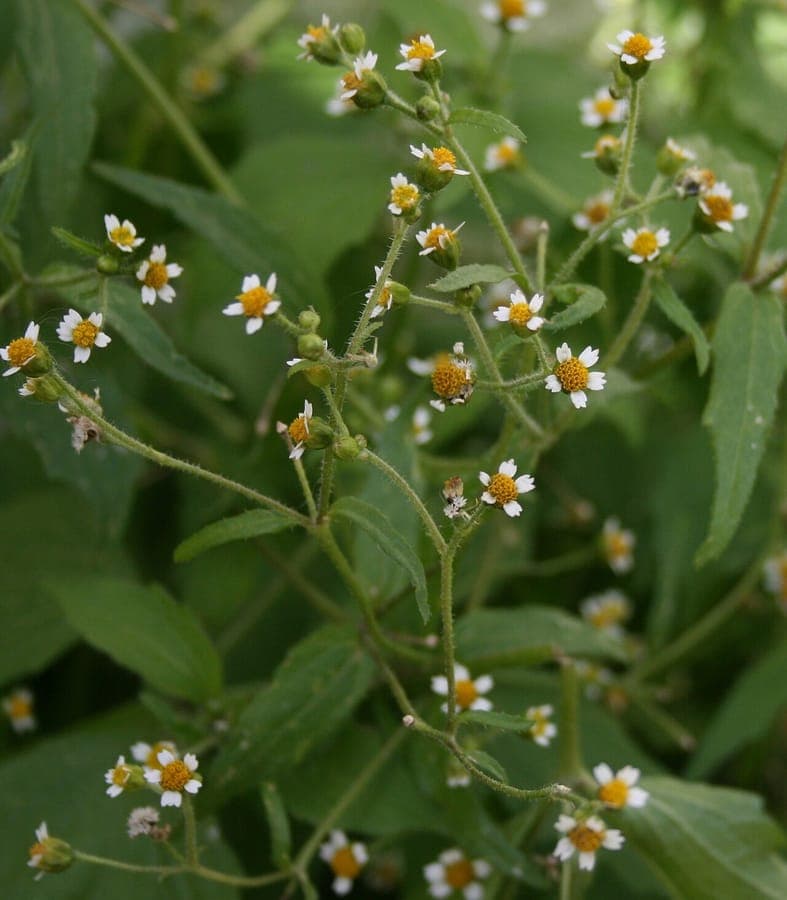
E Wusk / CC BY-SA 4.0, via Wikimedia Commons
Hairy galinsoga: complete guide
Galinsoga quadriradiata
Want to see Hairy galinsoga: complete guide in your garden?
1 minute, no credit card
Overview
Hairy galinsoga (Galinsoga quadriradiata) is an annual forb native to South and Central America, including regions of Colombia, Ecuador, and Brazil. It's now naturalised in many temperate gardens across Europe and North America. In the UK and US, it often appears uninvited in vegetable plots, borders, or disturbed soil. But don't dismiss it too quickly - this fast-growing plant has delicate flowers and can be a useful green filler in informal gardens. It completes its life cycle in as little as six weeks, making it a reliable self-seeder. On gardenworld.app, you can design a seasonal planting scheme that either welcomes or manages Hairy galinsoga effectively.
Appearance & bloom cycle
Hairy galinsoga grows 12 to 24 inches (30–60 cm) tall, with weak, upright stems that branch freely. The stems are distinctly hairy, with four prominent ridges of stiff bristles - a key ID feature. Leaves are opposite, ovate, coarsely toothed, and covered in short, rough hairs, giving them a sandpapery texture. The flowers are small, about 0.4 inches (1 cm) across, with five white ray florets surrounding a bright yellow central disc. Bloom time runs from early summer to first frost - June through October in most USDA zones (5–9). Because it sets seed so quickly, you'll often see seedlings, buds, and open flowers all at once on the same plant.
Ideal location
This plant thrives in full sun to light shade, scoring a 7 out of 10 for light preference. It performs best with morning sun and afternoon shade, especially in hotter climates. In deep shade, it becomes leggy and flowers poorly. Hairy galinsoga fits well in cottage gardens, urban plots, or as a temporary ground cover in empty beds. Avoid planting it near slow-growing perennials that could be outcompeted. It's happy in containers, too, but needs regular deadheading to prevent seeding into other pots.
Soil requirements
It tolerates a wide range of soils but prefers fertile, moist, well-drained loam with a pH between 5.5 and 6.5. It grows surprisingly well in poor or compacted soils, often appearing in cracks in pavements or compost heaps. For best results, amend garden beds with compost or well-rotted manure before planting. Avoid waterlogged clay; if you have heavy soil, mix in grit or perlite to improve drainage. Use gardenworld.app to assess your soil type and get custom prep recommendations.
Free design
Want to see Hairy galinsoga: complete guide in your garden? Make a free design now.
Watering
Water regularly during dry spells, especially when seedlings are establishing. Mature plants are somewhat drought-tolerant but flower more abundantly with consistent moisture. Aim for 1 inch (2.5 cm) of water per week, either from rain or irrigation. Water at the base to keep foliage dry and prevent powdery mildew. Overhead watering should be limited to early morning to allow leaves to dry in sunlight.
Pruning
Pinch back young stems by 2–3 inches (5–8 cm) in late spring to promote bushiness. This encourages lateral branching and more flowers. Deadhead spent blooms if you want to limit self-seeding - otherwise, let them go to seed for next year's volunteers. Regular pruning also helps prevent the plant from becoming floppy in humid conditions.
Maintenance calendar
January: Dormant. Clear old debris. February: Check for early seedlings in mild areas. March: Prepare beds; remove early sprouts. April: Sow seeds directly or thin seedlings. Keep soil moist. May: Begin pinching stems. Water seedlings weekly. June: First blooms appear. Monitor for aphids. July: Peak bloom. Water during dry weeks. August: Continue deadheading. Limit spread if needed. September: Allow some plants to set seed for next year. October: Cut back after frost. Compost healthy foliage. November: Clear remaining plants. Mulch beds. December: Plan next season's layout.
Winter hardiness
Hairy galinsoga is not winter-hardy. It dies back completely after the first hard frost (below -2°C). However, it reliably returns the following year from seed. It's rated for USDA zones 5–9 as a self-seeding annual, but cannot survive freezing roots. Seeds remain viable in soil for up to two years, so expect reappearances even if you clear the bed.
Companion plants
Grow Hairy galinsoga alongside tall, structured plants like delphiniums or hollyhocks to hide its floppy habit. In veg patches, it can act as a living mulch for young carrots or lettuce, shading soil and suppressing weeds. Avoid pairing with other Asteraceae like cosmos or sunflowers, as they may share pests. Good companions include basil, dill, and marigolds, which deter aphids and attract beneficial insects.
Closing
Hairy galinsoga walks the line between weed and wonder. It's fast, free, and friendly to pollinators - but can be invasive if unchecked. With thoughtful placement and light pruning, it earns its place in relaxed garden styles. Its cheerful little blooms bring life to neglected corners. For gardeners unsure where to start, gardenworld.app offers visual planning tools to map out where this plant fits - or doesn't. Seeds are available at garden centres across the UK and US, including local independents and chains.
Want to see Hairy galinsoga: complete guide in your garden? Make a free design now.
Upload a photo, pick a style, and get a photorealistic design with plant list in under a minute.
No credit card required


Similar plants
Calendula stellata: complete guide
Calendula stellata
Complete guide to Calendula stellata, the star-flowered marigold from Sicily: location, soil, watering and companion planting tips.
Korean chrysanthemum: complete guide
Chrysanthemum x rubellum
Chrysanthemum x rubellum is a hardy autumn perennial with single pink to copper flowers from August to November. Care and combinations.
Helianthus divaricatus: complete guide
Helianthus divaricatus
Helianthus divaricatus is a North American woodland sunflower with yellow summer blooms, ideal for naturalistic borders and shady edges.