
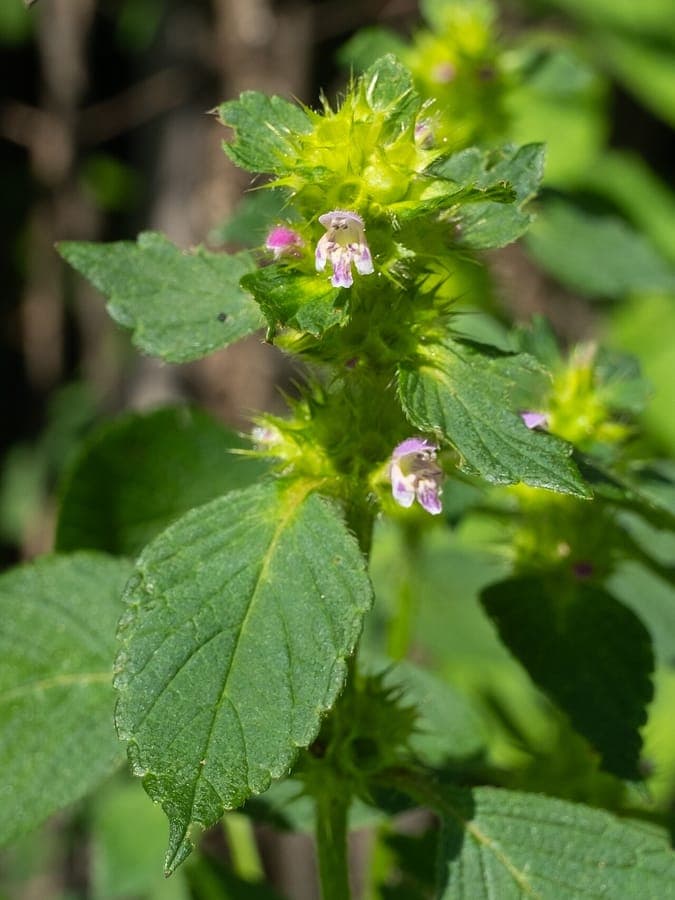
Alex Abair / CC BY 4.0, via Wikimedia Commons
Splitlip hempnettle: complete guide
Galeopsis bifida
Want to see Splitlip hempnettle: complete guide in your garden?
1 minute, no credit card
Overview
Splitlip hempnettle (Galeopsis bifida) is an annual forb in the Lamiaceae family, often spotted along roadsides, disturbed soils, and open woodland edges. Native across much of Europe and parts of temperate Asia, it grows 20 to 60 cm tall with upright, square, slightly hairy stems. While sometimes mistaken for a weed, it actually supports biodiversity and fits well in wildflower meadows or naturalistic garden designs.
On gardenworld.app, you can design a low-effort, ecologically sound garden that integrates native annuals like splitlip hempnettle, letting them thrive in their preferred conditions without constant intervention.
Appearance & bloom cycle
The flowers are tubular and two-lipped, typically white with purple spotting on the lower lip and a deeply split upper lip-hence the name. They bloom from July to September, arranged in short, whorled clusters at the leaf axils near the top of the stem. The foliage is opposite, lance-shaped, coarsely toothed, and covered in fine, stiff hairs, resembling young hemp leaves.
After pollination, the plant forms small nutlets that remain viable in the soil seed bank for several years. These seeds germinate in spring when soil temperatures consistently exceed 10°C. The plant completes its entire life cycle-from germination to seed set-within a single growing season.
Ideal location
Splitlip hempnettle thrives in full sun to light shade, scoring a 6 on the light scale (4–6 hours of direct sunlight daily). It prefers open, unshaded areas with minimal competition. Ideal spots include dry meadow patches, gravelly borders, or bare ground where other plants struggle.
Avoid deep shade or dense, moist undergrowth. This plant needs space and light to establish. In garden planning, consider using it in transitional zones where formal meets wild-perfect for blending structure with spontaneity. Use gardenworld.app to map out such zones and test plant compatibility before sowing.
Soil requirements
It grows best in well-drained, sandy or loamy soils with a pH between 6.5 and 7.0. While adaptable, it prefers low to moderate fertility. Rich soils can lead to excessive leafy growth at the expense of flowering. Avoid heavy clay or waterlogged sites, which increase the risk of rot.
No soil amendments or fertiliser needed. This species evolved in disturbed, nutrient-poor environments-over-improving the soil does more harm than good.
Watering
Once established, splitlip hempnettle is drought-tolerant and requires little to no supplemental watering. During germination and early growth (first 3–4 weeks), keep the soil lightly moist but never soggy. After that, rely on natural rainfall.
Overwatering is a common mistake. This plant is adapted to dry conditions and will decline in consistently damp soils. In a garden setting, it's ideal for xeriscaping or dry borders where irrigation is minimal.
Free design
Want to see Splitlip hempnettle: complete guide in your garden? Make a free design now.
Pruning
Pruning isn't necessary. As an annual, it won't regrow from cut stems. However, you can deadhead spent flower spikes if you want to limit self-seeding in confined spaces. Use gloves-the stem hairs can irritate sensitive skin.
If you'd like the plant to reappear next year, leave some mature stems intact through autumn. The seeds need time to fully ripen and disperse naturally.
Maintenance calendar
- March–April: Watch for germination in bare, sunny patches. Seedlings resemble other Lamiaceae species-identify carefully.
- May–June: Thin crowded seedlings if needed. Avoid disturbing roots.
- July–September: Peak bloom. No feeding or heavy watering.
- October: Assess whether to clear dead stems or leave them for seed dispersal.
- November–February: No care required. The plant has died back; seeds lie dormant.
Winter hardiness
As an annual, Galeopsis bifida doesn't survive winter above ground. However, its seeds are cold-hardy and remain viable in the soil through USDA zones 4 to 7 (down to -30°C). They require a period of cold stratification to break dormancy, making autumn or early spring sowing ideal.
No winter protection needed. Let nature handle the cycle-this plant is self-sustaining if given the right start.
Companion plants
Pair splitlip hempnettle with other sun-loving, drought-tolerant species: yarrow (Achillea millefolium), oxeye daisy (Leucanthemum vulgare), self-heal (Prunella vulgaris), and bird's-foot trefoil (Lotus corniculatus). It also fits well in early successional plantings with tansy mustard (Descurainia sophia) or common vetch (Vicia sativa).
Avoid aggressive perennials or groundcovers that monopolise space and light. This plant needs breathing room to establish.
You won't typically find splitlip hempnettle at mainstream garden centres, but it occasionally appears at native plant nurseries or seed swaps. If you're sourcing seeds, consider collecting from wild populations (with permission) and direct-sowing in prepared ground. Retail options in the UK and US are limited, so planning via gardenworld.app helps visualise where and how to integrate such niche species.
Closing
Splitlip hempnettle isn't a showy garden star, but it's a quiet workhorse for ecological balance. It supports pollinators, improves soil structure, and adds dynamic texture to wilder areas. Treat it not as a weed, but as a fleeting guest that enriches your garden's story.
For gardeners embracing natural processes, this plant is a low-maintenance ally. Let it pop up where it likes, and use gardenworld.app to design spaces that welcome spontaneity and resilience.
Want to see Splitlip hempnettle: complete guide in your garden? Make a free design now.
Upload a photo, pick a style, and get a photorealistic design with plant list in under a minute.
No credit card required


Similar plants
Apple mint (Mentha x villosa): complete guide
Mentha x villosa
Meet apple mint (Mentha x villosa): a fruity-scented kitchen herb with woolly leaves, perfect for tea and mojitos.
Salvia peyronii: complete guide
Salvia peyronii
Discover Salvia peyronii, a rare Lebanese mountain sage. Growing tips, hardiness, and companion planting for a Mediterranean gravel garden.
Bigleaf mint (Mentha x rotundifolia): complete guide
Mentha x rotundifolia
Discover bigleaf mint: cultivation, care tips, and garden uses. Learn how to grow this aromatic herb with soft, hairy leaves.