
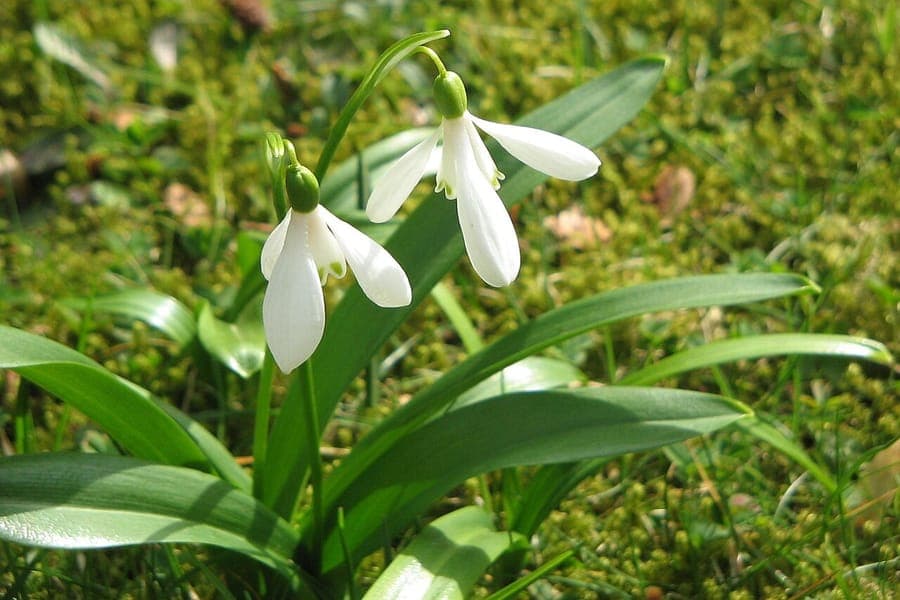
original: Meneerke bloem; derivative: Peter coxhead / CC BY-SA 3.0, via Wikimedia Commons
Green snowdrop: complete guide
Galanthus woronowii
Want to see Green snowdrop: complete guide in your garden?
1 minute, no credit card
Overview
Galanthus woronowii, known commonly as the green snowdrop, is a delicate yet resilient bulbous perennial in the Amaryllidaceae family. Native to the North Caucasus, Transcaucasus, and parts of Turkey, this plant brings quiet elegance to gardens from late winter into early spring. Unlike the classic white snowdrop, it features subtle green markings on its inner tepals and glossy, dark green foliage that stands out even before blooming.
This species thrives in naturalistic plantings and requires almost no attention once established. It's a perfect fit for gardeners who appreciate understated beauty and long-term value over flashy displays. On gardenworld.app, you can design a woodland-style planting scheme that highlights the soft glow of green snowdrops under deciduous trees.
Appearance & bloom cycle
The green snowdrop blooms from late February to mid-March, depending on local conditions. Each slender stem reaches 12 to 15 cm in height and carries a single, nodding, bell-shaped flower. The outer segments are pure white and elongated, while the inner ones are shorter and marked with green-often in the form of a V-shape or small blotch at the tip. This green tint is more pronounced than in Galanthus nivalis, giving the plant its distinctive name.
The leaves are strap-shaped, 10–15 cm long and 1–2 cm wide, with a shiny surface that catches the low winter light. After flowering, the foliage persists until May, gradually yellowing as the bulb enters dormancy. The plant dies back completely by early summer.
Ideal location
Galanthus woronowii prefers partial to full shade. It performs best under deciduous trees, along woodland edges, or beneath shrubs like viburnum or holly. The dappled light in early spring is ideal-bright enough to encourage flowering, but shaded enough to keep the soil cool and moist as temperatures rise.
Plant bulbs in groups of 10–20 for a natural drift effect. Avoid full sun, especially in warmer climates, as it can dry out the soil too quickly and reduce flowering in subsequent years. Use gardenworld.app to map out planting zones and see how your green snowdrops will interact with emerging perennials like hellebores or epimediums.
Soil requirements
This snowdrop likes moist, well-drained, humus-rich soil. A pH between 6.0 and 7.0 is optimal. Avoid waterlogged or compacted clay soils unless improved with organic matter. If planting in heavy soil, mix in leaf mould or compost to enhance structure and drainage.
In sandy soils, add compost or coconut coir to improve moisture retention. The key is consistent moisture during the growing season (February–May), followed by drier conditions in summer when the bulbs are dormant.
Free design
Want to see Green snowdrop: complete guide in your garden? Make a free design now.
Watering
Water regularly during dry spells in late winter and early spring, especially if rainfall is below average. Once the foliage appears, keep the soil evenly moist but not soggy. After flowering, reduce watering gradually. By June, the bulbs are dormant and require no supplemental irrigation.
Overwatering during summer dormancy is a common mistake and can lead to bulb rot. Rely on natural rainfall unless you're in an extended drought.
Pruning
No pruning is needed. Allow the leaves to die back naturally-this process feeds energy back into the bulb for next year's bloom. Do not cut or tie the foliage. Wait until the leaves turn completely yellow, usually by late May, before removing them.
If you need to relocate bulbs, do so in late spring or early summer, just as the foliage fades. Lift carefully and replant at the same depth (8–10 cm) in a new spot with similar conditions.
Maintenance calendar
- October: Plant bulbs 8–10 cm deep, spaced 5–8 cm apart.
- November–January: Minimal care. Water only if winter is unusually dry.
- February–March: Bloom period. Monitor soil moisture.
- April: Reduce watering. Foliage begins to yellow.
- May: Let leaves wither completely.
- June–August: Dormant. No action required.
- September: Check for natural bulblet formation. Divide if clumps become dense.
Winter hardiness
Galanthus woronowii is hardy in USDA zones 5 to 8. It tolerates temperatures down to -20°C and requires no winter protection. The bulbs remain in the ground year-round and benefit from natural freeze-thaw cycles.
In milder climates (zone 8), ensure the soil doesn't stay wet during summer. In colder zones, a light mulch of leaf litter can help regulate soil temperature but isn't essential.
Companion plants
Pair green snowdrops with other shade-tolerant, spring-blooming plants:
- Helleborus orientalis: blooms at the same time and hides fading foliage
- Erythronium 'Pagoda': similar habitat, elegant nodding flowers
- Anemone nemorosa: spreads well and complements the green-tinted blooms
- Cyclamen coum: overlaps in bloom time and shares soil preferences
Avoid aggressive ground covers or plants that dry out the soil in spring.
Closing
Galanthus woronowii is a quiet achiever in the garden-low in demand, high in reward. It naturalizes beautifully over time, forming gentle colonies that brighten shady corners when little else is growing. Once planted, it asks for almost nothing and returns year after year.
You can find these bulbs at garden centres in the UK and US, especially in the autumn months. Look for firm, plump bulbs from reputable suppliers. Plant them in drifts under trees or along pathways, and use gardenworld.app to visualise how they'll mature over the next few seasons. Simple, elegant, and enduring-this is a plant that knows its place in the garden.
Want to see Green snowdrop: complete guide in your garden? Make a free design now.
Upload a photo, pick a style, and get a photorealistic design with plant list in under a minute.
No credit card required


Similar plants
Douglas' Onion: complete guide
Allium douglasii
Douglas' onion is a compact ornamental allium with purple flowers, perfect for rock gardens and sunny borders. Learn care, siting and hardiness.
Oblique onion: complete guide
Allium obliquum
The oblique onion is a hardy ornamental allium with chartreuse flower heads and blue-green foliage. Location, soil and care explained.
False hooded garlic: complete guide
Allium pseudocalyptratum
Discover false hooded garlic (Allium pseudocalyptratum): a rare ornamental onion from Lebanon for rock gardens and alpine troughs.