
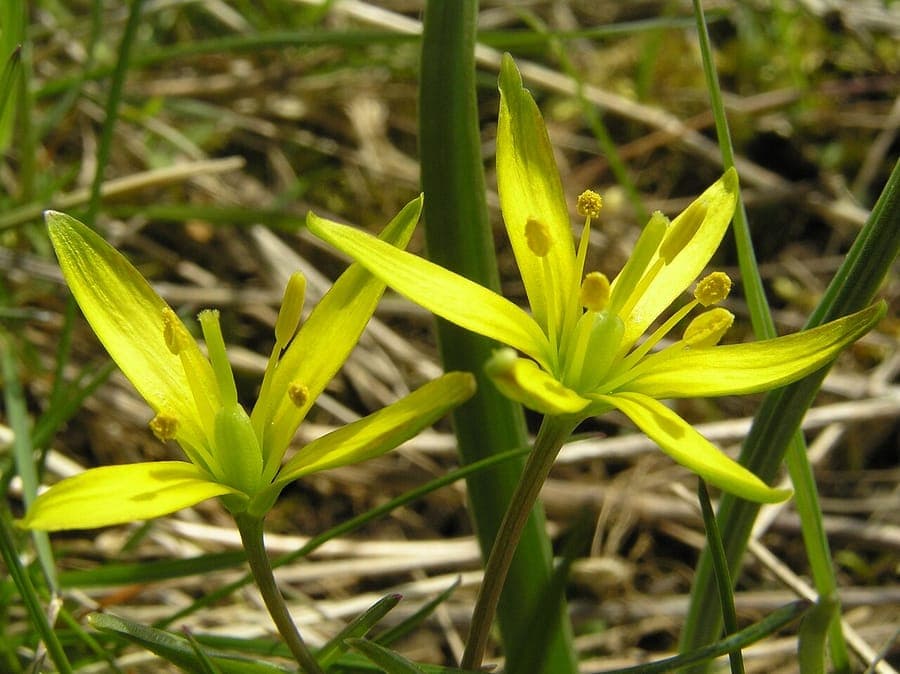
B.Preuschhof (Rabe19) / CC BY-SA 3.0, via Wikimedia Commons
Meadow gagea: complete guide
Gagea pratensis
Want to see Meadow gagea: complete guide in your garden?
1 minute, no credit card
Overview
Meadow gagea (Gagea pratensis) is a slender, early-spring bulb native to damp woodlands and meadows across central and western Europe. Standing just 10–15 cm tall, it's a quiet but welcome presence in gardens that embrace natural rhythms. Part of the Liliaceae family, this delicate plant thrives where larger, showier bulbs might struggle. Its cheerful yellow flowers appear as early as late March, making it a valuable food source for emerging bees and hoverflies.
Unlike flashy tulips, meadow gagea doesn't dominate – it blends. It's perfect for planting in drifts through long grass, under deciduous trees, or along woodland edges. On gardenworld.app, you can design a planting scheme that mimics its natural habitat, ensuring it gets the right mix of light and soil.
Appearance & bloom cycle
The flowers are star-shaped, with six pointed tepals (three petals and three sepals) in a bright yellow hue. Each tepal carries a green central stripe, adding subtle contrast. The blooms open fully only in direct sun, closing at dusk or on overcast days. Flowering runs from late March to early May, depending on your location and winter severity.
After blooming, the slender, grass-like leaves persist for several weeks, photosynthesising to feed the bulb. By late May or early June, the foliage dies back completely, leaving no trace in your lawn or planting bed. This makes meadow gagea ideal for meadow-style lawns – you can mow from mid-June onward without harming next year's growth.
Ideal location
Aim for a light shade to partial sun spot – about a 7 on the light scale (10 being full sun). Dappled sunlight under trees like birch, hazel or oak works perfectly. Avoid deep shade or hot, south-facing borders with all-day sun, which can dry out the soil too quickly in spring.
If you're planting in a lawn, choose an area that isn't too competitive with thick grass. Fine fescue or meadow grasses are better than vigorous rye grass. Use gardenworld.app to map your garden's light patterns and pick the best spots for naturalising meadow gagea.
Soil requirements
This plant prefers moisture-retentive, humus-rich loam or clay-loam with a neutral to slightly alkaline pH (7.0–7.5). It needs consistent moisture in early spring but tolerates summer drought once dormant. Avoid waterlogged soils in winter, as this leads to bulb rot.
If your soil is sandy, improve it with well-rotted leaf mould or garden compost before planting. Don't add lime if your pH is already above 7.5 – meadow gagea dislikes highly calcareous conditions.
Free design
Want to see Meadow gagea: complete guide in your garden? Make a free design now.
Watering
Once established, meadow gagea rarely needs watering. Rely on natural rainfall, which usually provides enough moisture during its active growth phase. Only intervene during unusually dry springs, and then water deeply but infrequently at soil level to avoid foliage diseases.
Stop watering completely by late May. The bulb enters dormancy and excess moisture can encourage fungal issues.
Pruning
No pruning is required. Let the foliage die back naturally – cutting it too early weakens the bulb. Wait until the leaves turn yellow and collapse before mowing or trimming around the area.
If you're using meadow gagea in a formal setting, you can discreetly remove dead leaves, but it's better to design your planting so the die-back isn't noticeable.
Maintenance calendar
- January–February: Check for heaved bulbs after frost; gently press back into soil if needed.
- March: Watch for slug damage on emerging shoots. Use organic pellets if necessary.
- April: Peak bloom. No feeding required.
- May: Foliage begins to yellow. Reduce watering.
- June–September: Dormant period. Leave undisturbed.
- October–November: Ideal time to plant new bulbs 5–8 cm deep, spaced 10 cm apart.
Winter hardiness
Meadow gagea is fully hardy in USDA zones 5–8 (-20°C to -10°C). It withstands freezing temperatures without protection. In areas with heavy, wet winters, ensure good drainage to prevent rot. A light mulch of leaf litter can help in exposed sites or heavy clay soils.
Companion plants
Pair meadow gagea with other spring ephemerals like wood anemone (Anemone nemorosa), snake's head fritillary (Fritillaria meleagris), or winter aconite (Eranthis hyemalis). In grass, combine with dwarf narcissus or Camassia leichtlinii for a layered spring effect.
Avoid aggressive spreaders like ivy or mint, which can smother the bulbs. Grass perennials such as Deschampsia cespitosa complement the look without competing.
Closing
Meadow gagea is a quiet achiever – unobtrusive but essential for a garden that evolves with the seasons. It asks for little and gives back with early colour and ecological value. Once established, it can self-seed and form gentle colonies over time.
You can find bulbs at garden centres across the UK in autumn. Look for fresh, firm bulbs in October or November. Plant them in groups of 25 or more for a natural effect. For help visualising how they'll look in your space, try gardenworld.app – it's a great tool for planning bulb layers and seasonal flow.
Want to see Meadow gagea: complete guide in your garden? Make a free design now.
Upload a photo, pick a style, and get a photorealistic design with plant list in under a minute.
No credit card required


Similar plants
Reverchon's gagea: complete guide
Gagea reverchonii
Full guide to Gagea reverchonii, Reverchon's gagea: rare Pyrenean bulb with bright yellow spring flowers, soil needs and companion planting.
Leafy gagea: complete guide
Gagea foliosa
Gagea foliosa is a rare Mediterranean bulb with bright yellow star-shaped flowers blooming February to March in well-drained rocky settings.
Tubular gagea: complete guide
Gagea fragifera
Gagea fragifera is a mountain bulb with golden-yellow star flowers blooming May to July on subalpine slopes from Europe to the Himalaya.