
Wikimedia Commons / Public domain, via Wikimedia Commons
Yellow star-of-bethlehem: complete guide
Gagea lutea
Want to see Yellow star-of-bethlehem: complete guide in your garden?
1 minute, no credit card
Overview
Yellow star-of-bethlehem (Gagea lutea) is a quiet charmer of the early spring garden. Often overlooked in favour of flashier bulbs, this modest perennial brings subtle beauty to shaded corners and naturalistic plantings. Native to woodlands across central and eastern Europe, it thrives in cool, humus-rich soils beneath deciduous trees. In the UK and northern Europe, it's gaining popularity among gardeners who value ecology, simplicity, and seasonal rhythm.
On gardenworld.app you can design a woodland planting scheme that integrates Yellow star-of-bethlehem with complementary foliage and bloom times, tailored to your garden's microclimate.
Appearance & bloom cycle
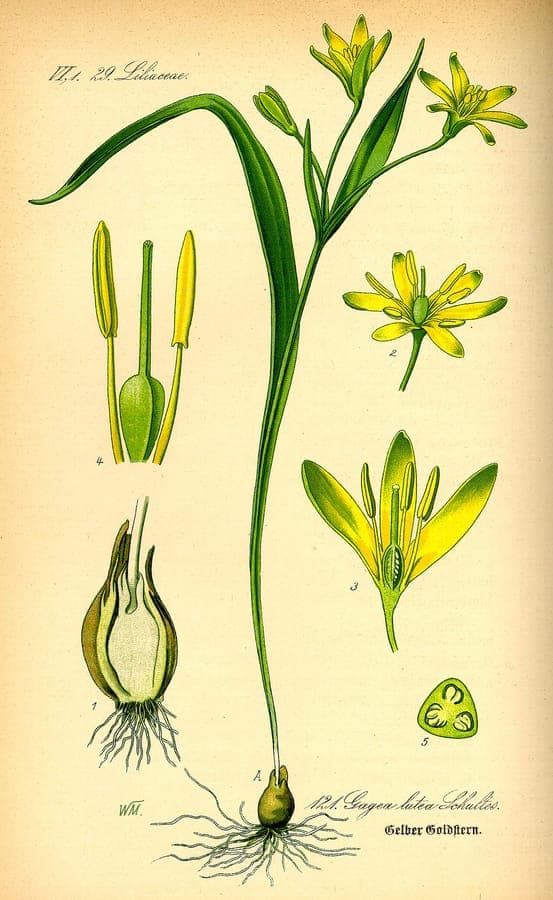
Gagea lutea reaches 10–20 cm in height, making it ideal for front-of-border or ground-level interest. Its star-shaped yellow flowers appear from mid-April through June, depending on local conditions. Each stem bears a single delicate bloom with six pointed tepals that reflex slightly backward. The flowers open only in direct sunlight and close on overcast days, a fascinating adaptation to its forest floor origins.
After flowering, the slender, grass-like leaves persist until early summer before dying back completely. The plant then enters dormancy, with the small bulb resting underground until the next spring. Its understated presence makes it perfect for naturalising in wilder areas of the garden.
Ideal location
This plant prefers partial to full shade, corresponding to a light level of 4 on a 1–10 scale. An ideal spot is beneath open-canopied deciduous trees like birch, hazel, or beech, where it receives dappled light in early spring before the canopy closes. Avoid hot, south-facing borders with intense afternoon sun, as this can dry out the soil too quickly and stress the plant.
East- or northeast-facing slopes under light tree cover are often perfect. It also works well in shaded rock gardens or between paving stones in woodland paths, as long as moisture is consistent.
Soil requirements
Gagea lutea thrives in moist, humus-rich, well-drained soil with a neutral to slightly alkaline pH between 7.0 and 7.5. Heavy clay soils should be improved with leaf mould, compost, or well-rotted manure to enhance drainage and organic content. Sandy soils benefit from added humus to retain moisture.
Avoid acidic soils (below pH 6.5), as this can inhibit growth. A light application of garden lime in autumn can help balance pH if needed, but don't overdo it – excessive alkalinity harms beneficial soil microbes.
Watering
Keep the soil consistently moist during the growing season, especially in dry springs. Water when the top inch of soil feels dry, but avoid waterlogging. Once the foliage begins to die back in June, reduce watering gradually. By July, the plant is dormant and requires no supplemental irrigation.
Overwatering during dormancy is a common mistake and can lead to bulb rot. Ensure good drainage, particularly in winter, to prevent standing water.
Free design
Want to see Yellow star-of-bethlehem: complete guide in your garden? Make a free design now.
Pruning
No pruning is required for Yellow star-of-bethlehem. Allow the foliage to yellow and die back naturally so the bulb can reabsorb nutrients. Never cut or pull green leaves, as this weakens the plant and reduces flowering the following year.
If you want to encourage self-seeding, leave the seed capsules intact until they dry and split. The plant spreads slowly via seed and small offsets, forming gentle colonies over time.
Maintenance calendar
- Jan: Dormant. No action needed.
- Feb: Check bulbs are covered. Top up with leaf mould if necessary.
- Mar: Clear debris. Watch for emerging shoots.
- Apr: Blooming begins. Water in dry spells. Protect from slugs.
- May: Peak bloom. Maintain moisture. Avoid disturbance.
- Jun: Flowers fade. Foliage yellows. Reduce watering.
- Jul: Dormancy begins. Stop watering. Leave undisturbed.
- Aug–Dec: Rest period. Plant new bulbs in Oct–Nov.
Use gardenworld.app to generate a custom maintenance calendar based on your USDA zone and local weather patterns.
Winter hardiness
Gagea lutea is hardy in USDA zones 5–8, surviving temperatures down to -20°C. The bulbs remain in the ground year-round and don't require lifting or mulching in most temperate climates. However, in areas with heavy, waterlogged soils, a light mulch of leaf litter can help protect against rot.
Ensure the planting site has good winter drainage to prevent bulb decay. Avoid low-lying areas where cold air and water collect.
Companion plants
Pair Yellow star-of-bethlehem with other spring ephemerals like Anemone nemorosa, Erythronium dens-canis, or Pulmonaria. These plants share similar cultural needs and create a layered, naturalistic effect. Later-emerging perennials like Hosta or ferns can cover the dying foliage without competing.
Avoid aggressive groundcovers like ivy or periwinkle, which can smother delicate bulbs. Instead, opt for light, airy companions such as Carex or Tiarella.
Closing
Yellow star-of-bethlehem may not grab attention like tulips or daffodils, but it offers something more lasting: a quiet presence that enhances the rhythm of the garden. Its resilience, low care needs, and ecological value make it a wise choice for sustainable planting schemes.
Plant bulbs in groups of 10–15 per square foot for a natural look. You can find Gagea lutea at garden centres across the UK in autumn, especially those specialising in woodland or native plants. With the right spot and minimal effort, this humble bulb will return year after year, a golden whisper beneath the trees.
Want to see Yellow star-of-bethlehem: complete guide in your garden? Make a free design now.
Upload a photo, pick a style, and get a photorealistic design with plant list in under a minute.
No credit card required


Similar plants
Reverchon's gagea: complete guide
Gagea reverchonii
Full guide to Gagea reverchonii, Reverchon's gagea: rare Pyrenean bulb with bright yellow spring flowers, soil needs and companion planting.
Leafy gagea: complete guide
Gagea foliosa
Gagea foliosa is a rare Mediterranean bulb with bright yellow star-shaped flowers blooming February to March in well-drained rocky settings.
Tubular gagea: complete guide
Gagea fragifera
Gagea fragifera is a mountain bulb with golden-yellow star flowers blooming May to July on subalpine slopes from Europe to the Himalaya.