
Didier Descouens / CC BY-SA 4.0, via Wikimedia Commons
Common fumitory: complete guide
Fumaria officinalis
Want to see Common fumitory: complete guide in your garden?
1 minute, no credit card
Overview
Common fumitory (Fumaria officinalis) might not be the first plant you think of for your garden, but this unassuming annual brings quiet charm from April through September. A member of the Papaveraceae family, it's native across much of Europe, including the Baltic States, Belarus, and Belgium. In the wild, you'll find it along roadsides, in rocky patches, and disturbed soils. In the garden, it shines as a low-maintenance filler in cottage-style borders, rock gardens, or between paving stones. Its fern-like foliage and soft purple blooms add lightness and movement, especially when backed by darker green perennials.
On gardenworld.app, you can visualize how common fumitory weaves into a layered planting scheme, filling gaps before slower perennials emerge. It's also a smart choice for wildlife gardens-its nectar attracts early-season pollinators like hoverflies and small bees.
Appearance & bloom cycle
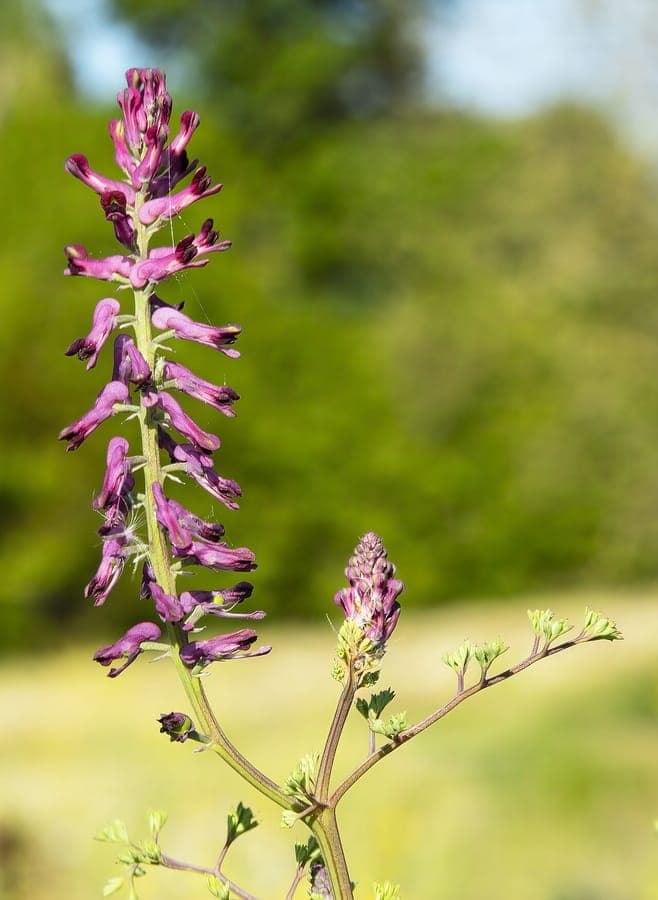
Common fumitory reaches 15 to 40 cm in height, with trailing or upright stems that branch finely. The foliage is finely divided, bluish-green, and delicate-almost lacy. From April to September, it produces slender, tubular flowers in soft purple with pale tips, each about 8–12 mm long. The blooms hang in short racemes and have a distinctive curved spur, typical of fumitories. Flowering peaks in May and June, but steady blooming continues through summer if conditions are favorable.
After pollination, small round seed capsules form and dry, releasing seeds that drop close to the parent plant. This self-seeding habit makes it easy to naturalize, though it rarely becomes invasive. Because it's annual, it won't return from rootstock-but it will reappear from seed the following spring.
Ideal location
Aim for full sun to light shade (light level 8/10). It thrives in dry, open spots with at least 6 hours of direct sunlight. Ideal spots include gravel paths, cracks in walls, dry borders, or poor soil pockets where other plants struggle. It's particularly well-suited to urban gardens with limited space and low fertility. Avoid heavily shaded or damp areas-these reduce flowering and encourage fungal issues.
In USDA hardiness zones 6–8, it adapts well to local conditions. In colder zones (5 and below), seed germination may be less reliable, but indoor sowing in late winter can help.
Free design
Want to see Common fumitory: complete guide in your garden? Make a free design now.
Soil requirements
Well-drained, sandy to loamy soil with a pH of 6.5–7.0 is ideal. Common fumitory prefers low to moderate fertility-rich soils encourage weeds that outcompete it. Avoid heavy clay unless amended with grit or sand. Do not fertilize; excess nutrients lead to leggy growth and fewer blooms. A thin layer of coarse sand as mulch improves drainage without smothering seedlings.
Watering
Once established, it's drought-tolerant. Water only during prolonged dry spells in the first few weeks after germination. Overwatering leads to root rot and weak stems. In average UK or Pacific Northwest conditions, rainfall is usually sufficient. During dry summers, a light soak every 10–14 days keeps it looking fresh.
Pruning
No pruning is needed. If you want to prevent self-seeding in a particular spot, deadhead spent flowers before seed forms. Otherwise, let it go to seed-this ensures next year's crop. Cutting back after flowering isn't required, as the plant will naturally die back by late September.
Maintenance calendar
- Jan: None
- Feb: Sow seeds indoors or in a cold frame
- Mar: Sow directly outdoors after last frost; prepare soil
- Apr: Germination occurs; protect from slugs
- May: Peak bloom; monitor for crowding
- Jun: Continued flowering; light watering if dry
- Jul: Mid-summer bloom; minimal care
- Aug: Seed development begins; reduce watering
- Sep: Plant dies back; seeds disperse
- Oct: Collect seeds or mark areas for next year
- Nov: None
- Dec: Dormant seed stage
Winter hardiness
As a true annual, common fumitory doesn't survive winter. However, seeds overwinter in the soil and germinate when temperatures rise in spring. No protection is needed. In zone 6 and above, natural reseeding is reliable. In colder zones, consider fall sowing to mimic natural stratification.
Companion plants
Pair with other low-water, sun-loving plants like thyme, sedum, or yarrow. It works well as a temporary ground cover among late-emerging perennials such as Echinacea or Rudbeckia. Avoid aggressive spreaders like mint or ground ivy. Its airy texture contrasts beautifully with bold-leaved plants like hostas or ferns in partial shade.
Closing
Common fumitory is not a flashy plant, but it's a reliable, graceful one. It asks for little and gives back with months of bloom and ecological value. You can find seeds or seedlings at garden centres across the UK and US, especially those specializing in native or cottage garden plants. Try it in a dry corner or along a pathway-you might just fall for its quiet beauty. On gardenworld.app, you can design a garden layout that uses self-seeding annuals like fumitory to create a dynamic, evolving space year after year.
Want to see Common fumitory: complete guide in your garden? Make a free design now.
Upload a photo, pick a style, and get a photorealistic design with plant list in under a minute.
No credit card required


Similar plants
Papaver gorodkovii: complete guide
Papaver gorodkovii
Papaver gorodkovii, the arctic poppy, thrives from Alaska to Russia's Far East. Discover how to grow this rare, extremely cold-hardy rock garden treasure.
Papaver setiferum: complete guide
Papaver setiferum
Papaver setiferum is a hardy giant Caucasian poppy with fiery red blooms. Discover siting, soil, deadheading and winter hardiness.
Pale Poppy: complete guide
Papaver alboroseum
Discover pale poppy (Papaver alboroseum) - rare alpine poppy with white-pink flowers. Precious beauty from Kamchatka. Cultivation in alpine and rock gardens.