
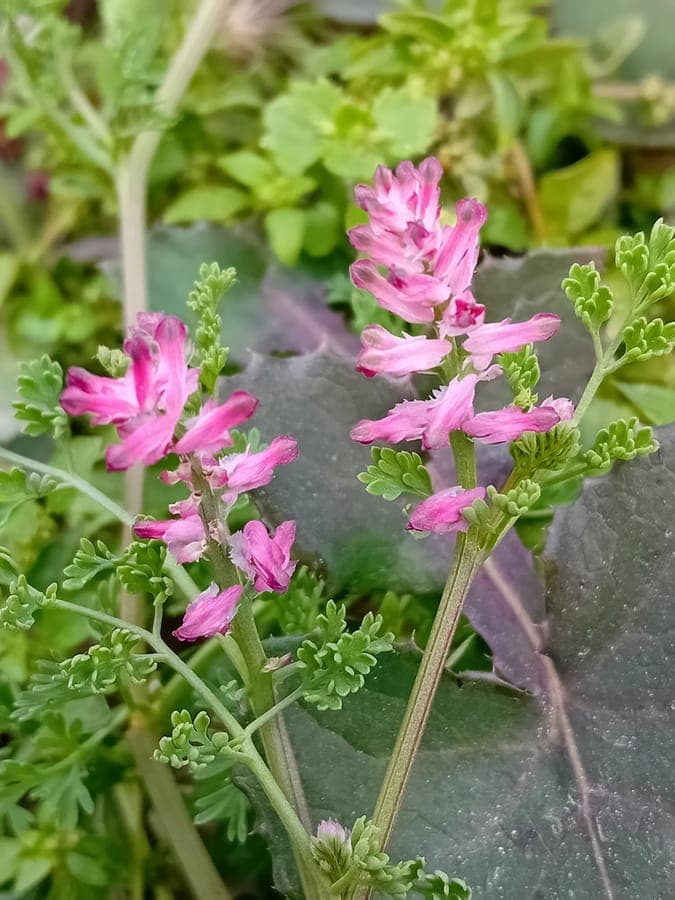
Bo Basil / CC BY-SA 4.0, via Wikimedia Commons
Narrow-leaf fumitory: complete guide
Fumaria densiflora
Want to see Narrow-leaf fumitory: complete guide in your garden?
1 minute, no credit card
Overview
Fumaria densiflora, commonly known as narrow-leaf fumitory, is a delicate annual that thrives in dry, sunny conditions across Europe. Native to regions like southern France, the Balkans and the eastern Mediterranean, it's perfectly adapted to lean soils and high light exposure. Despite its modest size - typically 15 to 30 cm tall - it brings a fine-textured elegance to gardens, especially in rockeries, gravel beds or between paving stones. It's not widely available in mainstream garden centres, but once planted, it often returns via self-seeding.
On gardenworld.app, you can create a custom planting plan that integrates narrow-leaf fumitory into your sun-baked zones, ensuring optimal spacing and companion planting.
Appearance & bloom cycle
The plant features finely divided, silvery-green foliage that resembles fennel fronds. Its slender stems carry dense racemes of small, tubular flowers from April through July, peaking in May and June. Each bloom is about 1 cm long, with white bases and purple-tipped petals, creating a soft two-tone effect. The flowers hang gracefully, like tiny lanterns, and attract early-season pollinators such as hoverflies and small bees.
As an annual, it completes its life cycle in one season. After flowering, it sets seed and dies back completely by late summer. If allowed to self-seed, new plants will emerge the following spring, usually in similar sunny, well-drained spots.
Ideal location
Narrow-leaf fumitory thrives in full sun - a 9 out of 10 on the light scale. It needs at least 6 to 8 hours of direct sunlight daily. Choose south- or west-facing walls, gravel paths, or dry stone crevices. It's excellent for xeriscaping and urban gardens where soil dries quickly. Avoid shaded or damp areas; in low light, the plant becomes leggy and produces few flowers.
This species is ideal for gardeners dealing with poor, fast-draining soils. It works well beneath drought-tolerant shrubs like lavender or santolina. Use gardenworld.app to map out sun patterns in your garden and identify the best microclimates for this sun-loving annual.
Soil requirements
Well-drained soil is essential. Fumaria densiflora dislikes wet feet and will rot in compacted or water-retentive clay. A neutral to slightly alkaline pH range of 7.0 to 7.5 is ideal. It grows well in sandy, gravelly, or chalky soils. Avoid enriching the soil with compost or manure - too much fertility promotes leafy growth at the expense of flowers.
If your soil is heavy, improve drainage by mixing in sharp sand, grit, or crushed limestone. Raised beds or shallow rock gardens are excellent options. Plant in clusters of 5 to 7 for a natural, informal look.
Free design
Want to see Narrow-leaf fumitory: complete guide in your garden? Make a free design now.
Watering
Once established, narrow-leaf fumitory is drought-tolerant. During germination and the first few weeks after transplanting, keep the soil lightly moist. Water at the base to prevent fungal issues. After 4 to 6 weeks, reduce watering significantly. In average UK or northern European summers, no supplemental irrigation is needed, even during dry spells.
Overwatering is a common mistake. It leads to root rot and weak stems. Avoid overhead sprinklers. If you're unsure about soil moisture, check real-time conditions using the garden monitoring tools on gardenworld.app.
Pruning
Pruning isn't required, but deadheading spent flower spikes encourages prolonged blooming. Use clean, sharp snips and cut just above a leaf node. If you want the plant to self-seed, leave the final flowers in place. Seeds ripen in July and disperse naturally, often reappearing in the same spot next year.
Maintenance calendar
- March: Sow seeds indoors or directly in the garden (when soil reaches 8°C)
- April: Transplant seedlings outdoors; protect from late frosts
- May: Monitor flowering; water lightly if prolonged dry spell
- June: Deadhead regularly to extend bloom time
- July: Allow seed heads to mature for self-sowing
- August – February: No maintenance needed; plant dies back
Winter hardiness
As a true annual, narrow-leaf fumitory is not winter-hardy. It dies off completely after setting seed. However, it reliably reappears in suitable spots if conditions are right. It's rated for USDA zones 8–10 as a perennial, but in cooler climates like the UK or Benelux, it's grown as a self-seeding annual. No winter protection is needed.
Companion plants
Pair with other drought-tolerant species such as lavender, thyme, sedum, or Stipa tenuissima. The silvery foliage contrasts beautifully with yellow, purple, or white blooms. Avoid moisture-loving plants like hostas or astilbes. It fits perfectly in Mediterranean-style gardens, gravel schemes, or cottage-style front borders.
Closing
Narrow-leaf fumitory is an underrated gem for low-maintenance, sun-drenched gardens. It asks for little, delivers long-lasting blooms, and adds fine texture to planting schemes. Look for seeds or young plants at garden centres like B&Q, Wyevale, or local independents in spring. Sow early for best results. With gardenworld.app, you can design a drought-smart garden layout where Fumaria densiflora plays a starring role in your seasonal display.
Want to see Narrow-leaf fumitory: complete guide in your garden? Make a free design now.
Upload a photo, pick a style, and get a photorealistic design with plant list in under a minute.
No credit card required


Similar plants
Papaver gorodkovii: complete guide
Papaver gorodkovii
Papaver gorodkovii, the arctic poppy, thrives from Alaska to Russia's Far East. Discover how to grow this rare, extremely cold-hardy rock garden treasure.
Papaver setiferum: complete guide
Papaver setiferum
Papaver setiferum is a hardy giant Caucasian poppy with fiery red blooms. Discover siting, soil, deadheading and winter hardiness.
Pale Poppy: complete guide
Papaver alboroseum
Discover pale poppy (Papaver alboroseum) - rare alpine poppy with white-pink flowers. Precious beauty from Kamchatka. Cultivation in alpine and rock gardens.