
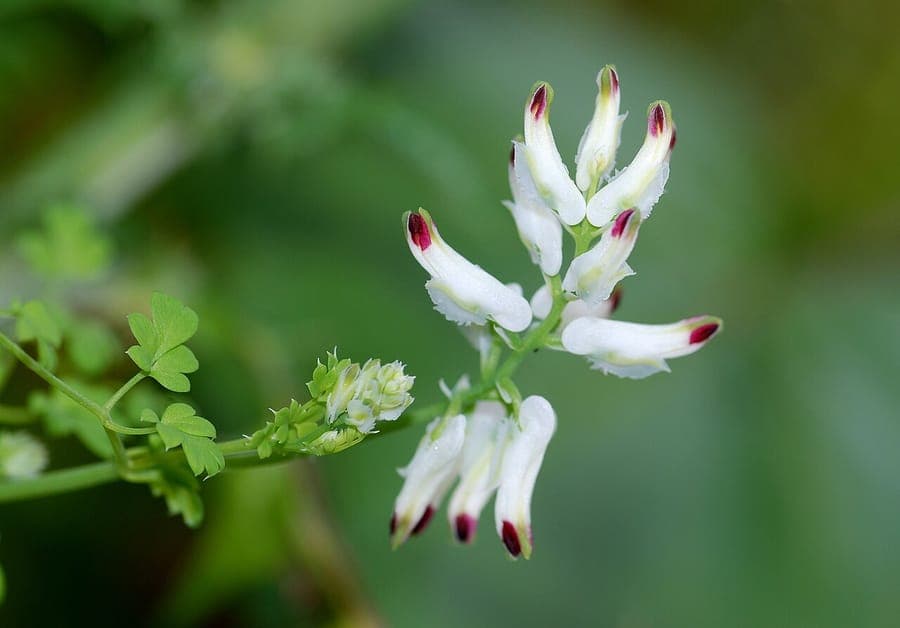
Alvesgaspar / CC BY-SA 3.0, via Wikimedia Commons
Climbing fumitory: complete guide
Fumaria capreolata
Want to see Climbing fumitory: complete guide in your garden?
1 minute, no credit card
Overview
Climbing fumitory (Fumaria capreolata) is a graceful, lesser-known member of the Papaveraceae family that deserves a place in more gardens. Native to southern Europe, it thrives in rocky slopes and old walls from France to Cyprus. In the UK and parts of the northern US, it performs best in sheltered, sunny spots where it can climb with support. Though not widely stocked, it's available through specialty nurseries and sometimes at garden centres like those affiliated with gardenworld.app, where seasonal plant guides help match it to your garden's microclimate.
This herbaceous climber brings a delicate charm from April to June, with fern-like blue-green foliage and slender racemes of soft pink and white flowers. It grows to about 50–60 cm and uses leaf tendrils to climb, making it ideal for light structures. Once established, it self-seeds gently, creating naturalised patches over time.
Appearance & bloom cycle
Climbing fumitory has airy, finely divided leaves that resemble smoke bush foliage - hence the common name 'fumitory'. The pale pink and white, helmet-shaped flowers dangle in clusters from April to June, depending on local temperatures. Each bloom lasts several days, and the overall flowering period spans six to eight weeks.
Stems twine upward to 60 cm, often leaning on neighbouring plants or supports. After flowering, the plant begins to die back, especially in hotter summers. Seed pods form quickly, and ripe seeds disperse easily, so if you want to limit spread, deadhead after bloom.
Ideal location
This plant loves full sun to light shade, scoring an 8 out of 10 for light. That means at least 6 hours of direct sun daily. South- or southwest-facing walls, fences, or trellises work best. Avoid dense shade or north-facing exposures. In cooler zones like USDA 7–8, a warm microclimate near a brick wall can boost performance.
In garden designs, it pairs well with low stone walls or rustic obelisks. Whether you're planting in beds or containers, ensure it has something to climb. For layout ideas, gardenworld.app offers 3D garden planning tools that simulate how Climbing fumitory integrates with structures and companion plants.
Soil requirements
Well-drained soil is critical. Climbing fumitory prefers a pH between 6.5 and 7.0 - slightly acidic to neutral. Heavy clay or water-retentive soils will lead to root rot. Amend garden beds with sharp sand and compost to improve drainage. For containers, use a mix of loam, perlite, and grit in equal parts.
Avoid overly rich soils, as this can lead to leggy growth. A lean, rocky mix mimics its natural habitat. Garden centres in the UK may carry multipurpose compost, but adding grit ensures better results.
Free design
Want to see Climbing fumitory: complete guide in your garden? Make a free design now.
Watering
Water regularly during the growing season (April–June), about once a week. Increase frequency during dry spells, especially in containers. The soil should dry slightly between waterings - never waterlog.
Once dormant in summer, reduce watering. In winter, water only if the soil is bone dry and temperatures are above freezing. Rainwater is preferable, as fumitory can be sensitive to lime in tap water.
Pruning
Pruning isn't essential, but deadheading spent flowers encourages a tidier look and may prompt a minor second flush in late summer. Cut stems back to a leaf node after bloom. Avoid heavy pruning after mid-July, as the plant needs time to store energy for winter.
In autumn, trim back dead foliage. You can leave some stems standing for winter interest and to provide cover for overwintering insects.
Maintenance calendar
- January: Check root zone; protect with mulch if in containers
- February: Remove any remaining debris; loosen soil around base
- March: Begin light feeding; watch for new growth
- April: Water weekly; monitor for aphids
- May: Peak bloom; deadhead regularly
- June: Allow seed set or remove spent flowers
- July: Reduce watering; let plant decline naturally
- August: Light trim if second flush appears
- September: Cut back or collect seeds
- October: Prepare for dormancy; mulch lightly
- November: Protect container plants from frost
- December: No action - dormant period
Winter hardiness
Climbing fumitory is semi-hardy, surviving USDA zones 7–9. In zone 7, it benefits from winter mulch. In colder areas, it may behave as a short-lived perennial or annual. Protect the crown with dry leaves or horticultural fleece if prolonged frost is expected. In containers, move to a sheltered spot or insulate the pot.
Self-seeding can compensate for winter losses, so allow a few plants to go to seed if you want natural reappearances.
Companion plants
Pair with early bloomers like Pulmonaria officinalis, Narcissus 'Tête-à-Tête', or Bellis perennis. For structure, use low obelisks with Thalictrum or upright Geranium cultivars. Avoid aggressive spreaders like mint or ground ivy.
It also works well with drought-tolerant plants such as Sedum spectabile or Eryngium, especially in gravel gardens. The airy texture contrasts beautifully with bold-leaved companions.
Closing
Climbing fumitory is a quiet achiever - not flashy, but full of subtle beauty. It asks for little and gives back with elegance in spring. Once you understand its rhythm, it becomes a reliable part of your garden's early-season tapestry.
For gardeners who value naturalised planting schemes, this plant is a gem. And before you plant, try visualising it on gardenworld.app. With accurate plant dimensions and bloom timelines, you can plan a space where Climbing fumitory thrives without overcrowding.
Want to see Climbing fumitory: complete guide in your garden? Make a free design now.
Upload a photo, pick a style, and get a photorealistic design with plant list in under a minute.
No credit card required


Similar plants
Papaver gorodkovii: complete guide
Papaver gorodkovii
Papaver gorodkovii, the arctic poppy, thrives from Alaska to Russia's Far East. Discover how to grow this rare, extremely cold-hardy rock garden treasure.
Papaver setiferum: complete guide
Papaver setiferum
Papaver setiferum is a hardy giant Caucasian poppy with fiery red blooms. Discover siting, soil, deadheading and winter hardiness.
Pale Poppy: complete guide
Papaver alboroseum
Discover pale poppy (Papaver alboroseum) - rare alpine poppy with white-pink flowers. Precious beauty from Kamchatka. Cultivation in alpine and rock gardens.