Krzysztof Ziarnek, Kenraiz / CC BY-SA 4.0, via Wikimedia Commons
Honeysuckle fuchsia (Fuchsia triphylla): care guide
Fuchsia triphylla
Want to see Honeysuckle fuchsia (Fuchsia triphylla): care guide in your garden?
Full design in HD: €7.99
Look after your Honeysuckle fuchsia with the GardenWorld app
Identify plants with your camera and get a care calendar with reminders for this plant.


Overview
Fuchsia triphylla, often sold as honeysuckle fuchsia, is the fuchsia for anyone who thinks fuchsias only belong in shade. It comes from Hispaniola, the Caribbean island shared by Haiti and the Dominican Republic, and it copes with more sun and heat than most of the fuchsias you know. Described around 1700, it was the first fuchsia known in Europe. The name triphylla means "three leaves" and refers to the leaves that often sit in whorls of three around the stem.
The pure species is not that common in garden centres. What you usually find are the triphylla hybrids: cultivars with Fuchsia triphylla as a parent, such as 'Thalia', 'Gartenmeister Bonstedt', 'Koralle' and 'Mary'. They share the long tubular flowers in clusters and the dark, velvety foliage. Labels often add a (T) after the name to show that a plant belongs to this group. Everything in this guide applies to those cultivars as well.
Fuchsia triphylla is a plant for containers and summer bedding. In a pot it usually stays 40 to 60 cm tall, while vigorous cultivars can reach 80 cm to 1 metre over a good season. If you are wondering how a warm splash of colour like this fits into a patio or front garden, you can have a garden design made on gardenworld.app in which pots and beds work together as one whole.
Appearance and bloom cycle
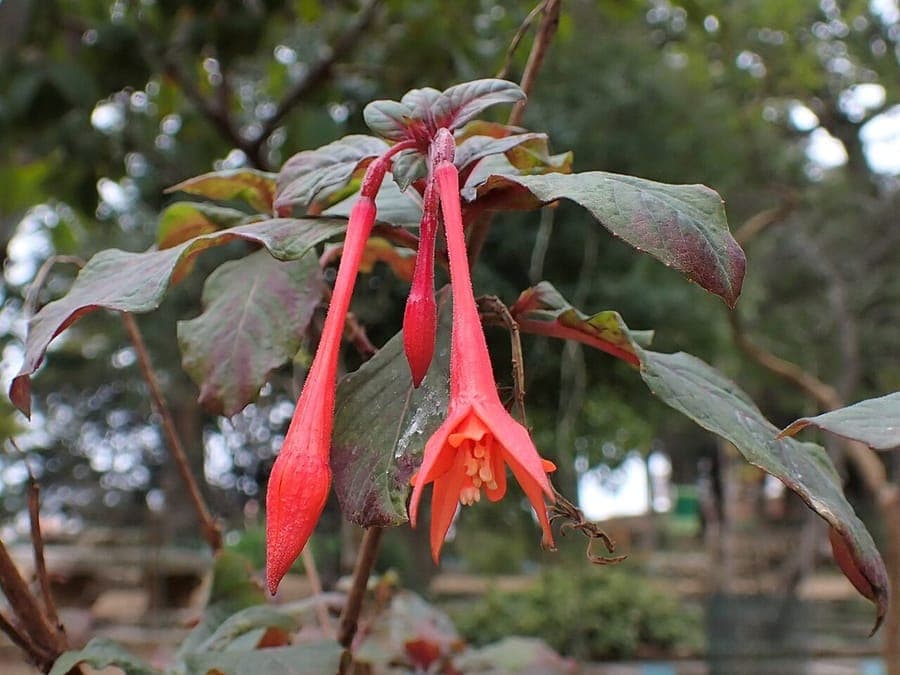
The leaves are oval to lance-shaped, 5 to 10 cm long and slightly velvety to the touch. The upper surface is dark olive to bronze-green, the underside a clear purple or wine red. On young shoots and in sun that red tint spreads to the upper side too. The photo shows this: purple-flushed leaves with three long orange-red flowers.
The flowers are the giveaway. They are 3 to 5 cm long, slender and tubular, and they hang in clusters at the tips of the shoots. Unlike a classic fuchsia with widely spreading sepals and a bell-shaped skirt, the sepals here are short and open only a little. The petals are small and barely noticeable. Each flower therefore looks like a narrow trumpet, which explains the common name: the bloom is reminiscent of honeysuckle.
Flowering starts in June or July and carries on until the first frost. In a warm summer the plant blooms without a break, because it keeps producing new shoots with flower clusters. In its native range hummingbirds pollinate the flowers; in our gardens bumblebees and the odd butterfly visit.
Ideal location
A triphylla fuchsia wants light. A spot with morning and late afternoon sun is ideal, and it can take full sun as long as the pot does not dry out. Against a hot south-facing wall, some midday shade helps. In deep shade it flowers poorly and becomes leggy.
Shelter from wind matters. The branches are sturdy but brittle, and the long flower clusters are easily damaged by gusts. The corner of a patio, a place near a hedge or a group of pots against a wall all work well. In beds, plant out only after mid-May, once the risk of night frost has passed.
Soil and containers
Use a good compost for container plants, open and rich in organic matter, with some perlite or fine grit for better drainage. The pH can be slightly acidic to neutral, roughly 5.5 to 7. A pot 25 to 35 cm across is enough for a plant in its first or second year; repot older specimens every one or two years in spring into a slightly larger pot.
A drainage hole is essential. Fuchsias like moisture, but sitting in water rots the roots. In a bed the plant needs fertile, humus-rich soil that does not dry out. Work in a spadeful of compost at planting time and, from June to the end of August, give a liquid feed for flowering plants every week.
Watering
Watering is the main summer task. Keep the compost evenly moist but never soggy. On warm days that means watering daily, and in a heatwave sometimes morning and evening. If the top 2 cm is dry, water until it drains out. Never leave the saucer full of water.
Fuchsia triphylla tolerates heat better than other fuchsias, but it does not forgive a completely dried-out root ball. It drops buds and flowers, and it takes weeks to bloom freely again. Water preferably in the morning and at the base of the plant. In autumn, gradually reduce watering.
Free preview
Want to see Honeysuckle fuchsia (Fuchsia triphylla): care guide in your garden? Make a free preview of your design.
Pruning
Most pruning happens in spring. In March, when the plant comes out of winter storage, cut all branches back by a third to a half, each time just above a pair of buds. Remove thin, weak and dead twigs as well. This gives a compact plant with plenty of new shoots, and since the flowers appear on new growth, more shoots mean more flowers.
Pinch young plants two or three times in spring: remove the tip of each shoot once it has three pairs of leaves. This delays flowering by a few weeks but gives a much fuller plant. During summer you can remove spent clusters so the plant does not put energy into berries.
Cuttings root easily. In spring or August take tip cuttings 8 to 10 cm long, strip the lower leaves and insert them in moist cutting compost. At 18 to 20 °C they root within three weeks, so you always have young plants in reserve.
Maintenance calendar
March: Bring the plant out of winter storage, cut back by a third to a half and repot if needed. Keep it light and cool, around 12 to 15 °C.
April: Start feeding lightly again. Pinch young shoots. Put the plant outside on warm days but bring it in at night.
May: After mid-May the plant can go outside for good. Plant out bedding specimens.
June to August: Full bloom. Water daily in warm weather and feed weekly. Check for whitefly, aphids and spider mite, especially in hot, dry spells.
September: Stop feeding. Take cuttings if you have not done so yet.
October: Bring the plant in before the first frost. Water less.
November to February: Overwinter in a light, cool place. Water sparingly now and then so the root ball does not dry out completely.
Overwintering
Fuchsia triphylla is not hardy. Where Fuchsia magellanica can survive winter in a sheltered garden, this species dies at the first proper frost. The triphylla group also needs warmer winter quarters than ordinary bush and trailing fuchsias: keep a minimum of 5 to 7 °C, and preferably 8 to 12 °C.
Choose a light spot: a cool conservatory, an unheated porch that stays above freezing or a cool room with an east- or north-facing window. A dark cellar or garage is not recommended for this group; the plant loses all its leaves there and struggles to shoot again in spring. Water very sparingly in winter and do not feed. Some yellowing or leaf drop is normal.
Overwintering a few August cuttings on a bright windowsill gives you a reserve. The plant calendar at gardenworld.app shows month by month when to bring container plants in, prune them and move them outside again.
Toxicity to pets
Fuchsias are listed as non-toxic to dogs, cats and horses in the well-known poison lists, including that of the American ASPCA. No poisonings in people are known either; fuchsia berries are even edible, although those of this species have little flavour. A cat or dog nibbling the leaves is therefore not at risk. Plant feed and pesticides, however, are more harmful to animals than the plant itself.
Companion plants
With its dark foliage and orange-red flowers, Fuchsia triphylla goes well with warm and silver tones. In a large pot or bed, pair it with heliotrope (Heliotropium arborescens), whose deep purple flowers stand out beautifully against the orange. Salvia farinacea with blue spikes and Lantana camara in yellow or orange create a sunny, southern mood. Note that lantana is toxic to pets, so choose another partner if your cat likes to chew plants.
If you prefer cool combinations, the blue Plumbago auriculata in a neighbouring container is a calm counterpart. Silver-leaved fillers such as Helichrysum petiolare provide contrast with the dark foliage.
Final thoughts
Fuchsia triphylla is a container plant that gives a great deal back: months of long, orange-red flower clusters, dark velvety foliage and more tolerance of sun than you would expect from a fuchsia. Give it light, moist but open compost, a weekly feed and a bright, mild place to spend the winter. Prune firmly in March and take a few cuttings in August, and you will have a full, flowering plant on the patio year after year, safe for cats and dogs alike.
Frequently asked questions about Honeysuckle fuchsia
When and how do you prune Honeysuckle fuchsia?
Most pruning happens in spring. In March, when the plant comes out of winter storage, cut all branches back by a third to a half, each time just above a pair of buds.
How much water does Honeysuckle fuchsia need?
Watering is the main summer task. Keep the compost evenly moist but never soggy.
Where does Honeysuckle fuchsia grow best?
A triphylla fuchsia wants light. A spot with morning and late afternoon sun is ideal, and it can take full sun as long as the pot does not dry out.
What soil does Honeysuckle fuchsia need?
Use a good compost for container plants, open and rich in organic matter, with some perlite or fine grit for better drainage. The pH can be slightly acidic to neutral, roughly 5.5 to 7.

See it in your garden
See Honeysuckle fuchsia in your garden
One photo of your garden and a few questions. You see the result in about a minute.
Try it with a photoIdentify this plant in your own garden. Identify a plant
Similar plants
Fuchsia: complete guide
Fuchsia magellanica
Master growing Fuchsia magellanica with its elegant hanging flowers. Care tips, ideal conditions, and winter protection for this South American gem.
Heliotropium arborescens: complete guide
Heliotropium arborescens
Heliotropium arborescens, the garden heliotrope, is a fragrant shrub with purple flowers and delightful vanilla scent, perfect for sunny borders.
Lantana: complete guide
Lantana camara
Discover lantana, the exotic shrub with colorful flower clusters. Learn how to cultivate this tropical plant, handle overwintering, and enjoy stunning blooms all summer.
