Borealis55 / Public domain, via Wikimedia Commons
Michael's flower (Fritillaria michailovskyi): planting and care
Fritillaria michailovskyi
Want to see Michael's flower (Fritillaria michailovskyi): planting and care in your garden?
Full design in HD: €7.99
Look after your Michael's flower with the GardenWorld app
Identify plants with your camera and get a care calendar with reminders for this plant.


Overview
Fritillaria michailovskyi, sold as Michael's flower, is a small bulb you only truly appreciate when you kneel down beside it. In April, stems barely 15 cm tall carry two to four bells in a striking two-tone pattern: purple-brown with a broad, bright yellow band at the rim. Each bell looks as if it has been dipped in paint. Do not confuse it with the snake's head fritillary (Fritillaria meleagris): that species loves wet meadows, whereas this one looks for a dry, stony spot.
The plant belongs to the lily family (Liliaceae) and comes from stony mountain slopes in north-eastern Turkey and the neighbouring Transcaucasus. There a deep layer of snow covers the ground in winter, meltwater soaks in during spring and summer is dry. In the garden you try to imitate that: moisture in spring, an open soil that never stays waterlogged and a quiet, fairly dry summer.
Fritillaria michailovskyi grows 10 to 20 cm tall, so it belongs at the front of a border, in a rock garden, a gravel bed or a pot on the patio. If you would like to know how to place such small bulbs so they are not lost among bigger plants, you can have a garden design made on gardenworld.app.
Please note: like all fritillaries, this species is poisonous. The bulb contains alkaloids that cause nausea and vomiting if swallowed, in people and pets alike. A small bulb is easily mistaken for a shallot or dug up by a playful dog, so keep loose bulbs out of reach and wear gloves when planting.
Appearance and flowering season
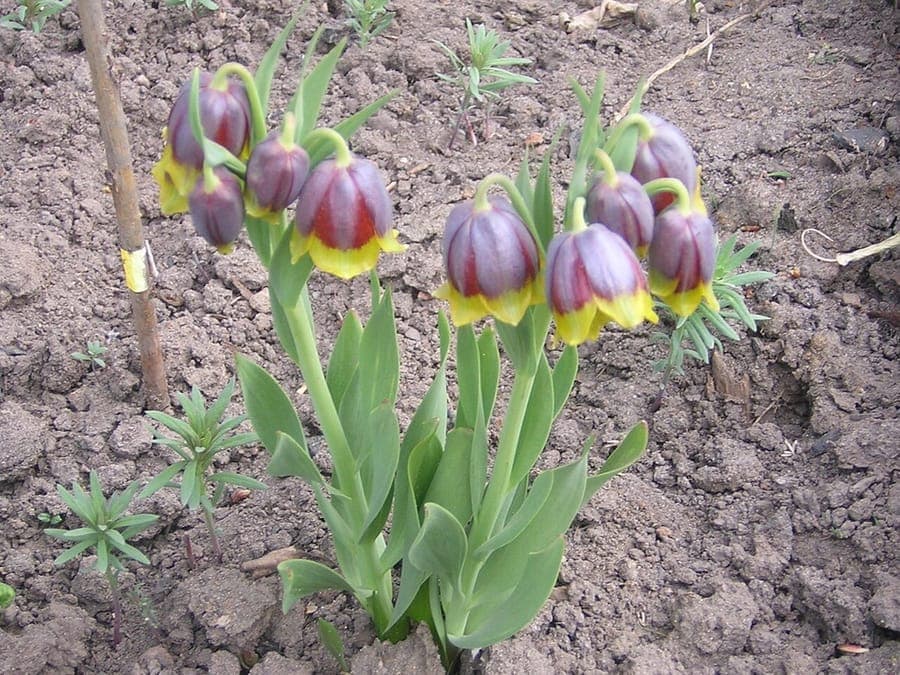
In March each bulb produces four to six lance-shaped, grey-green leaves. The lower ones are the widest, the upper ones narrower and more upright. They are slightly fleshy and matt, as you can see in the photo.
The plant flowers from mid-April to early May. Each stem carries one to four bells, occasionally more, about 2 to 2.5 cm long. The petals are purple-brown with a faint sheen and end in a broad, greenish to bright yellow tip that curls outwards slightly. The flower stalks arch gracefully so the bells hang straight down. Early bumblebees crawl inside in search of nectar.
After flowering the seed capsules turn upwards. The plant then finishes quickly: by June the leaves are yellow and everything disappears below ground.
Ideal position
Grow the bulbs in sun or light shade. A spot with morning sun and some shade during the hottest part of the day is perfect. Above all, the site must not become boggy in winter. A gently sloping rock garden, the edge of a gravel path or a raised bed is ideal.
Plant them at the front, where you can see them. Among tall perennials they disappear completely. Groups of ten to fifteen bulbs make far more impact than single plants.
Soil requirements
The soil should be open and well-drained yet able to hold a little moisture in spring. A mix of garden soil, some compost and a generous amount of coarse sand or fine grit is ideal. Heavy clay is unsuitable unless you raise the bed considerably and mix in grit.
The species is not fussy about pH; neutral to slightly alkaline is fine. Feeding is hardly necessary, although a little bulb fertiliser in spring, when the leaves appear, helps the bulbs to multiply.
Planting the bulbs
Plant in September or October. The bulbs are small, about 2 to 3 cm, and like other fritillaries they lack a tough protective tunic. Do not leave them in their bag for weeks, or they will dry out.
Make holes 8 to 10 cm deep, about three times the height of the bulb. Sprinkle a little coarse sand in the bottom, set the bulb on it with the tip upwards and fill in. Space them 8 to 10 cm apart. After planting, top-dress with a layer of fine gravel: it keeps the neck of the plant dry, suppresses weeds and shows off the small flowers beautifully.
Free preview
Want to see Michael's flower (Fritillaria michailovskyi): planting and care in your garden? Make a free preview of your design.
In a pot or trough
Fritillaria michailovskyi makes an excellent pot plant. Use a pot at least 15 cm deep with a large drainage hole and fill it with a mix of roughly half potting compost and half coarse sand or perlite. Plant the bulbs 8 cm deep, close together, and finish with grit.
Keep the pot outdoors in winter where it does not sit in the rain, for example against the house under the eaves. Hard frost is no problem; sodden compost that freezes is. As soon as the buds colour up, move the pot to a table or the patio, where you can admire the flowers up close.
Watering
In open ground you usually do not need to water. In a dry spring a can of water in March or April is welcome, because that is when the plant grows and flowers and, as in the mountains, expects some moisture.
Pots need moderate watering from autumn until the end of flowering, letting the surface dry slightly between waterings. After flowering, reduce gradually, and stop once the leaves turn yellow.
Dormancy
From June to September Fritillaria michailovskyi is dormant. Unlike the large fritillaries from hot regions, it does not need to be baked dry, but it will not tolerate wet soil during this period. Soil that is dry to at most slightly moist is ideal.
Let the leaves turn completely yellow before removing them after flowering, as the bulb needs those weeks to build strength. In a good spot it also produces small offsets, so a group gradually fills out by itself over a few years. If you want to divide them, lift the bulbs carefully in August and replant them straight away. Keep pots dry under cover in summer and start watering lightly again in September.
In April and May keep an eye out for lily beetles, the red beetles that can strip fritillaries bare, even on this small species.
Maintenance calendar
January to February: dormant. Keep pots out of the rain.
March: leaves emerge. Scatter a little bulb fertiliser and watch for slugs.
April to early May: flowering. Water in dry weather and check for lily beetles.
May to June: let the leaves yellow and remove them only once withered.
July to August: dormant. No watering; divide clumps if you wish.
September to October: plant new bulbs and restart pots. Add planting and flowering times to your plant calendar on gardenworld.app so you know exactly when to look.
November to December: dormant. Refresh the gravel layer if needed.
Winter hardiness
Fritillaria michailovskyi is reliably hardy. In its native range it survives harsh winters under snow, and American sources give USDA zone 5, which means frost well below -20 °C. In a British or Belgian garden cold is never the problem. A wet winter without snow cover is more dangerous, because bulbs sitting in waterlogged soil rot. Well-drained soil and a layer of gravel are therefore the best winter protection.
Companion plants
Choose partners that stay equally low and enjoy the same lean, sunny conditions. Grape hyacinths (Muscari armeniacum) and Siberian squill (Scilla siberica) set blue beside the purple and yellow. Small irises such as Iris reticulata flower earlier and announce the season.
The pasque flower (Pulsatilla vulgaris) blooms at the same time and shares the same nodding, understated charm. The blue-grey rosettes of Euphorbia myrsinites provide structure all year and pick up the yellow rim of the bells. Avoid rampant ground cover, which quickly smothers small bulbs.
Final thoughts
Fritillaria michailovskyi is a plant to enjoy up close: in a rock garden, along a path or in a pot on the table. An open soil, moisture in spring, a quiet summer without wet feet and a layer of gravel are all it needs. Plant a group of ten or more in autumn and remember that the bulb is poisonous. Every spring you will then have a handful of bells that look as though they were painted by hand.
Frequently asked questions about Michael's flower
Is Michael's flower winter hardy?
Fritillaria michailovskyi is reliably hardy. In its native range it survives harsh winters under snow, and American sources give USDA zone 5, which means frost well below -20 °C.
How much water does Michael's flower need?
In open ground you usually do not need to water. In a dry spring a can of water in March or April is welcome, because that is when the plant grows and flowers and, as in the mountains, expects some moisture.
What soil does Michael's flower need?
The soil should be open and well-drained yet able to hold a little moisture in spring. A mix of garden soil, some compost and a generous amount of coarse sand or fine grit is ideal.

See it in your garden
See Michael's flower in your garden
One photo of your garden and a few questions. You see the result in about a minute.
Try it with a photoIdentify this plant in your own garden. Identify a plant
Similar plants
Common grape-hyacinth: complete guide
Muscari armeniacum
Muscari armeniacum blooms in early spring with dense clusters of blue, grape-like flowers. Hardy, low-maintenance, and bee-friendly, it's perfect for borders, lawns, and naturalized plantings.
Scilla siberica: complete guide
Scilla siberica
Discover Scilla siberica, the Siberian squill - the most reliable and prolific early spring bulb. With vivid blue flowers that multiply readily, it creates stunning naturalized drifts and restores joy to winter-weary gardens.
Iris reticulata: complete guide
Iris reticulata M.Bieb.
The netted iris is a precious early-blooming iris from the Middle East with beautiful violet flowers. Discover how to grow this enchanting miniature iris in your front yard.
