
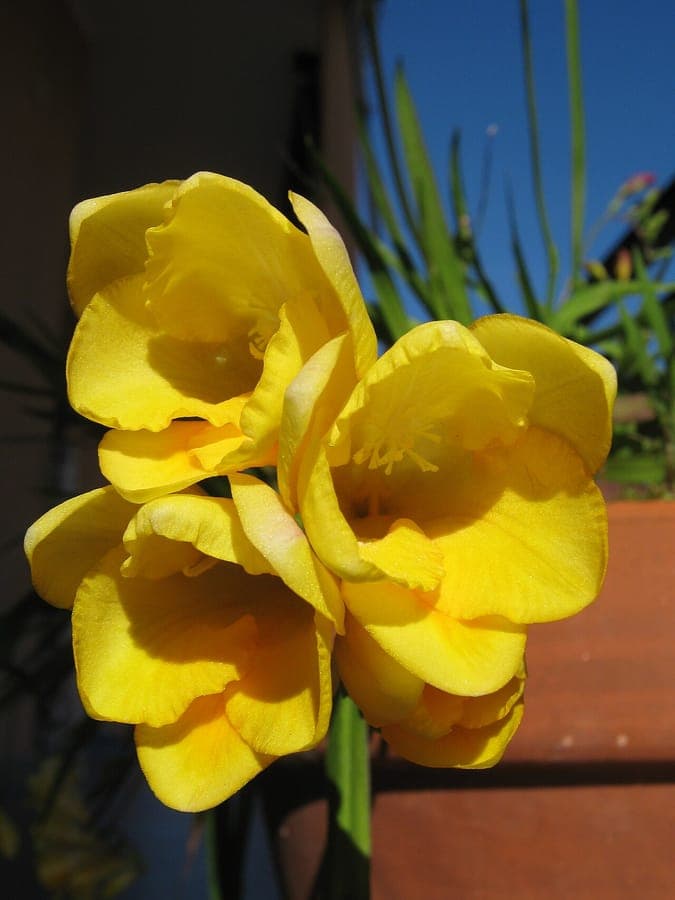
Senet / CC BY-SA 3.0, via Wikimedia Commons
Freesia refracta: complete guide
Freesia refracta
Want to see Freesia refracta: complete guide in your garden?
1 minute, no credit card
Overview
Freesia refracta, the common freesia, is an elegant corm-forming plant of the Iridaceae family, originating from South Africa. This plant is primarily renowned for its intensely fragrant flowers, appreciated by florists and gardeners for centuries. Flowers appear in various colors including yellow, white, pink, and diverse combinations.
Although freesias naturally grow in warm Africa, they can still be cultivated in temperate regions with careful attention. The plant is therefore popular as a cut flower in floral designs and as a potted houseplant. For garden plantings, freesia requires frost protection.
Appearance and bloom
Freesia refracta grows from corms and reaches approximately 30 to 45 cm in height. The plant bears long, slender, grass-like foliage forming elegant fountains. The foliage is bright green and notably attractive even before flowers appear.
The flowers are highly characteristic and arranged in dense, one-sided spikes. Each bloom is trumpet-shaped with six petals curling outward. Flowers measure approximately 3 to 4 cm in diameter and stand on strong, upright stems.
Freesias bloom from February to May, depending on planting time and climate. The flowers possess an intensely sweet fragrance capable of filling an entire room. This unique scent profile makes freesia indispensable for fragrant gardens. As freesias smell sweet, they work well combined with other fragrant plants.
Ideal location
Freesia prefers a sheltered, sunny location receiving minimum 6 hours direct sunlight. Without adequate light, plants produce fewer flowers and stems become weak. Ideal positioning is against a south or southwest-facing wall, protected from cold winds.
Frost protection is essential. Never plant freesias in open locations where cold air stagnates. In regions with mild winters (coastal areas), freesias can grow outdoors with frost protection.
Inland gardens: container cultivation is recommended, planted in October and brought under cover during winter.
Soil
Freesia prefers well-drained, moderately nutrient-rich soil. pH should be neutral to slightly acidic (pH 6.0 to 7.0). Heavy clay soil must be avoided; sand and organic material should be added.
Soil must be well-draining in all circumstances. Stagnant water inevitably causes corm rot. This is a primary cause of freesia cultivation failure.
Perfect mix: garden soil (50%), sand or perlite (30%), and leaf mold or garden compost (20%). This ensures excellent drainage while maintaining nutrient availability.
Free design
Want to see Freesia refracta: complete guide in your garden? Make a free design now.
Watering
Freesias require regular water during growth and blooming. After planting, soil should be moisture-retentive but never wet. If soil feels dry at the surface, add water.
During bloom: water when soil feels slightly dry. Excess water promotes leaf diseases. Stagnant water must absolutely be avoided.
After bloom and as foliage fades: gradually reduce watering. Once foliage has disappeared, cease watering entirely until next planting season.
Pruning
Freesia requires no conventional pruning. Remove spent flowers and flower stems after bloom. Healthy, green foliage should remain; it translocates energy back to the corm.
At season's end, as foliage naturally yellows, remove dead leaf material.
Maintenance calendar
Freesia follows a seasonal cultivation calendar.
Autumn (September-October): Plant corms outdoors (where frost-free) or in large containers. Use quality-grade corms. Plant approximately 5-8 cm deep.
Winter (November-January): For containers: place under glass or in a cold frame where temperature remains around 10-15 degrees Celsius. Outdoor-planted corms tolerate frost; protect with mulch.
Spring (February-April): Blooming occurs. Water regularly. Stake against wind if corms grow outdoors.
Summer (May-August): Foliage gradually yellows and dies back. Cease watering. Corms (if planted outdoors) can remain in soil if winters remain frost-free, otherwise dig up, dry, and store in cool, dry location.
Winter hardiness
Freesia refracta is not fully hardy in temperate Northern Europe. In severe frosts, exposed corms perish. Therefore, freesia must be treated as an annual cultivation.
Exception: in very sheltered coastal regions with mild winters, freesias can sometimes overwinter. Plant 10 cm deep and mulch heavily.
Safer method is container cultivation or greenhouse growing, guaranteeing complete frost protection.
Companion planting ideas
Freesias work well combined with other spring-blooming bulbs:
- With Tulipa varieties for color contrast and height variation
- With Muscari (grape hyacinth) for a tiered flower effect
- With Chionodoxa (glory-of-the-snow) for extended flowering period
- With Crocus for a preview of freesia blooming
- With silver-leaved perennials for foliage contrast
For cut-flower arrangements: combine freesias with Eucalyptus, Ruscus, or Myrsine foliage for texture contrast.
Closing
Freesia refracta is a noble, fragrant plant essential for fragrant gardens and cut-flower production. Although not winter-hardy, it delivers tremendous satisfaction through its intoxicating fragrance and elegant flowers.
Freesia corms are available at major garden retailers, with prices around EUR 2-4 per corm.
Gardenworld.app can help you position freesias optimally in your garden design, as a cut-flower section of your front yard or in fragrant borders. Our design tools show how freesias appear in your specific setting, so you can plant fragrant specimens with confidence.
Want to see Freesia refracta: complete guide in your garden? Make a free design now.
Upload a photo, pick a style, and get a photorealistic design with plant list in under a minute.
No credit card required


Similar plants
Iris tingitana: complete guide
Iris tingitana
Iris tingitana, the Morocco iris, is the bulb species behind the Dutch iris: early blue-violet blooms that need a sunny, well-drained position.
Iris hookeri: complete guide
Iris hookeri
Hooker's Iris is a compact North American native plant with blue flowers. Low-growing and moisture-loving water plant.
Siskiyou iris: complete guide
Iris bracteata
Complete guide to Iris bracteata, the Siskiyou iris: location, soil, bloom cycle, watering, pruning and companion plants for this rare Pacific Coast iris.