
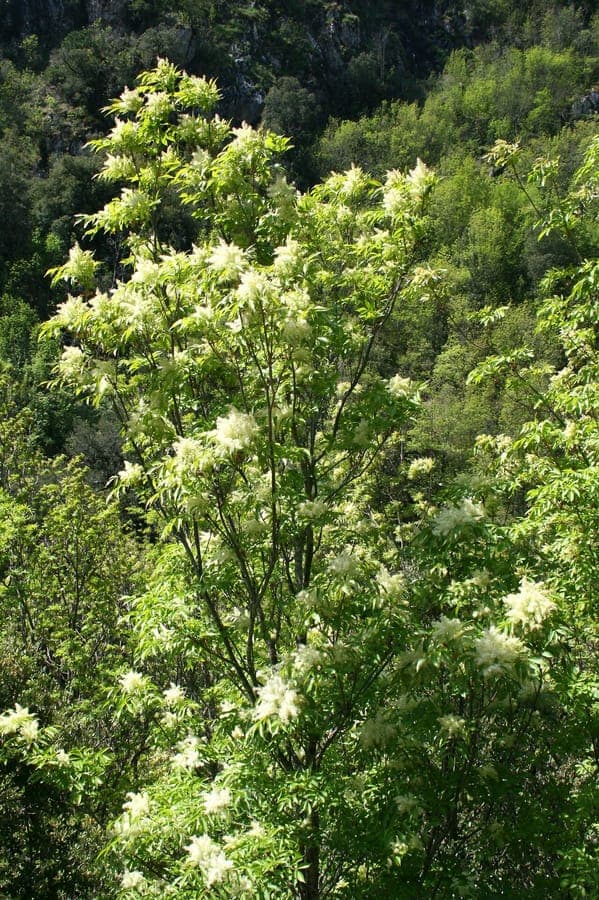
Jean-Pol GRANDMONT / CC BY 3.0, via Wikimedia Commons
Manna: complete guide
Fraxinus ornus
Want to see Manna: complete guide in your garden?
1 minute, no credit card
Overview
Fraxinus ornus, commonly known as Manna Ash, is a graceful medium-sized deciduous tree native to southern Europe and the eastern Mediterranean. It thrives in temperate to warm climates, reaching a mature height of 8–12 meters with a spread of 6–8 meters. Growth is slow and steady-about 20–30 cm per year-making it ideal for gardens where you want structure without overwhelming size. Its upright, oval habit when young matures into a rounded, open canopy that provides light shade.
This tree belongs to the Oleaceae family, sharing lineage with lilacs and olives. Unlike some ash species affected by emerald ash borer, Fraxinus ornus shows notable resistance, making it a more sustainable choice in regions where pests are a concern. It's not a fast grower, but its longevity-often exceeding 60 years-means it becomes a lasting feature in the landscape.
On gardenworld.app, you can plan your garden layout to include Manna Ash as a focal point or avenue tree, depending on your space. The platform helps visualize spacing and sunlight needs for optimal placement.
Appearance & bloom cycle
The standout feature of Manna Ash is its late spring bloom in May. Dense, plume-like panicles of small white flowers emerge at the branch tips, each cluster reaching 15–20 cm in length. The flowers have a sweet, honey-like fragrance that intensifies in warm weather, attracting bees and hoverflies. Unlike many trees that bloom early, Manna Ash waits until the risk of frost has passed, ensuring reliable flowering each year.
The leaves are pinnately compound, with 5 to 9 glossy, lance-shaped leaflets. They emerge in April with a fresh green hue, darkening to a rich green by summer. Autumn colour is modest-typically a pale yellow to brown-and not a major ornamental feature.
Fruits are slender, winged samaras that persist into winter, adding subtle movement to bare branches. They're not considered messy, as they're light and widely dispersed. Birds rarely eat them, so there's little concern about dropping or staining.
Ideal location
Manna Ash thrives in full sun, scoring an 8 out of 10 on the light scale. It needs at least 6–8 hours of direct sunlight daily to flower well. Plant it in a south- or southwest-facing spot to maximize warmth and light exposure.
Avoid deep shade or heavily wooded areas-flowering will be sparse or nonexistent. It also dislikes cold, drying winds, especially when young. In exposed sites, consider planting near a wall or evergreen hedge for wind protection. Urban gardens suit this tree well, as it tolerates air pollution and compacted soils better than many other ornamental trees.
Use gardenworld.app to map sun patterns in your garden and identify the best planting site for maximum bloom potential.
Soil requirements
This tree prefers well-drained, neutral to slightly alkaline soils with a pH between 7.0 and 7.5. It grows well on chalky, limestone-based, or sandy loam soils. While it can tolerate mildly acidic conditions (down to pH 6.5), flowering may be reduced.
Heavy clay soils are problematic unless amended for drainage. If planting in clay, dig a hole twice as wide as the root ball and mix in grit or sharp sand to improve aeration. Avoid waterlogged spots-standing water leads to root rot.
Do not enrich the planting hole with compost or manure; this can discourage roots from spreading into native soil.
Free design
Want to see Manna: complete guide in your garden? Make a free design now.
Watering
Young trees (first 2–3 years) need consistent moisture. Water deeply once a week with 10–15 liters per tree, increasing to twice weekly during hot, dry spells. Use a slow drip method to encourage deep root development.
After establishment, Manna Ash is drought-tolerant. Mature trees rarely need supplemental watering except during prolonged droughts (over 4 weeks without rain). In such cases, deep soak once every 10–14 days.
Never rely on light sprinkling-the surface moisture does nothing for deep roots and promotes fungal issues.
Pruning
Minimal pruning is required. The tree naturally develops a strong, balanced structure. If pruning is needed, do it in mid to late summer (July–August). Avoid late winter or early spring pruning, as the sap runs heavily and wounds won't heal quickly.
Remove only dead, damaged, or crossing branches. Use clean, sharp tools and limit removal to 20% of the canopy in a single year. Wear gloves-sap can cause skin irritation in sensitive individuals.
Maintenance calendar
- Jan: Inspect for storm damage
- Feb: Prepare tools; no pruning
- Mar: Loosen soil around base; avoid fertilizing
- Apr: Light organic feed for young trees
- May: Peak bloom-do not prune
- Jun: Monitor for aphids or powdery mildew
- Jul: Light shaping if needed; water during drought
- Aug: Final pruning window
- Sep: Cease feeding to harden off new growth
- Oct: Rake fallen leaves if desired
- Nov: Protect young trunks from rodents with guards
- Dec: Final check for winter readiness
Winter hardiness
Manna Ash is hardy to USDA zone 6b (-20.5°C). In the UK (zones 7–8), it performs well with little winter protection. Young trees may suffer from late spring frosts that damage new foliage, so consider fleece covers if frost is forecast.
In harsh winters, tip dieback can occur but regrowth is usually vigorous the following season. Avoid late-season feeding, as it promotes soft growth vulnerable to cold.
Companion plants
Pair with drought-tolerant, low-growing perennials that won't compete for water. Good choices include:
- Lavender (Lavandula angustifolia)
- Catmint (Nepeta x faassenii)
- Sedum 'Autumn Joy'
- Dalmatian toadflax (Linaria vulgaris)
- Early bulbs like Crocus or Narcissus 'Tête-à-Tête'
Avoid invasive species with aggressive root systems. Manna Ash needs space for its roots to expand without competition.
Closing
Manna Ash is a refined, low-maintenance tree that brings elegance and seasonal interest to gardens. Its fragrant May blooms and tidy habit make it a standout choice for patios, driveways, or woodland edges. Plant in autumn (Oct–Nov) or early spring (Feb–Mar) for best root establishment.
Buy a healthy 1–1.5m specimen from garden centres with well-branched structure and no signs of disease. With proper siting and care, Fraxinus ornus becomes a long-term asset-graceful, resilient, and quietly spectacular.
Want to see Manna: complete guide in your garden? Make a free design now.
Upload a photo, pick a style, and get a photorealistic design with plant list in under a minute.
No credit card required


Similar plants
Rough menodora: complete guide
Menodora scabra
Full guide to Menodora scabra: a drought-tolerant desert subshrub with bright yellow flowers, ideal for rock gardens and xeriscapes.
Fraxinus dipetala: complete guide
Fraxinus dipetala
California ash or two-petal ash from southwestern USA. Beautiful spring flowers, drought-tolerant. Experimental choice for warm Mediterranean front gardens.
Syringa komarowii: complete guide
Syringa komarowii
Syringa komarowii is a striking lilac from central China with elegant flower spikes and lovely foliage. Discover the complete care guide here.